
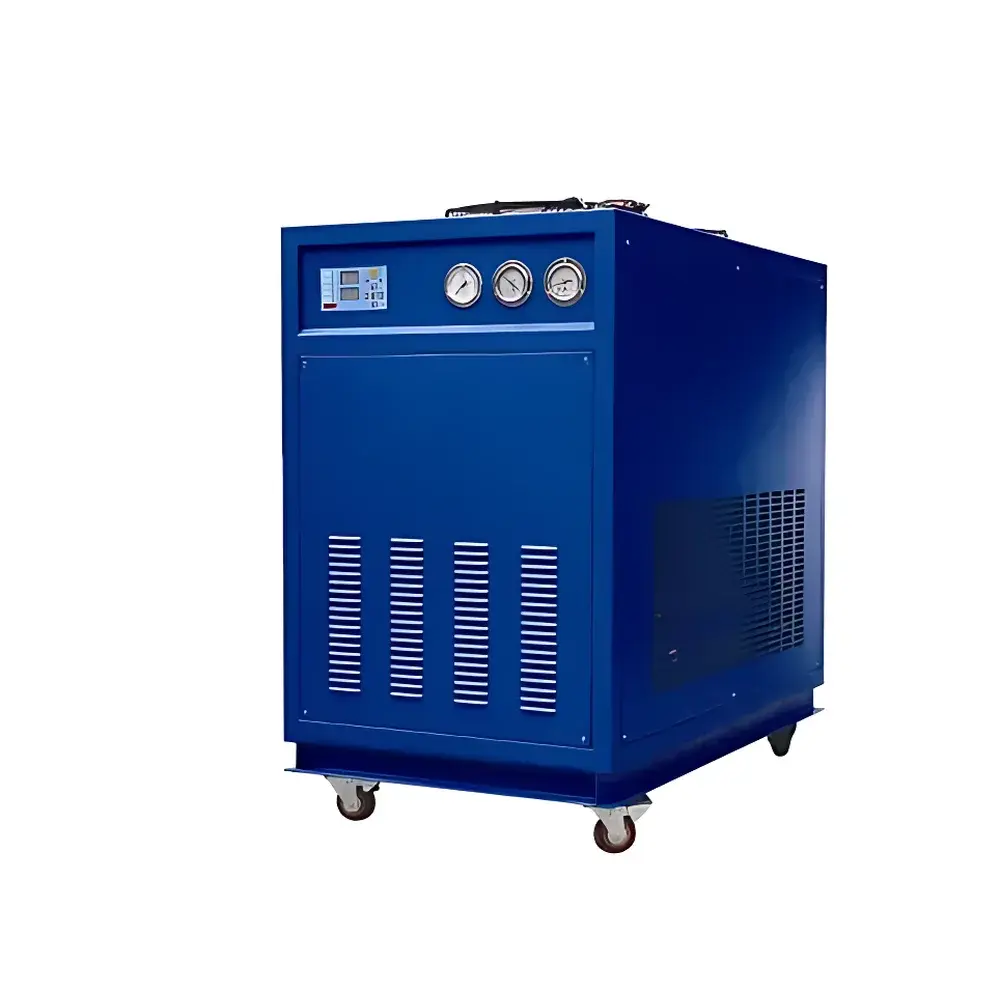
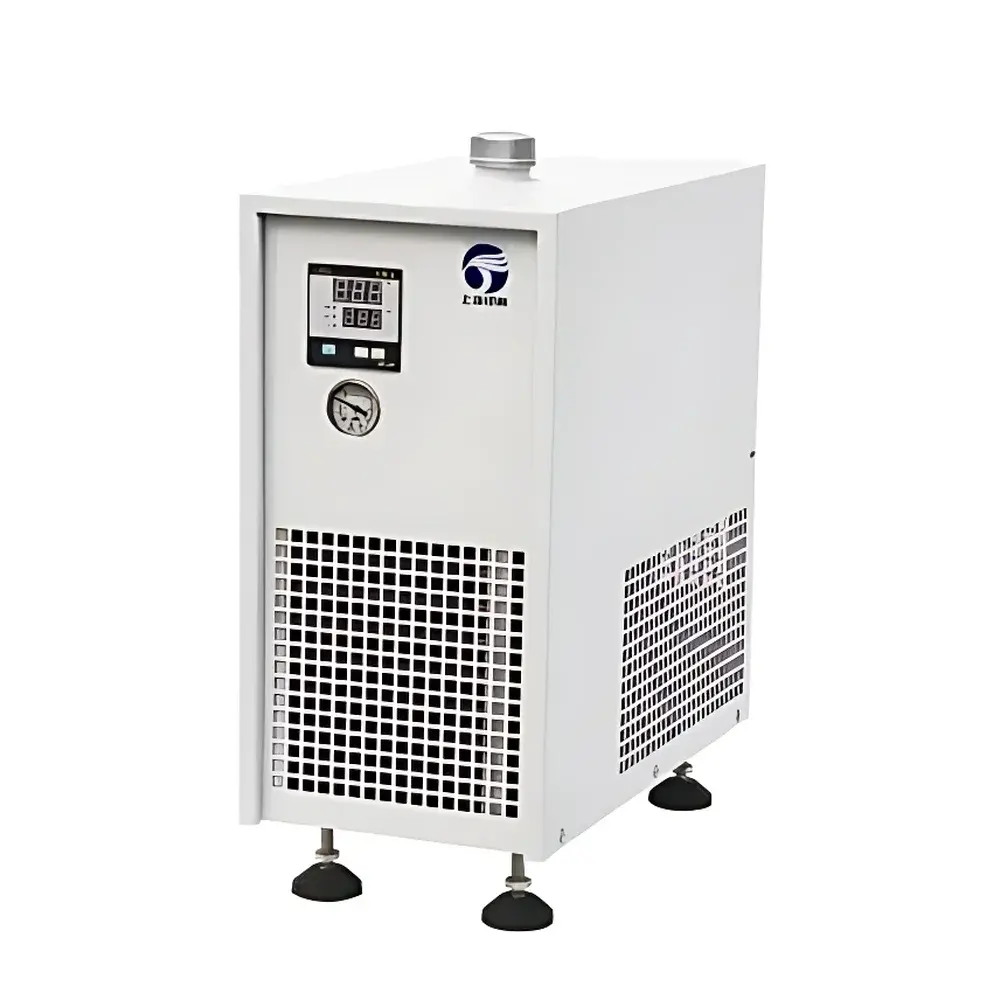
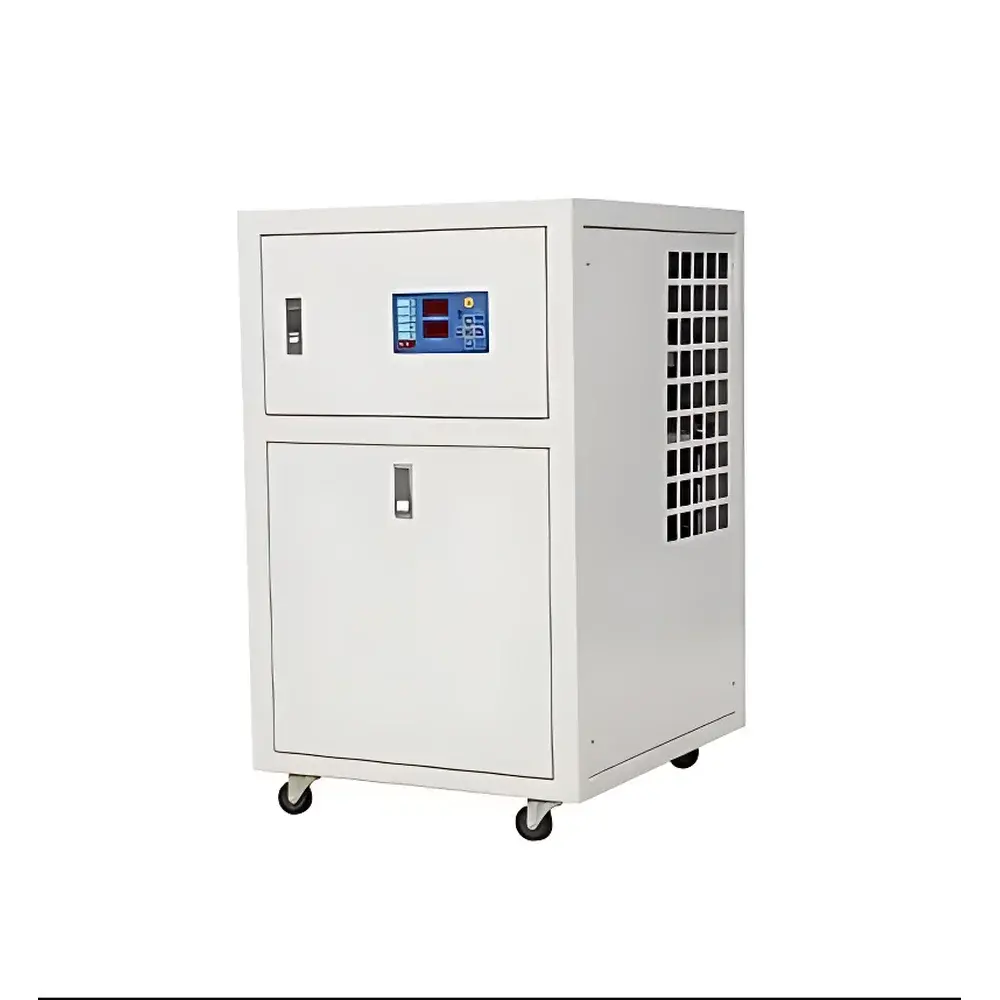
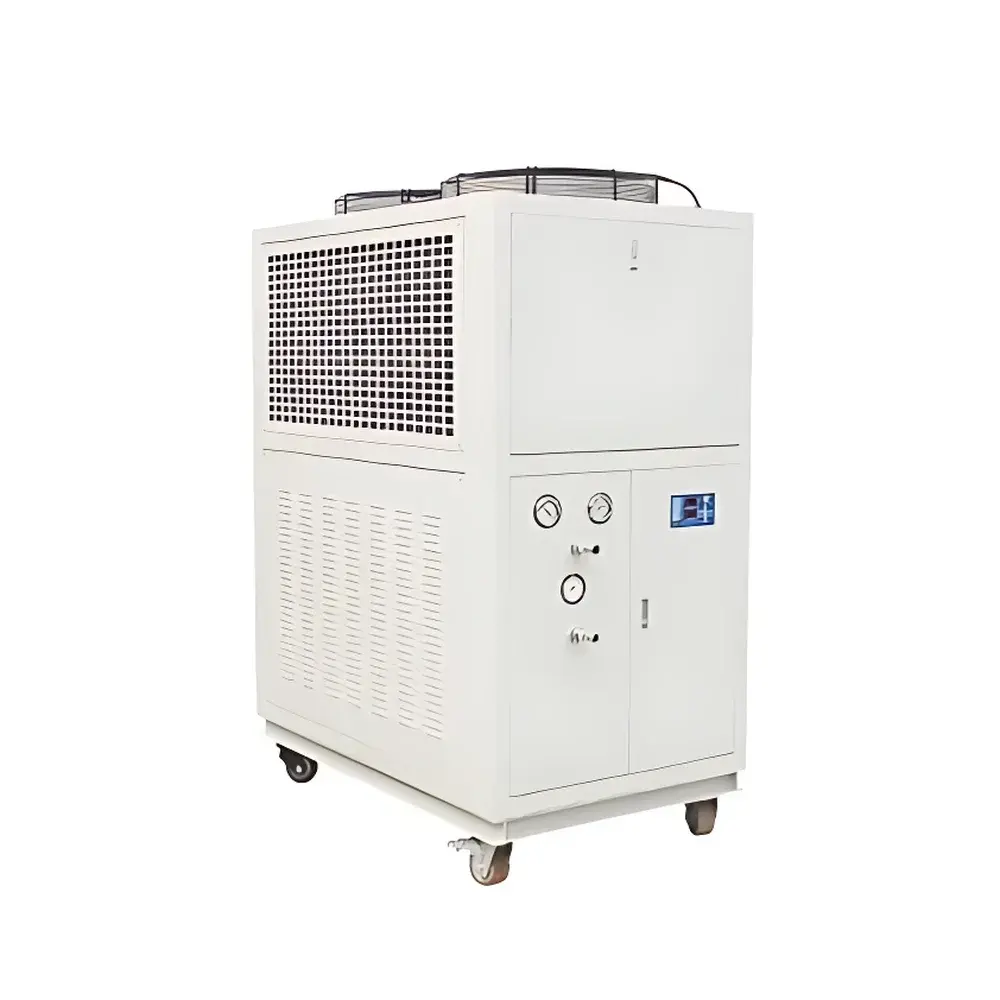
Tianfeng TF-LS-10HP Circulating Chiller
| Brand | Tianfeng |
|---|---|
| Origin | Shanghai, China |
| Manufacturer Type | Direct Manufacturer |
| Equipment Type | Integrated Circulating Chiller |
| Cooling Method | Air-Cooled |
| Temperature Control Range | 0–50 °C |
| Refrigeration Capacity | 32.5 kW (standard @ 12 °C in / 7 °C out) |
| Temperature Stability | ±0.1 °C |
| Circulating Pump Pressure | 0–2 bar |
| Circulating Flow Rate | 0–60 m³/h |
| Reservoir Volume | 200 L (standard for TF-LS-10HP) |
| Duty Cycle | Continuous Operation |
| Compressor | Hermetic Scroll Type (9.06 kW) |
| Refrigerant | R22 |
| Condenser | High-Efficiency Copper Tube with Aluminum Fins + Low-Noise External Rotor Fan (10,000 m³/h airflow) |
| Evaporator | Immersed Coil in Stainless Steel Reservoir |
| Pump | Stainless Steel, 0.37 kW, 5.59 m³/h @ 14 m head |
| Electrical Supply | 380 V, 3-phase + N + PE, 50 Hz |
| Safety Protections | Compressor Overheat, Overcurrent, High/Low Pressure, Overtemperature, Phase Sequence & Phase Loss |
| Controller | Industrial-Grade Digital PID Temperature Controller (optional RKC Japan) |
| Enclosure Dimensions (L×W×H) | 1350 × 900 × 1845 mm |
| Noise Level | ≤72 dB(A) |
| Compliance | ISO 9001:2000 Certified Design & Manufacturing |
Overview
The Tianfeng TF-LS-10HP Circulating Chiller is an integrated, air-cooled precision temperature control system engineered for continuous-duty laboratory and industrial applications requiring stable, high-flow coolant delivery within a 0–50 °C operating range. It operates on the vapor-compression refrigeration cycle, utilizing a hermetic scroll compressor and R22 refrigerant to achieve a nominal cooling capacity of 32.5 kW under standard conditions (chilled water inlet 12 °C, outlet 7 °C; ambient air 30 °C in, 40 °C out). Its core function is to maintain thermal equilibrium in heat-generating instrumentation—such as analytical spectrometers, electron microscopes, laser systems, and plasma sources—by circulating temperature-regulated water through external jackets or internal heat exchangers. The chiller’s ±0.1 °C temperature stability and programmable PID control architecture ensure minimal thermal drift during extended operation, critical for maintaining measurement repeatability in trace elemental analysis (e.g., ICP-OES, ICP-MS), X-ray diffraction, and high-resolution SEM/TEM imaging.
Key Features
- Hermetic scroll compressor (9.06 kW) delivering consistent refrigeration output with low mechanical wear and high volumetric efficiency
- Stainless steel reservoir (200 L standard) and pump housing resistant to corrosion from deionized water, glycol-water mixtures, and mild chemical coolants
- Digital PID temperature controller with real-time display, adjustable setpoint resolution of 0.1 °C, and configurable ramp-soak profiles
- Integrated safety suite: high/low pressure switches, compressor overheat protection, phase sequence monitoring, and overcurrent cutoff compliant with IEC 60204-1
- Low-noise condensing unit featuring aluminum-finned copper tubes and external rotor fan (10,000 m³/h airflow) optimized for laboratory environments
- Adjustable flow and pressure via variable-speed circulation pump (0–60 m³/h, 0–2 bar), supporting both low-head open-loop and high-backpressure closed-loop configurations
- Modular electrical architecture using Siemens, Schneider, and Omron components meeting CE and RoHS directives
- Continuous-duty rating validated per ISO 5149-2 for refrigeration system integrity under 24/7 operation
Sample Compatibility & Compliance
The TF-LS-10HP is compatible with a broad spectrum of laboratory instruments requiring active thermal management, including graphite furnace atomic absorption spectrometers (GFAAS), inductively coupled plasma optical emission spectrometers (ICP-OES), X-ray fluorescence (XRF) analyzers, scanning and transmission electron microscopes (SEM/TEM), and high-power laser sources (e.g., CO₂, fiber, and diode-pumped solid-state lasers). Its stainless steel fluid path and sealed refrigerant circuit meet material compatibility requirements for use with ASTM D1193 Type II/III deionized water and 20–30% ethylene glycol solutions. The system adheres to ISO 9001:2000 quality management standards throughout design, manufacturing, and final testing. While not inherently 21 CFR Part 11 compliant, its digital controller supports audit-trail-capable data logging when interfaced with validated third-party SCADA or LIMS platforms—a prerequisite for GLP/GMP-regulated laboratories performing method validation or instrument qualification (IQ/OQ/PQ).
Software & Data Management
The chiller features a standalone embedded controller with no proprietary software dependency. Temperature setpoints, real-time outlet temperature, flow rate, and fault codes are displayed locally on a backlit LCD interface. Analog (4–20 mA) and digital (RS485 Modbus RTU) outputs enable integration into centralized building management systems (BMS) or laboratory automation frameworks. Optional analog input allows external temperature feedback for cascade control loops—commonly deployed in tandem with vacuum chamber jackets or cryostat interfaces. All operational parameters—including cumulative runtime, compressor cycles, and alarm history—are stored in non-volatile memory for post-event diagnostics. For laboratories requiring electronic records, field-upgradable firmware supports time-stamped event logging (start/stop, alarms, setpoint changes) compatible with CSV export via USB or serial connection, facilitating alignment with ALCOA+ data integrity principles.
Applications
- Analytical Instrument Cooling: Stabilizes detector temperatures in ICP-MS and XRD systems to minimize thermal noise and peak drift; maintains graphite furnace thermal gradients for reproducible atomization efficiency
- Electron Microscopy: Regulates specimen stage and column cooling in SEM/TEM to suppress thermal expansion-induced image distortion and reduce beam drift
- Laser Systems: Manages thermal load in high-power CW and pulsed lasers (e.g., Nd:YAG, excimer), preserving beam quality and diode lifetime
- Plasma Sources: Controls RF generator and torch coolant temperature in ICP systems to sustain plasma impedance stability and prevent arcing
- Materials Testing: Supplies regulated coolant to environmental test chambers, rheometers, and differential scanning calorimeters (DSC) during dynamic thermal profiling
- Pharmaceutical Process Support: Provides precise jacket cooling for bioreactors and chromatography columns during GMP-compliant fermentation and purification workflows
FAQ
What is the maximum allowable return water temperature for continuous operation?
For sustained compressor longevity and system reliability, the recommended maximum return water temperature is 40 °C. Exceeding this threshold increases discharge pressure and oil degradation risk, potentially triggering high-pressure cutout protection.
Can this chiller operate with glycol-based coolant mixtures?
Yes—up to 30% ethylene or propylene glycol by volume is supported. Glycol reduces freezing point and improves corrosion inhibition but decreases heat transfer coefficient; flow rate and setpoint should be adjusted accordingly.
Is remote monitoring and control supported out of the box?
Standard configuration includes RS485 Modbus RTU and 4–20 mA analog I/O. Ethernet or Wi-Fi connectivity requires optional gateway hardware and third-party SCADA integration.
Does the chiller comply with electromagnetic compatibility (EMC) standards for lab environments?
Yes—the unit meets EN 61000-6-2 (immunity) and EN 61000-6-3 (emission) Class B limits, ensuring coexistence with sensitive measurement equipment without signal interference.
What maintenance intervals are recommended for laboratory-grade operation?
Compressor oil and refrigerant charge require verification every 24 months; condenser coil cleaning every 6 months in dusty environments; and annual calibration of temperature sensor and pressure transducers per ISO/IEC 17025 guidelines.



