
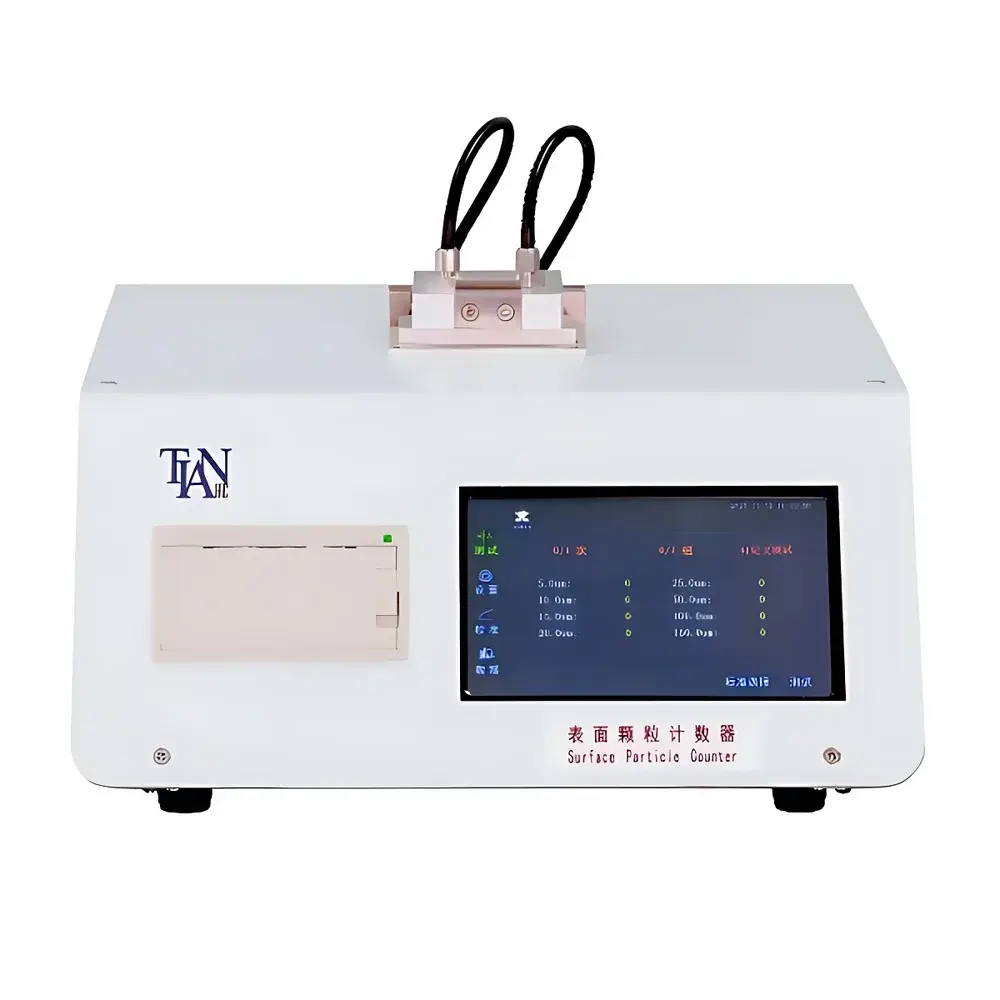
Tianhe BM-2A Optical Surface Particle Counter
| Brand | Tianhe |
|---|---|
| Origin | Tianjin, China |
| Model | BM-2A |
| Instrument Type | Optical Surface Particle Counter |
| Measurement Range | 0.1–5 µm, 0.3–10 µm, 5–150 µm, 20–500 µm |
| Number of Channels | 8 |
| Channel Resolution | 0.1 µm |
| Sampling Area | 10 cm² (configurable) |
| Sampling Duration | 5–59 s (user-defined) |
| Accuracy | ≤ ±20% |
| Relative Standard Deviation (RSD) | ≤ 5% |
| Counting Capacity | 0–9,999,999 particles |
| Reporting Units | cm², m², sq.in, sq.ft |
| Operating Temperature | 10–40 °C |
| Power Supply | AC 220 V ±10%, 50 Hz, ≤100 W |
| Sampling Flow Rate | 1.0 CFM (28.3 L/min) |
| Interface | RS232, USB port for U-disk storage |
| Display & Control | Color touchscreen with bilingual (English/Chinese) UI |
| Data Output | Built-in thermal printer, automatic local storage, PC connectivity |
Overview
The Tianhe BM-2A Optical Surface Particle Counter is a precision-engineered instrument designed for quantitative surface contamination analysis in high-sensitivity manufacturing and R&D environments. It operates on the principle of laser light scattering detection—where particles deposited on flat, solid substrates intercept a collimated laser beam, generating scattered light pulses proportional to particle size and number. The system employs a fixed-focus optical sensor array coupled with real-time pulse-height analysis to classify and count particles across four configurable size ranges (0.1–5 µm, 0.3–10 µm, 5–150 µm, and 20–500 µm), enabling trace-level particulate monitoring critical to semiconductor wafer handling, photomask inspection, lithium-ion battery electrode coating QC, and advanced ceramic or thin-film material development. Unlike bulk liquid or air counters, the BM-2A is optimized for *surface-bound* particulates—measuring particle density per unit area (e.g., particles/cm²) rather than volumetric concentration—making it indispensable for cleanroom qualification, process validation, and post-cleaning verification per ISO 14644-1 Class 1–5 and SEMI F22-0304 protocols.
Key Features
- Laser-based optical sensing with eight user-selectable size channels and 0.1 µm channel resolution for granular classification fidelity
- Sealed, recirculating sampling chamber powered by a low-vibration micro-vacuum pump and HEPA-filtered airflow—ensuring stable laminar flow over the sample surface and minimizing environmental interference
- Adaptive mechanical stage accommodating substrates from 0.1 mm to 5 mm thickness without manual recalibration
- Programmable sampling duration (5–59 seconds) and configurable sampling area (default 10 cm², scalable via software-defined ROI)
- Onboard calibration curve library with auto-fitting algorithms that compensate for refractive index variability and sensor drift using NIST-traceable reference standards
- Multi-standard compliance engine: automatically converts raw counts to reporting units (particles/cm², /m², /sq.in, /sq.ft) and applies threshold logic per ISO 14644-1, USP , or internal SOPs
- Full-featured embedded OS with color capacitive touchscreen, bilingual (English/Chinese) interface, role-based access control (administrator/operator/auditor tiers), and audit-trail-enabled operation logs
- Integrated thermal printer and dual-data-path storage: local flash memory + USB mass-storage mode for U-disk export—supporting >10,000 test records with timestamp, operator ID, and parameter metadata
Sample Compatibility & Compliance
The BM-2A accepts rigid, planar samples up to 150 × 150 mm, including silicon wafers (200 mm/300 mm compatible with optional fixtures), glass photomasks, metal foils, polymer films, and sintered ceramic substrates. Its non-contact, dry measurement method eliminates solvent-induced artifacts or electrostatic redistribution—critical for electrostatic-sensitive devices (ESD) and hydrophobic surfaces. The instrument complies with ISO 21501-4 for light-scattering particle characterization and supports data integrity requirements under FDA 21 CFR Part 11 when deployed with validated software configuration and electronic signature workflows. All firmware and calibration routines are documented per GLP/GMP Annex 11 principles, and system suitability testing (SST) templates are included for routine performance verification.
Software & Data Management
Firmware v3.2 includes an embedded Linux-based platform supporting CSV/Excel export via USB, RS232 serial output for SCADA integration, and optional Ethernet module (sold separately) for LabVantage or Empower LIMS connectivity. Raw scatter pulse data, classified histograms, and spatial distribution heatmaps are stored with SHA-256 checksums. Audit trails record all parameter changes, user logins, calibration events, and print actions—including IP address (if networked) and digital signature timestamps. The system supports 21 CFR Part 11-compliant electronic signatures when paired with external PKI infrastructure and enables retrospective data reprocessing using updated calibration coefficients without raw data loss.
Applications
- Semiconductor: post-etch/post-CMP wafer surface cleanliness screening; photomask defect density mapping prior to lithography
- Battery Manufacturing: cathode/anode coating uniformity validation; separator film particulate carryover assessment
- Optics & Photonics: laser-grade mirror and lens substrate certification; anti-reflective coating defect quantification
- Medical Device Packaging: sterile barrier integrity verification via particulate shedding analysis on Tyvek® and foil-laminates
- Advanced Materials R&D: nanoparticle deposition homogeneity studies on graphene, MXene, or perovskite thin films
FAQ
What particle sizing standards does the BM-2A support?
It natively implements ISO 21501-4 Mie theory-based calibration and allows user-defined size bins aligned with SEMI F22, ASTM E2457, or internal metrology specifications.
Can the BM-2A measure particles on curved or textured surfaces?
No—it requires optically flat, rigid substrates with surface roughness Ra < 0.8 µm. Curved or highly diffusive surfaces degrade scatter signal-to-noise ratio and invalidate size calibration.
Is firmware validation documentation available for regulated environments?
Yes—Installation Qualification (IQ), Operational Qualification (OQ), and Performance Qualification (PQ) protocols are provided upon request, along with version-controlled release notes and change control history.
How is traceability maintained for calibration standards?
The instrument ships with a certificate of conformance referencing NIST SRM 2806a (polystyrene latex spheres) and includes procedures for in-house standard verification using certified reference materials.
Does the system support remote diagnostics or preventive maintenance alerts?
Firmware v3.2 includes self-test diagnostics at boot and sensor health monitoring; remote access requires optional Ethernet module and secure VPN configuration per IT security policy.



