
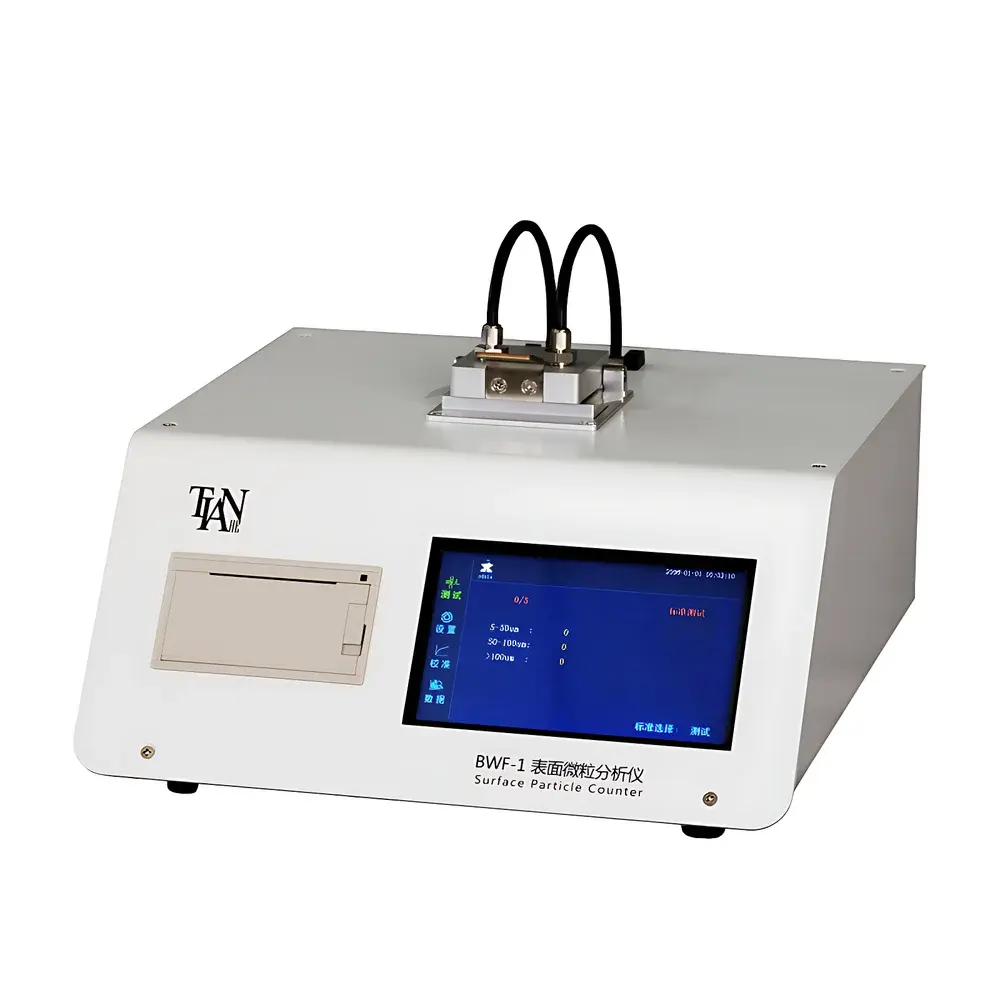
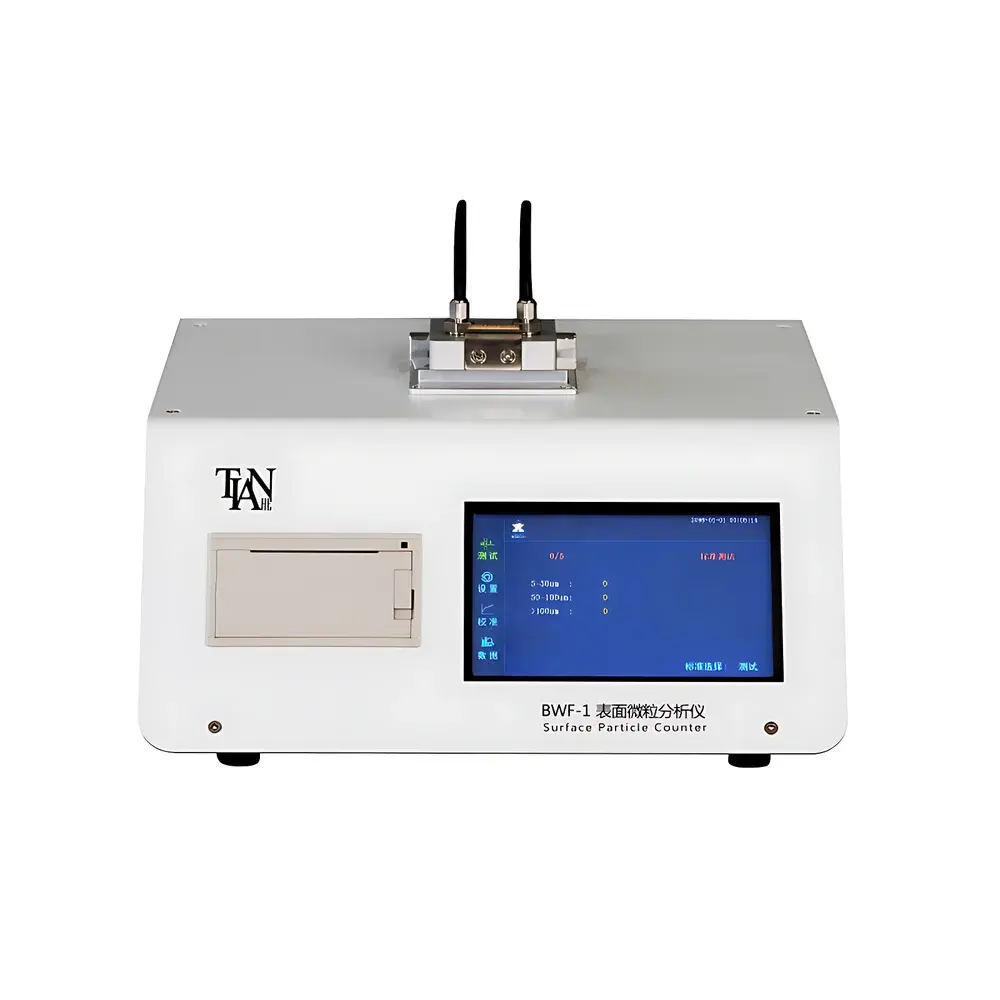

Tianhe BWF-1 Surface Particle Analyzer
| Brand | Tianhe |
|---|---|
| Origin | Tianjin, China |
| Instrument Type | Optical Surface Particle Counter |
| Measurement Principle | Laser Light Scattering & Obscuration |
| Detection Range | 5–150 µm |
| Number of Size Channels | 8 |
| Channel Resolution | 0.1 µm |
| Sampling Area | 10 cm² |
| Adjustable Sampling Duration | 5–59 s |
| Accuracy | ±20 % |
| Repeatability (RSD) | <5 % |
| Particle Count Capacity | 0–9,999,999 |
| Display Units | cm², m², sq.in, sq.ft |
| Operating Temperature | 10–40 °C |
| Power Supply | AC 220 V ±10 %, 50 Hz, ≤100 W |
| Interface | RS232, USB (U-disk storage) |
| Data Security | Role-based User Management System |
| Calibration | Internal Reference Curve with Auto-Fit Algorithm |
| Compliance Support | ASTM F3212 (Standard Guide for Evaluating Particulate Contamination on Medical Device Packaging), ISO 11140 (Sterilization – Qualification of Process Indicators), GB/T 24334–2009 (Determination of Dust Specks on Paper and Paperboard) |
Overview
The Tianhe BWF-1 Surface Particle Analyzer is a dedicated optical surface particle counter engineered for quantitative assessment of loose particulate contamination on planar solid substrates. It operates on the principle of laser light obscuration combined with high-sensitivity photodetection—where particles suspended in a controlled airflow interrupt a collimated laser beam, generating pulse signals proportional to their projected area. These pulses are classified in real time across eight user-configurable size channels (5–150 µm), enabling simultaneous enumeration and size distribution analysis per unit sampling area (10 cm²). Unlike bulk suspension analyzers, the BWF-1 employs a sealed, vacuum-assisted sampling head that draws ambient air across the sample surface under laminar flow conditions, minimizing turbulence-induced particle loss or redistribution. This architecture ensures measurement integrity for low-mass, weakly adhered contaminants—critical in sterile packaging validation, cleanroom material qualification, and regulatory-compliant dust speck evaluation.
Key Features
- Sealed isolation sampling module with integrated miniature vacuum pump and HEPA-filtered recirculating airflow—eliminates environmental cross-contamination and stabilizes particle lift-off dynamics
- Auto-adaptive sampling head accommodates variable substrate thicknesses (0.1–5 mm) without mechanical recalibration
- Programmable sampling duration (5–59 seconds) supports both rapid screening and statistically robust counting for low-density surfaces
- Onboard calibration curve library with auto-fitting algorithm reduces operator dependency and maintains traceability across instrument lifecycles
- Full-featured touchscreen interface with bilingual (English/Chinese) input, role-based access control, and audit-ready session logging
- Integrated thermal printer and dual data export pathways (RS232 serial + USB mass storage) ensure compliance with laboratory documentation workflows
- Unit conversion engine automatically renders results in cm², m², sq.in, or sq.ft—aligned with regional regulatory reporting formats (e.g., FDA guidance for medical packaging, ISO 11607 Annex A)
Sample Compatibility & Compliance
The BWF-1 is validated for use on non-porous and semi-porous flat materials including Tyvek® pouches, aluminum-laminated foils, sterilization wraps, pharmaceutical blister films, printing-grade paperboard, and coated label stocks. Its sampling geometry excludes textured or highly curved surfaces where particle retention mechanics deviate from ISO-defined flat-surface assumptions. The system supports test protocols aligned with ASTM F3212 (surface particle monitoring for medical device packaging), GB/T 24334–2009 (paper dust speck quantification), and internal QC specifications requiring RSD <5 % at ≥100 particles/cm². While not certified to IEC 61326-1 for electromagnetic compatibility in Class A environments, it meets basic electrical safety requirements per GB 4793.1 for laboratory equipment.
Software & Data Management
Data acquisition and reporting are handled via embedded firmware—not external PC software—ensuring deterministic timing and eliminating OS-level latency in pulse capture. All measurements store timestamp, operator ID, sampling parameters, and raw channel counts in non-volatile memory. Exported .CSV files include metadata headers compliant with LIMS ingestion standards (e.g., Anthesis, LabVantage). Audit trails record user login/logout events, parameter modifications, and calibration actions—supporting GLP-aligned review processes. The system does not implement FDA 21 CFR Part 11 electronic signature functionality but provides configurable password protection and hierarchical user roles (Admin, Technician, Viewer) to enforce data governance policies.
Applications
- Pre-release inspection of sterile barrier systems (SBS) per ISO 11607-1:2019 clause 5.3.2 (particulate shedding assessment)
- Dust speck verification in food-contact paperboard per FDA Food Contact Notification (FCN) requirements
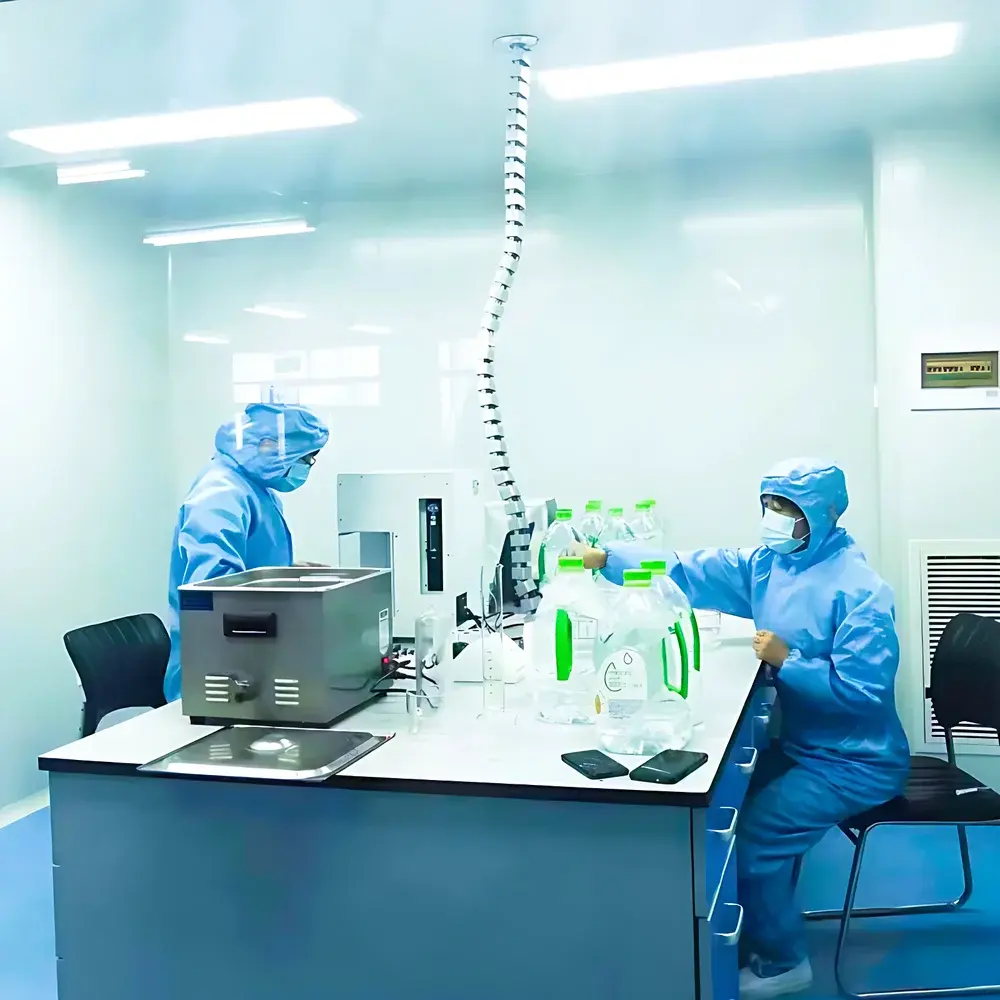
- In-process monitoring of cleanroom-compatible packaging during aseptic filling line qualification
- Root cause analysis of filter clogging incidents by correlating upstream surface shedding with downstream particle load
- Supplier qualification testing for polymer film suppliers supplying to Class 8 cleanrooms (ISO 14644-1)
- Validation of cleaning efficacy for reusable surgical instrument trays prior to sterilization
FAQ
What particle detection principle does the BWF-1 employ?
It uses laser obscuration (light blockage) detection—not dynamic light scattering or imaging—optimized for dry, airborne particles liberated from surfaces under controlled vacuum aspiration.
Can the BWF-1 measure particles smaller than 5 µm?
No. Its optical design and signal-to-noise threshold limit reliable detection to ≥5 µm; sub-5 µm particles fall below the system’s resolution envelope and are excluded from count statistics.
Is the instrument suitable for measuring particles on rough or embossed surfaces?
Not recommended. The 10 cm² sampling footprint assumes uniform contact pressure and laminar airflow; irregular topography causes inconsistent particle entrainment and violates ISO 11140-5 sampling assumptions.
Does the BWF-1 require annual third-party calibration?
While no mandatory certification exists for surface particle counters, Tianhe recommends biannual verification using NIST-traceable polystyrene latex (PSL) microsphere standards (e.g., 10 µm and 50 µm) to confirm channel alignment and counting accuracy.
How is data integrity maintained during power interruption?
All active measurements are buffered in RAM and written to flash memory upon completion; unsaved sessions are discarded—no partial or corrupted datasets are retained.



