
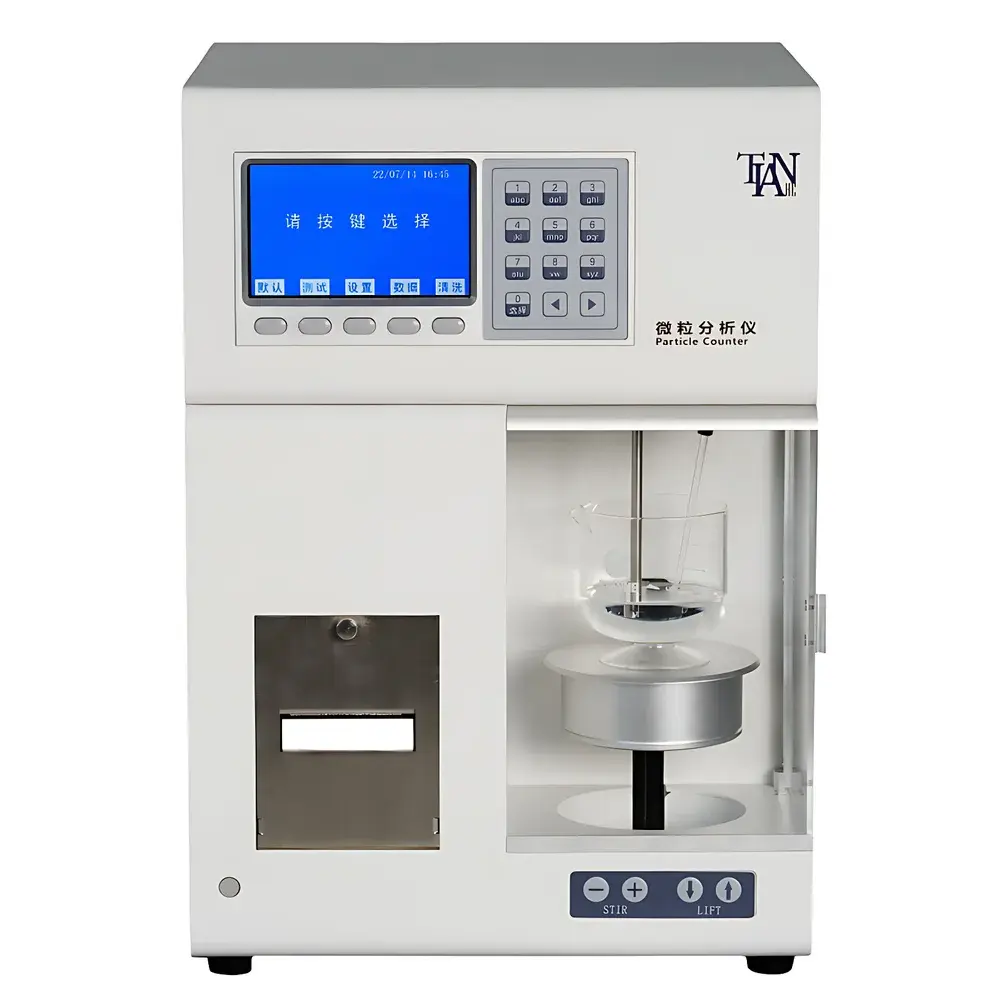
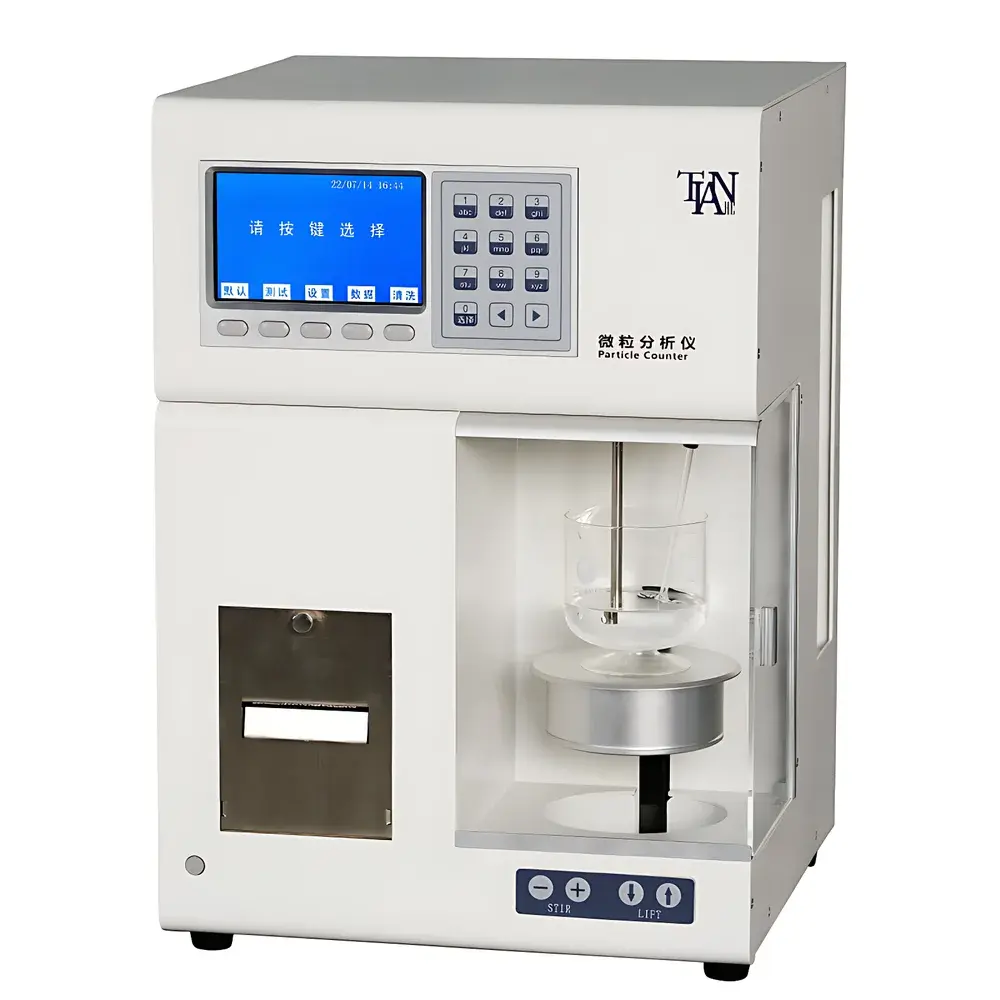

Tianhe GWF-8JA Insoluble Particle Analyzer
| Brand | Tianhe |
|---|---|
| Origin | Tianjin, China |
| Manufacturer Type | Authorized Distributor |
| Product Origin | Domestic (China) |
| Model | GWF-8JA |
| Pricing | Available Upon Request |
| Principle | Light Obscuration (LO) with Laser Detection |
| Compliance | Fully Aligned with Chinese Pharmacopoeia (ChP) 2020 Edition, General Chapter 0903 |
| Sample Types | Sterile Injectable Solutions, Lyophilized Powders, Concentrated Injection Solutions |
| Detection Range | 1–500 µm (Configurable Channel Segments) |
| Channel Settings | ≥2 µm, 4–6 µm, ≥5 µm, ≥8 µm, ≥10 µm, ≥12 µm, ≥25 µm, ≥100 µm |
| Count Range | 0–9,999,999 particles per sample |
| Max. Particle Concentration | <10,000 particles/mL |
| Sample Volume | 0.2–1000 mL (5 mL accuracy: ±0.5%) |
| Flow Rate | 5–80 mL/min (adjustable) |
| Measurement Accuracy | ±10% of reference value |
| Channel Resolution | >95% |
| RSD | <2% (for standard latex particles ≥1000 particles/mL) |
| Stirring Speed | 0–2000 rpm (propeller-type, frictionless, programmable) |
| Operating Temperature | 10–40 °C |
| Power Supply | AC 220 V ±10%, 50 Hz, ≤100 W |
| Display | Large LCD with Chinese GUI |
| Data Handling | Onboard storage, USB export, LAN connectivity, optional integration with LIMS or ELN platforms |
| Preloaded Drug Library | >300 ChP-listed injectables |
Overview
The Tianhe GWF-8JA Insoluble Particle Analyzer is a regulatory-compliant light obscuration (LO)-based instrument engineered for quantitative analysis of extraneous particulate matter in parenteral pharmaceuticals. It operates in strict accordance with the methodology outlined in Chapter 0903 of the Chinese Pharmacopoeia (ChP) 2020 Edition — the official compendial standard governing particulate contamination limits for sterile injectables, lyophilized powders, and concentrated solutions intended for reconstitution. The system employs a high-stability laser diode coupled with an energy-compensated photodetector array to ensure consistent signal integrity across both colorless and tinted澄明 (clarity-compliant) formulations. Unlike traditional fixed-flow systems, the GWF-8JA integrates a precision high-pressure syringe pump with programmable volumetric control and flow-rate modulation, enabling accurate delivery independent of sample viscosity — a critical capability when evaluating viscous biologics or oil-based preparations.
Key Features
- Pharmacopoeia-aligned operation: Dedicated ChP 2020 test protocols preloaded, including automatic pass/fail evaluation against threshold limits for ≥10 µm and ≥25 µm particles per container.
- Configurable particle sizing channels: Eight user-selectable thresholds (≥2 µm, 4–6 µm, ≥5 µm, ≥8 µm, ≥10 µm, ≥12 µm, ≥25 µm, ≥100 µm), plus customizable binning across 1–500 µm range for research-grade granulometric profiling.
- Viscosity-resilient fluidics: High-pressure syringe pump supports flow rates from 5 to 80 mL/min with ±0.5% volumetric accuracy at 5 mL — validated per USP Annex and ISO 21501-4 calibration traceability requirements.
- Uniform dispersion assurance: Propeller-type frictionless stirrer (0–2000 rpm, digitally controlled) ensures homogeneous particle suspension in vials, ampoules, and cartridges of varying geometry and volume — minimizing settling bias and improving inter-run reproducibility (RSD <2% at ≥1000 particles/mL).
- Regulatory-ready interface: Chinese-language LCD with intuitive navigation; built-in drug library containing >300 ChP-listed injectables for rapid method selection and labeling compliance.
- Scalable data architecture: Local storage of raw count data, histograms, and audit trails; optional Ethernet/LAN connectivity for centralized deployment within GLP/GMP environments; compatible with 21 CFR Part 11–compliant software modules for electronic signatures and secure data archiving.
Sample Compatibility & Compliance
The GWF-8JA accommodates a full spectrum of ChP-defined dosage forms: small-volume parenterals (SVPs) such as 1–25 mL ampoules and vials, large-volume parenterals (LVPs) up to 1000 mL, lyophilized powders (post-reconstitution), and highly concentrated stock solutions. Its optical design maintains measurement fidelity across absorbance ranges typical of amber-glass-packaged products and lightly pigmented formulations. Instrument validation documentation supports IQ/OQ/PQ execution per ISO/IEC 17025 and ASTM E2454 guidelines. All channel calibrations are traceable to NIST-traceable polystyrene latex (PSL) standards. The system meets essential requirements for routine QC release testing under GMP Annex 1 and aligns with ICH Q5A(Q3C) particulate control expectations for biotechnology-derived products.
Software & Data Management
Data acquisition and reporting are managed via embedded firmware supporting real-time histogram visualization, multi-channel differential counting, and automatic conversion to “particles per container” — especially critical for small-volume injections where volumetric normalization must reflect labeled fill volume. Export formats include CSV, PDF, and XML for seamless ingestion into laboratory information management systems (LIMS) or electronic lab notebooks (ELN). Optional PC-based analytical software provides advanced statistical tools: trend analysis across batches, SPC charting, outlier detection using Grubbs’ test, and comparative reporting between multiple instruments or sites. Audit trail functionality records all user actions, parameter changes, and calibration events with timestamps and operator IDs — satisfying FDA 21 CFR Part 11 and EU Annex 11 data integrity mandates.
Applications
- Final container release testing of sterile injectables per ChP 0903 and USP .
- Stability-indicating monitoring of particulate generation during accelerated and long-term storage studies.
- Filter validation support: quantifying upstream/downstream particle shedding in sterilizing-grade filtration processes.
- Comparative assessment of container-closure integrity (e.g., rubber stopper leachables, glass delamination fragments).
- Process development support for lyophilization cycle optimization — detecting aggregation onset via subvisible particle kinetics.
- Investigational analysis of protein therapeutics, mRNA-LNP formulations, and nanosuspensions where submicron-to-micron particulate profiles impact safety and efficacy.
FAQ
Does the GWF-8JA comply with international pharmacopoeias beyond ChP?
Yes — its optical configuration, calibration methodology, and counting algorithms conform to the core principles of USP , EP 2.9.19, and JP 6.07. While ChP-specific workflows are preloaded, users may configure custom protocols aligned with other regional standards.
Can the instrument handle viscous samples such as monoclonal antibody formulations?
Yes — the high-pressure syringe pump and adjustable flow rate (5–80 mL/min) enable robust handling of samples with dynamic viscosities up to 50 cP without compromising volumetric accuracy or particle resuspension uniformity.
Is 21 CFR Part 11 compliance supported out-of-the-box?
The base instrument includes audit trail logging and user access controls. Full Part 11 compliance requires deployment of the optional validated software suite with electronic signature, role-based permissions, and encrypted database storage.
What maintenance is required to sustain optical calibration?
Annual verification using NIST-traceable PSL standards is recommended. The laser source and detector exhibit <0.5% intensity drift over 12 months under normal operating conditions (10–40 °C, non-condensing humidity), per internal MTBF analysis.
How is sample carryover mitigated between runs?
The fluidic path includes automated rinse cycles (programmable volume and duration) using purified water or IPA-compatible solvents. System suitability tests confirm residual particle counts remain below 5 particles/mL post-rinse.






