
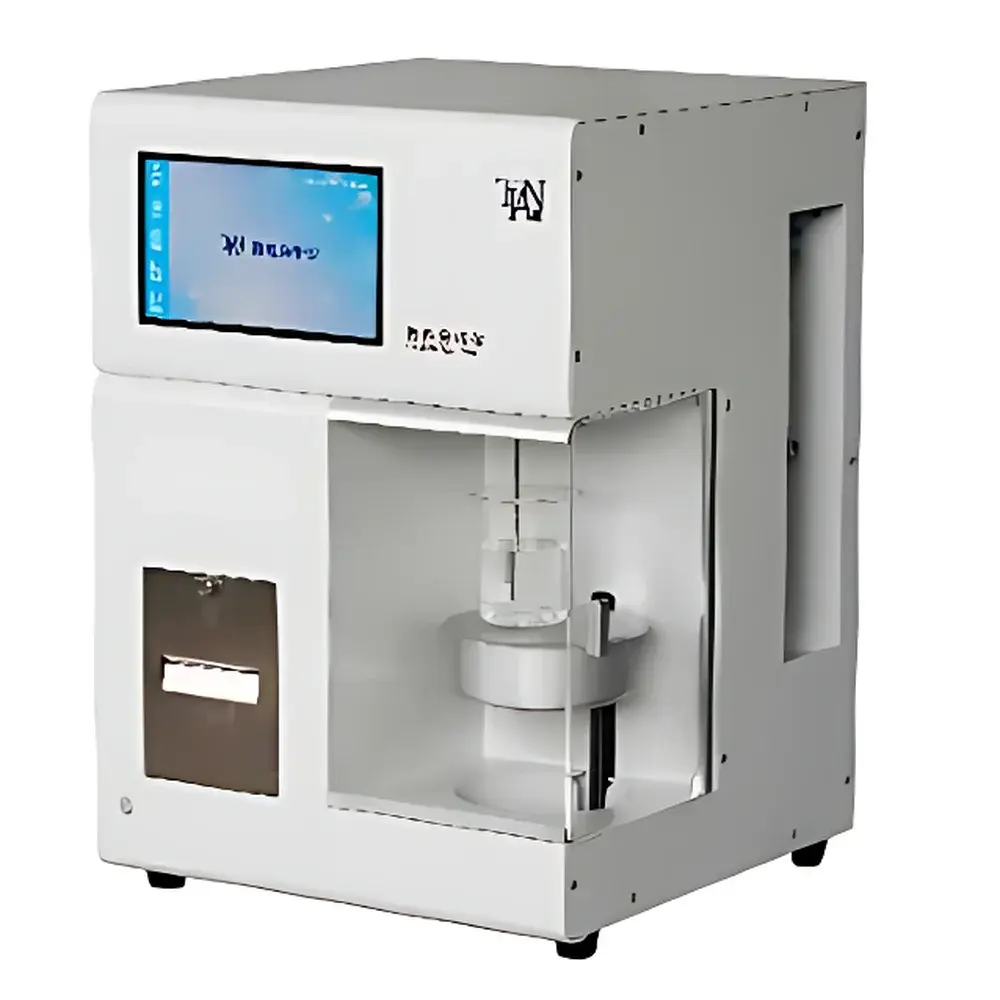
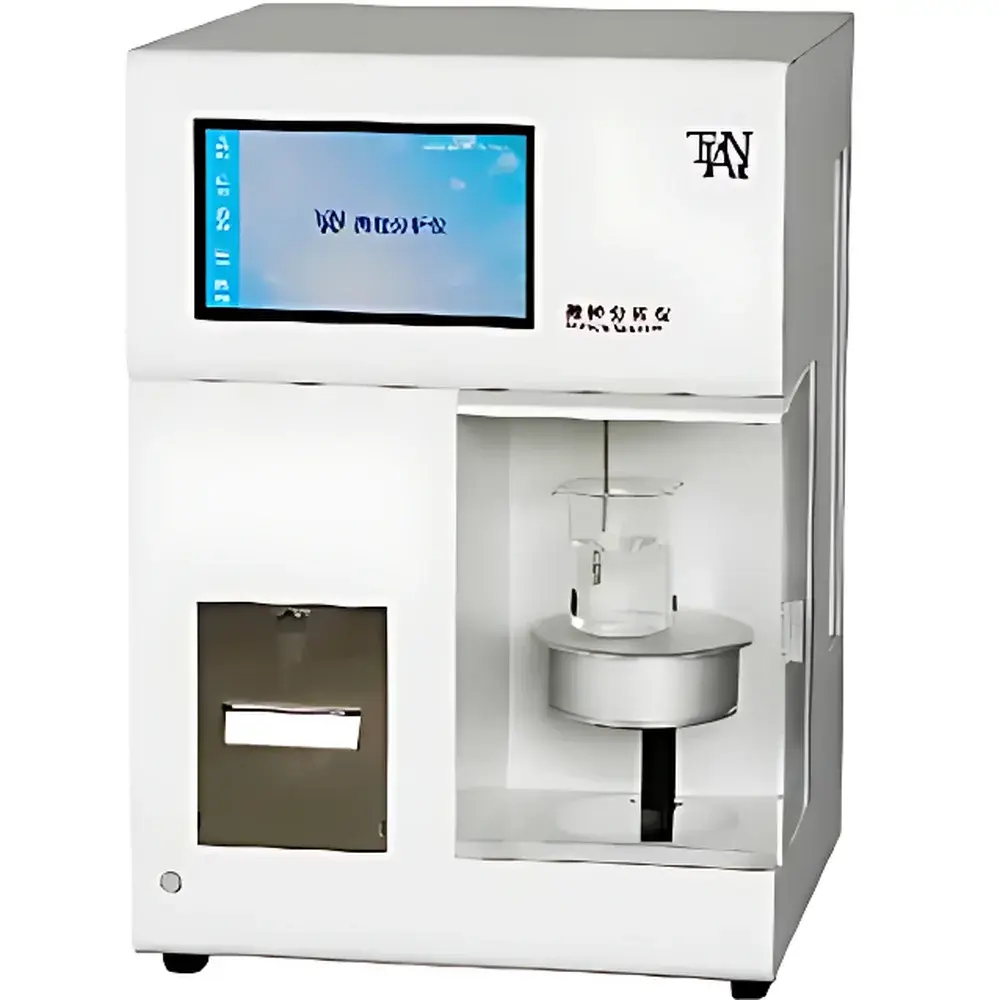
Tianhe GWF-A1 Insoluble Particle Detector
| Brand | Tianhe |
|---|---|
| Origin | Tianjin, China |
| Manufacturer Type | Authorized Distributor |
| Region of Manufacture | Domestic (China) |
| Model | GWF-A1 |
| Pricing | Available Upon Request |
| Light Source | High-Stability Laser Diode with Optical Power Compensation Circuit |
| Sample Compatibility | Colorless & Colored Clear Liquids, Organic Solvents, Oil-Based Matrices, Weakly Acidic/Alkaline Solutions |
| Fluidic Path Materials | Imported 316L Stainless Steel & PTFE |
| Particle Size Range | 1–500 µm |
| Channel Resolution | >95% |
| Counting Accuracy | ±5% of Reference Value |
| Relative Standard Deviation (RSD) | <1.5% (for standard particles ≥1000 particles/mL) |
| Minimum Detectable Concentration | 18,000 particles/mL |
| Adjustable Sampling Volume | 0.2–1000 mL (0.1 mL resolution, accuracy <±0.5%) |
| Flow Rate Control | 5–80 mL/min (programmable) |
| Stirring Speed | 0–1000 rpm |
| Operating Temperature | 10–40 °C |
| Power Supply | 100–240 VAC, 50/60 Hz, <80 W |
| Data Interfaces | RS232, USB Storage, Thermal Printer Port |
| Software Platform | Embedded Android OS with Multi-Tier User Authentication & Audit Trail Support |
| Calibration Standards | USP <788>, USP <789>, ChP (Chinese Pharmacopoeia) Vol. IV, ISO 21510, EP 2.9.19 |
| Data Storage | Local SQLite Database with Statistical Analysis Engine |
| Compliance Features | Electronic Signature Support, User Access Logs, Data Integrity Controls per ALCOA+ Principles |
Overview
The Tianhe GWF-A1 Insoluble Particle Detector is a fully automated, laser-based light obscuration instrument engineered for quantitative analysis of extraneous particulate matter in parenteral drug products, ophthalmic solutions, biologics, and pharmaceutical packaging extracts. It operates on the principle of single-particle optical sensing (SPOS), where particles suspended in a liquid medium pass through a precisely defined detection zone illuminated by a stabilized laser diode. Transient reductions in transmitted light intensity—proportional to particle cross-sectional area—are captured by a high-sensitivity photodetector and converted into digital pulse signals. These pulses are classified across 48 factory-configured size channels (1–500 µm), with software-enabled customization supporting up to thousands of user-defined thresholds at 0.1 µm resolution. Designed for regulatory compliance in global pharmaceutical quality control laboratories, the GWF-A1 meets the instrumental performance requirements specified in USP , USP , Chinese Pharmacopoeia (ChP) Volume IV, ISO 21510, and EP 2.9.19. Its robust architecture integrates optical power compensation circuitry to maintain measurement stability across variable sample absorbance—including amber-colored or opalescent formulations—and eliminates baseline drift during extended run sequences.
Key Features
- Laser-based light obscuration detection with real-time optical power feedback for consistent signal fidelity across colorless, tinted, and solvent-based matrices.
- Chemically inert fluidic path constructed from imported 316L stainless steel and PTFE, enabling direct analysis of aggressive media including ethanol, isopropanol, castor oil, and low-pH buffer systems without degradation or leaching.
- Motorized auto-lift sample chamber with transparent dust-resistant access door—designed to minimize operator intervention and prevent environmental contamination during vial loading/unloading.
- Embedded Android operating system with intuitive touchscreen interface, multi-level role-based authentication (administrator, analyst, reviewer), and full audit trail generation compliant with ALCOA+ data integrity principles.
- Onboard statistical engine supporting cumulative/differential histograms, batch trending, pass/fail reporting per pharmacopoeial limits, and export-ready CSV/PDF reports.
- Automated calibration verification using NIST-traceable polystyrene latex (PSL) standards; supports dual-point and multi-point calibration protocols aligned with USP Annex and ISO 21510 validation guidelines.
Sample Compatibility & Compliance
The GWF-A1 accommodates a broad spectrum of pharmaceutical preparations: sterile injectables (e.g., monoclonal antibodies, small-molecule APIs in saline or dextrose), ophthalmic suspensions, liposomal formulations, and container-closure system extracts (e.g., silicone oil from prefilled syringes). Its flow cell design minimizes shear-induced particle generation, while programmable stirring (0–1000 rpm) ensures homogeneous suspension prior to aspiration. Regulatory alignment extends beyond method-specific compliance—its firmware enforces electronic signature workflows, immutable user activity logs, and time-stamped data archiving to support FDA 21 CFR Part 11 readiness and GLP/GMP audit preparedness. All calibration and performance qualification records are stored locally with cryptographic hashing to prevent post-acquisition modification.
Software & Data Management
The embedded Android platform hosts a purpose-built analytical suite featuring offline data acquisition, real-time histogram visualization, and integrated statistical tools (mean, SD, CV%, percentile ranking). Raw pulse data and processed counts are retained in a local SQLite database with automatic backup to USB storage. RS232 serial output enables legacy LIMS integration, while USB host mode permits direct connection to external printers or network-attached storage. Audit trail entries capture user ID, timestamp, action type (e.g., “calibration executed”, “report generated”), and parameter modifications—retained for minimum 12 months as recommended under ICH GCP and EU Annex 11. Export formats include CSV (for Excel-based secondary analysis) and PDF (with embedded digital signatures for release documentation).
Applications
- Final product release testing of injectables per USP and ChP 0903 specifications.
- Stability-indicating assessment of particulate formation during accelerated and long-term storage studies.
- Comparative evaluation of filtration efficiency across membrane types and pore ratings.
- Extractables and leachables screening from rubber stoppers, glass vials, and polymer-based delivery devices.
- Process validation support for aseptic fill-finish operations, including pre-sterilization filter challenge tests.
- Supplier qualification of active pharmaceutical ingredients (APIs) and excipients where subvisible particle burden impacts formulation robustness.
FAQ
Does the GWF-A1 support USP for ophthalmic preparations?
Yes—the instrument’s adjustable flow rate (5–80 mL/min), low-volume sampling capability (down to 0.2 mL), and enhanced sensitivity at the 10 µm threshold meet all operational and performance criteria outlined in USP .
Can it analyze samples containing high concentrations of surfactants or viscosity modifiers?
Yes—its wide dynamic range (up to 18,000 particles/mL) and adaptive signal processing mitigate coincidence error; however, dilution may be required for samples exceeding this limit to preserve counting accuracy.
Is 21 CFR Part 11 compliance fully implemented?
The system provides foundational elements: electronic signatures, audit trails, and role-based access control. Full Part 11 compliance requires site-specific validation protocols, including risk assessment, IQ/OQ/PQ documentation, and procedural SOPs—which Tianhe supports via its Validation Support Package.
What calibration standards are recommended for routine verification?
NIST-traceable 10 µm and 25 µm PSL reference particles are used for daily system suitability checks; annual full-range calibration employs a 5-point set spanning 2–100 µm per ISO 21510 Annex B.
How is data integrity ensured during power interruption?
All active acquisitions are buffered in non-volatile RAM; upon recovery, the system resumes logging from the last valid timestamp without data loss or corruption.





