
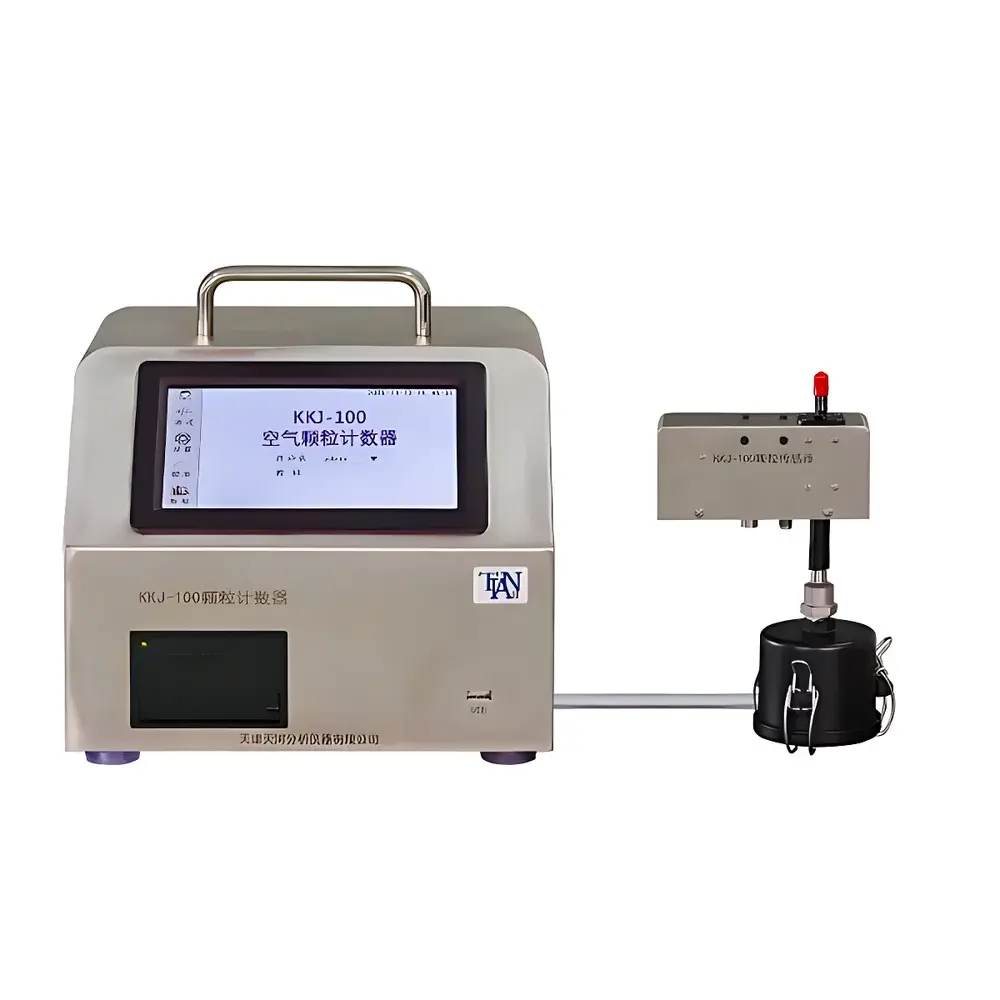
Tianhe KKJ-100 Optical Airborne Particle Counter
| Brand | Tianhe |
|---|---|
| Origin | Tianjin, China |
| Model | KKJ-100 |
| Instrument Type | Optical Airborne Particle Counter |
| Channel Configuration | 8 configurable channels |
| Particle Size Range | 20–640 µm |
| Maximum Sample Concentration | 100,000 particles/L |
| Accuracy | ≤ ±20% |
| Repeatability | RSD ≤ 5% |
| Sampling Flow Rate | 20–50 L/min (±5%) |
| Standard Flow Rate | 28.3 L/min (1.0 CFM) |
| Sampling Duration | 1–600 min |
| Zero Count Time | ≤ 10 min |
| Internal Data Storage | 3,000 measurement records |
| Display | 7-inch IPS touchscreen |
| Interfaces | USB, RS232 |
| Power Supply | AC 220 V ±10%, 50 Hz, ≤120 W |
| Operating Environment | 0–35 °C, 10–90% RH |
Overview
The Tianhe KKJ-100 Optical Airborne Particle Counter is a benchtop-grade, real-time monitoring instrument engineered for quantitative assessment of suspended particulate matter in cleanroom environments, controlled manufacturing spaces, and research laboratories. It operates on the principle of light scattering—where airborne particles passing through a precisely collimated laser beam generate scattered photons detected by a high-sensitivity photodiode array. Signal amplitude and pulse width are correlated to particle size via calibrated Mie scattering models, enabling classification across eight user-defined size channels within the 20–640 µm range. Designed for continuous duty in ISO Class 5–8 cleanrooms and semiconductor front-end fabrication support zones, the KKJ-100 delivers stable, repeatable counts under variable airflow conditions, with minimal drift over extended operational cycles. Its external sensor architecture minimizes flow path turbulence and particle loss, improving counting fidelity—particularly critical when monitoring coarse particulates in battery electrode slurry drying rooms or photovoltaic wafer handling areas.
Key Features
- Optically optimized dual-beam detection system with temperature-stabilized 650 nm laser diode and low-noise analog front-end electronics, ensuring long-term signal integrity.
- Modular external sensor head with <100 mm inlet-to-detection zone distance, reducing particle deposition and inertial losses for improved recovery of ≥50 µm particulates.
- Configurable 8-channel pulse-height analysis with programmable bin boundaries—supporting both cumulative and differential counting modes per EN ISO 21501-4 and JIS B 9921 standards.
- 7-inch industrial-grade IPS touchscreen with glove-compatible interface, local real-time histogram display, and on-device pass/fail threshold alerts.
- Dual data acquisition pathways: internal flash memory (3,000 timestamped records, including flow rate, ambient RH/T, and channel-specific counts) and direct export via USB mass storage or RS232 serial protocol.
- Standardized 28.3 L/min (1.0 CFM) sampling flow, compliant with ISO 21501-4 calibration traceability requirements; adjustable 20–50 L/min range supports integration into laminar flow hoods and environmental test chambers.
Sample Compatibility & Compliance
The KKJ-100 is validated for use with non-hazardous, non-corrosive, and non-oily aerosols in ambient air, compressed dry air (CDA), and nitrogen-purged enclosures. It is not intended for oil mist, sticky polymer fumes, or hygroscopic particles prone to rapid size change upon humidity exposure. The instrument meets electromagnetic compatibility requirements per GB/T 18268.1–2010 (IEC 61326-1) and safety compliance per GB 4793.1–2007 (IEC 61010-1). While not certified to FDA 21 CFR Part 11 out-of-the-box, audit-ready data logs—including operator ID, time stamps, and configuration metadata—are exportable for integration into validated GMP/GLP workflows where raw count data undergo secondary review in compliant LIMS platforms.
Software & Data Management
No proprietary desktop software is bundled; however, the device exports comma-separated value (CSV) files compatible with industry-standard analysis tools including MATLAB, Python (pandas), and JMP. RS232 output supports ASCII-based SCPI-like command sets for remote triggering, flow calibration verification, and channel reset—enabling integration into centralized facility monitoring systems via Modbus TCP gateways or PLC-linked serial servers. All stored records include UTC timestamps, sampling duration, actual measured flow rate, and ambient temperature/humidity from onboard sensors—facilitating retrospective environmental correlation during root cause analysis of contamination excursions.
Applications
- Semiconductor manufacturing: Monitoring tool exhaust lines, load port environments, and FOUP purge gas quality for ≥0.5 µm equivalent spherical diameter (ESD) particles—though note the KKJ-100’s lower size limit begins at 20 µm, making it suitable for macro-contamination screening rather than submicron wafer defect forensics.
- Lithium-ion battery production: In-line verification of electrode coating room air cleanliness, slurry mixing hood exhaust validation, and dry room particulate baseline trending prior to cell assembly.
- Photovoltaic module fabrication: Detection of glass grit, ceramic dust, and metal flake contaminants during tabbing/stringing station qualification.
- Materials science labs: Quantifying agglomerate dispersion stability in suspension-based nanomaterial synthesis and monitoring powder handling emissions during additive manufacturing feedstock sieving.
- Energy infrastructure QA: Verifying filter integrity in transformer oil handling systems and assessing particulate carryover in hydrogen compression skids.
FAQ
What calibration standards does the KKJ-100 support?
The instrument is factory-calibrated using NIST-traceable PSL (polystyrene latex) spheres. Users may perform field verification using ISO 21501-4 compliant reference aerosols; full recalibration requires return to an authorized Tianhe service center.
Can the KKJ-100 be integrated into a Building Management System (BMS)?
Yes—via RS232 serial output or optional Ethernet-to-serial converter, enabling Modbus RTU or custom ASCII polling protocols for alarm state and count rate telemetry.
Is the internal memory sufficient for long-term unattended operation?
At one measurement per minute, the 3,000-record buffer supports ~2 days of continuous logging; for extended campaigns, scheduled USB dump intervals or network-based pull requests are recommended.
Does the device meet ISO 14644-1 cleanroom classification requirements?
It provides raw count data required by ISO 14644-1 Annex B but does not perform automatic classification calculations; post-processing in Excel or dedicated cleanroom software is necessary to derive ISO classes.
What maintenance is required to sustain measurement accuracy?
Bi-weekly zero-count verification, quarterly optical window cleaning with spectroscopic-grade isopropanol, and annual flow sensor recalibration—documented in the included maintenance log template.



