
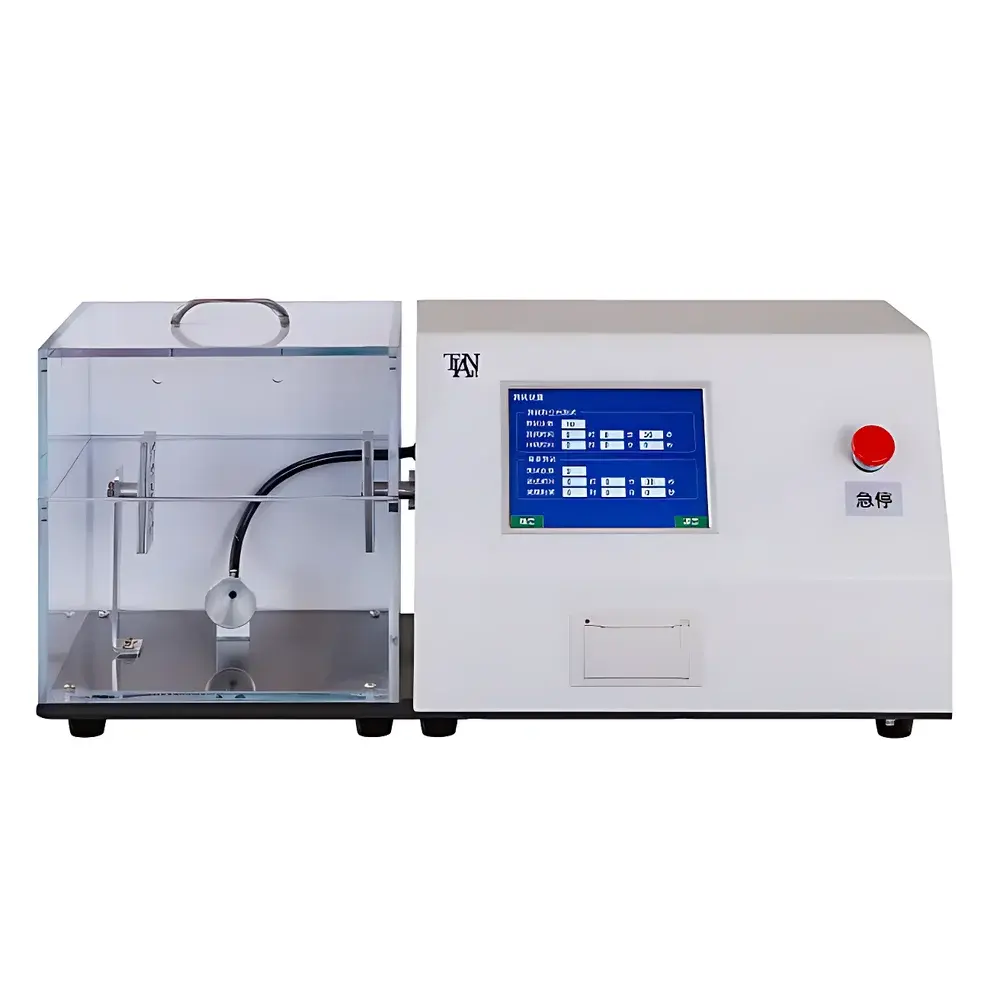
Tianhe LX-A Optical Particle Counter for Cleanroom & Material Surface Contamination Monitoring
| Brand | Tianhe |
|---|---|
| Origin | Tianjin, China |
| Model | LX-A |
| Instrument Type | Optical Particle Counter |
| Measurement Range | 5–150 µm |
| Number of Size Channels | 8 |
| Channel Resolution | 0.1 µm |
| Sampling Area | 220 cm² |
| Adjustable Sampling Duration | 5–59 s |
| Accuracy | ≤ ±20% |
| Relative Standard Deviation (RSD) | ≤ 5% |
| Particle Count Capacity | 0–9,999,999 particles |
| Report Units | cm², m², sq.in, sq.ft |
| Operating Temperature | 10–40 °C |
| Power Supply | AC 220 V ±10%, 50 Hz, ≤100 W |
Overview
The Tianhe LX-A Optical Particle Counter is an engineered solution for quantitative surface particle contamination assessment in controlled environments—specifically designed for quality assurance and process validation in electronics manufacturing, semiconductor fabrication, battery electrode coating lines, and advanced materials R&D laboratories. It operates on the principle of light obscuration (also known as single-particle optical sensing), where particles deposited on a flat substrate interrupt a collimated laser beam; the magnitude of signal attenuation correlates directly with particle cross-sectional area, enabling size-resolved enumeration across eight calibrated channels from 5 µm to 150 µm. Unlike airborne particle counters, the LX-A is optimized for *surface-bound particulate analysis*, making it critical for monitoring residual contamination after cleaning steps, evaluating wipe test efficacy, or qualifying laminar flow hoods and glovebox interiors prior to sensitive material handling.
Key Features
- High-stability 650 nm semiconductor laser sensor with wide dynamic range and sub-micron channel resolution (0.1 µm per bin)
- Sealed, recirculating sampling chamber with integrated micro-vacuum pump and HEPA-grade air filtration—ensures consistent laminar flow over the 220 cm² test area without external ducting
- Adaptive height-adjustable sampling head accommodates substrates up to 30 mm thick, including wafers, pouch cells, ceramic substrates, and polymer films
- User-configurable sampling duration (5–59 seconds) supports both rapid screening and statistically robust low-concentration measurements
- Onboard calibration curve library with auto-fitting algorithm—reduces operator dependency and maintains traceability to NIST-traceable reference standards
- Dual-mode operation: pre-programmed compliance tests (e.g., ISO 14644-1 Class 5 surface limits, SEMI F22-0301 wipe test protocols) and fully customizable test templates
- Intuitive 7-inch color capacitive touchscreen with bilingual (English/Chinese) UI, role-based access control, and audit-ready user log
- Integrated thermal printer, RS-232 serial interface, and USB mass storage support—enables local hardcopy output and seamless integration into LIMS or MES platforms
Sample Compatibility & Compliance
The LX-A accepts rigid and semi-rigid planar samples including silicon wafers (up to 300 mm), lithium-ion battery cathode/anode foils, sputtered metal films, optical filters, and cleanroom-compatible packaging materials. Its sealed sampling architecture eliminates ambient interference, satisfying ISO 14644-1 Annex B requirements for surface cleanliness verification in Grade 5–8 environments. The instrument’s data reporting structure aligns with SEMI C10-0301 (Particle Contamination on Wafer Surfaces) and IEST-STD-CC1246E (Product Cleanliness Levels), supporting both internal QA documentation and third-party audit readiness. All measurement records include timestamp, operator ID, environmental conditions (temperature logged internally), and full metrological metadata required under GLP and GMP frameworks.
Software & Data Management
Firmware v3.2 embeds a deterministic real-time operating system with non-volatile memory for ≥10,000 complete test logs. Data export supports CSV and XML formats compliant with ASTM E2917-22 for electronic record integrity. Optional PC software (Tianhe DataLink v2.1) provides statistical process control (SPC) charting, trend analysis across multiple instruments, and automated report generation aligned with FDA 21 CFR Part 11 requirements—including electronic signatures, audit trails, and immutable record archiving. All firmware updates are digitally signed and validated prior to installation.
Applications
- Final inspection of photomask blanks and reticles prior to lithography
- Quantitative validation of solvent-based cleaning efficacy on copper-clad laminates
- Monitoring particulate shedding from slurry-coated electrodes during drying and calendering
- Surface cleanliness qualification of vacuum chamber components before thin-film deposition
- Comparative evaluation of wipe materials and cleaning solvents per ISO 14644-10 Annex D
- Root-cause analysis of yield loss in high-aspect-ratio via filling processes
FAQ
Does the LX-A comply with ISO 14644-10 for surface particle measurement?
Yes—the instrument’s sealed sampling geometry, calibrated detection sensitivity, and standardized reporting units meet the physical measurement criteria defined in ISO 14644-10:2017 Annex A for non-volatile residue (NVR) and discrete particle enumeration.
Can the LX-A measure particles smaller than 5 µm?
No—the optical design and signal-to-noise optimization are specified for the 5–150 µm range. Sub-5 µm detection requires scanning electron microscopy (SEM) or atomic force microscopy (AFM) correlation.
Is the internal calibration traceable to national standards?
Calibration is performed using NIST-traceable polystyrene latex (PSL) microspheres certified to ISO 21501-4, with certificate of conformance supplied with each unit.
What maintenance is required for long-term stability?
Annual verification of laser alignment and vacuum flow rate is recommended; optical path cleaning with lint-free swabs and isopropyl alcohol every 200 hours of operation ensures optimal signal fidelity.
Can test methods be exported and shared across multiple LX-A units?
Yes—test configurations, calibration profiles, and reporting templates are stored as encrypted .tcf files and can be synchronized across instruments via USB drive or network share.
Related Products



