
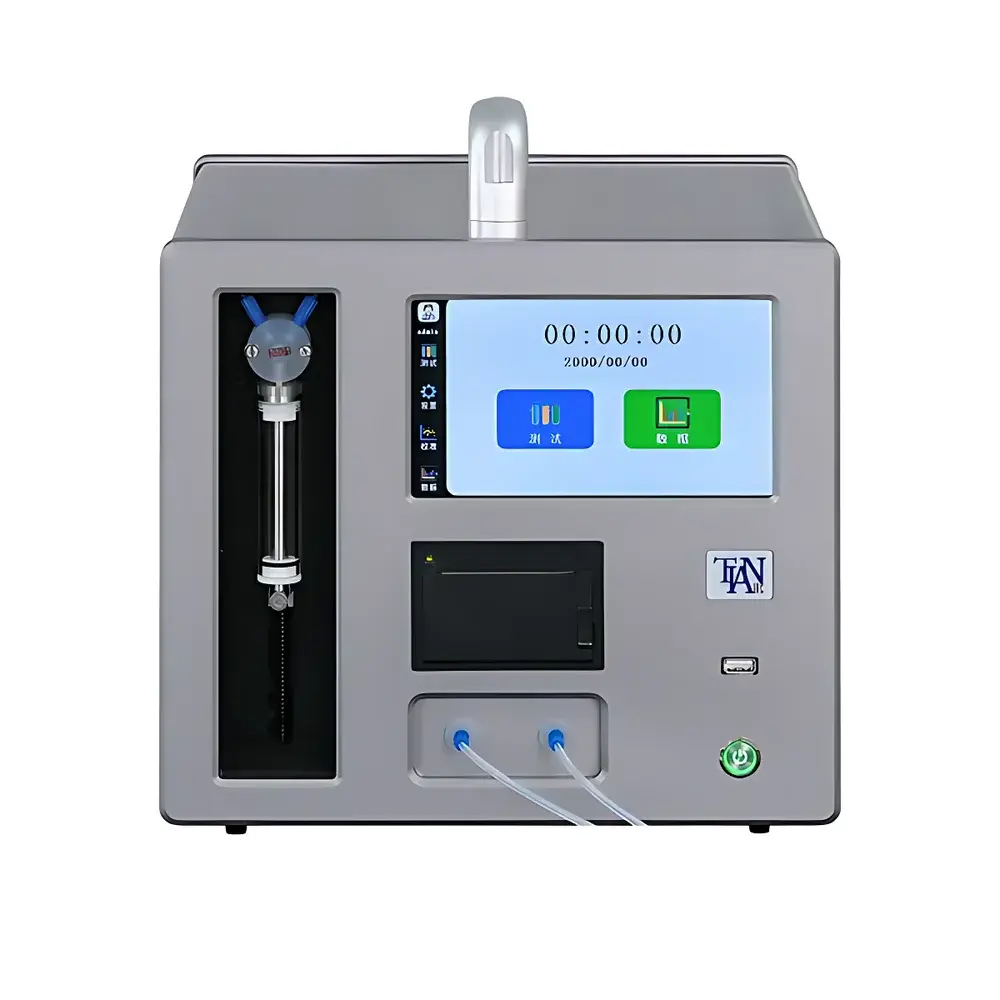
Tianhe SKJ-1 Optical Liquid Particle Counter
| Brand | Tianhe |
|---|---|
| Origin | Tianjin, China |
| Model | SKJ-1 |
| Instrument Type | Optical Particle Counter |
| Particle Size Range | 0.1–2 µm / 0.2–5 µm / 0.5–25 µm |
| Number of Detection Channels | 8 |
| Default Channel Sets (µm) | [0.1, 0.15, 0.2, 0.25, 0.3, 0.5, 1.0, 2.0] |
| Sample Flow Rate | 10–80 mL/min |
| Test Duration (Online Mode) | 1–999 s |
| Sample Volume (Offline Mode) | 1–999 mL |
| Maximum Particle Concentration | 20,000 particles/mL |
| Maximum Operating Pressure (Online) | 0.7 MPa |
| Connection Thread | 1/4-28 UNF |
| Electrostatic Discharge Protection | ≥2 kV |
| Internal Data Storage Capacity | 10,000 measurement records |
| Power Supply | AC 80–305 V, ≤30 W |
| Display | 7-inch TFT LCD |
| Dimensions (L×W×H, excluding protrusions) | 285 × 280 × 293 mm |
| Weight | 6 kg |
| Operating Temperature | 10–50 °C |
| Operating Humidity | 10–90 % RH (non-condensing) |
| Interface Options | USB, RS-232, TCP/IP |
| Compliance | CE-marked design principles |
| compatible with ISO 11171 | 2016 reference calibration protocols |
Overview
The Tianhe SKJ-1 Optical Liquid Particle Counter is a precision-engineered instrument designed for high-sensitivity, real-time quantification of suspended particulate matter in ultraclean process liquids. It operates on the principle of light obscuration (also known as single-particle optical sensing), where individual particles passing through a focused laser beam cause transient reductions in detected light intensity—each pulse amplitude correlating to particle size via calibrated Mie scattering response. The system supports three configurable size ranges (0.1–2 µm, 0.2–5 µm, and 0.5–25 µm), enabling application-specific optimization for semiconductor wafer rinse monitoring, battery electrolyte purity verification, photovoltaic precursor solvent qualification, and advanced material dispersion stability assessment. Its modular architecture ensures rapid reconfiguration between online bypass-loop and offline syringe-driven sampling modes without recalibration.
Key Features
- Optical detection path constructed with chemically inert perfluoroelastomer (FFKM) wetted components—resistant to aggressive solvents including NMP, DMSO, HF-based etchants, and lithium-ion battery electrolytes.
- Eight-channel digital pulse-height analysis with user-selectable threshold binning, supporting simultaneous multi-size-class reporting per ISO 4406:2017 and NAS 1638 classification standards.
- Integrated real-time alarm logic for fluid leakage (via capacitive sensor array), pressure excursion (>0.7 MPa), concentration saturation (>20,000 p/mL), and hardware fault conditions—each triggering visual, audible, and relay-output alerts.
- Embedded 7-inch industrial-grade TFT display with capacitive touch interface; dual-language firmware (English/Chinese) switchable without reboot.
- Comprehensive connectivity suite: isolated RS-232 for legacy PLC integration, USB host/device for flash-drive data export or keyboard/mouse input, and Ethernet (TCP/IP) enabling remote configuration, live streaming of particle histograms, and secure HTTPS-based API access.
- Onboard non-volatile memory stores up to 10,000 full-resolution datasets—including timestamp, environmental metadata, operator ID, and raw pulse train logs—retained during power loss.
Sample Compatibility & Compliance
The SKJ-1 accommodates a broad spectrum of low-conductivity, optically transparent fluids common in microelectronics fabrication and energy materials R&D. Validated compatibility includes deionized water (≥18.2 MΩ·cm), isopropyl alcohol (IPA), acetone, ethylene carbonate/dimethyl carbonate (EC/DMC) blends, and fluorinated solvents such as FC-40 and PFPE oils. All fluidic pathways meet ASTM F50-22 requirements for cleanroom-compatible surface finish (Ra ≤ 0.4 µm) and are certified free of extractables per USP . While not intrinsically rated for hazardous area use, its ≥2 kV ESD-hardened electronics comply with IEC 61340-5-1 for electrostatic protected environments. Data integrity aligns with ALCOA+ principles: attributable, legible, contemporaneous, original, accurate, complete, consistent, enduring, and available—supporting FDA 21 CFR Part 11 readiness when deployed with validated PC software.
Software & Data Management
The included Tianhe ParticleView™ PC application (Windows 10/11, 64-bit) provides full instrument control, dynamic histogram visualization, statistical trend analysis (e.g., moving averages, Cp/Cpk calculation), and automated report generation compliant with ISO 21501-4 Annex B. Raw data exports support CSV, PDF, and XML formats—with embedded digital signatures and immutable audit trails tracking all parameter changes, user logins, and calibration events. Remote operation via Ethernet allows centralized fleet management across multiple fab tools or QC labs, with TLS 1.2 encryption ensuring secure data transmission. Optional OPC UA server module enables seamless integration into MES/SCADA platforms for real-time SPC dashboarding.
Applications
- Semiconductor front-end: Monitoring post-CMP slurry carryover and DI water rinse efficacy at sub-100 nm defect thresholds.
- Lithium-ion battery manufacturing: Quantifying metallic particulates in cathode/anode slurries and electrolyte fill lines to prevent micro-shorts.
- Photovoltaic thin-film deposition: Verifying nanoparticle contamination in precursor inks used for CIGS and perovskite coating processes.
- Pharmaceutical excipient development: Characterizing colloidal stability of nanoemulsions and liposomal drug carriers under shear-free conditions.
- Advanced ceramics processing: Assessing agglomeration behavior of alumina and zirconia suspensions prior to tape casting or injection molding.
FAQ
What calibration standards are supported?
The SKJ-1 accepts NIST-traceable polystyrene latex (PSL) spheres per ISO 11171:2016, with optional factory calibration kits covering 0.1 µm to 10 µm diameters.
Can it be integrated into an automated production line?
Yes—via programmable relay outputs, Modbus RTU over RS-232, or HTTP RESTful API over Ethernet for PLC-triggered sampling and pass/fail decision logic.
Is cleaning validation supported?
The instrument includes a built-in flush cycle protocol with programmable flow rate and duration, and supports post-cleaning blank verification against ISO 8573-4 cleanliness classes.
Does it meet regulatory requirements for GMP documentation?
When operated with validated ParticleView™ software and defined SOPs, it satisfies data integrity expectations outlined in EU Annex 11 and PIC/S PI 041-1 for computerized systems in pharmaceutical manufacturing.
How is temperature drift compensated during extended runs?
An internal thermistor continuously monitors optical chamber temperature; gain correction coefficients are applied in real time using polynomial compensation models derived from thermal soak testing across 10–50 °C.
Related Products



