
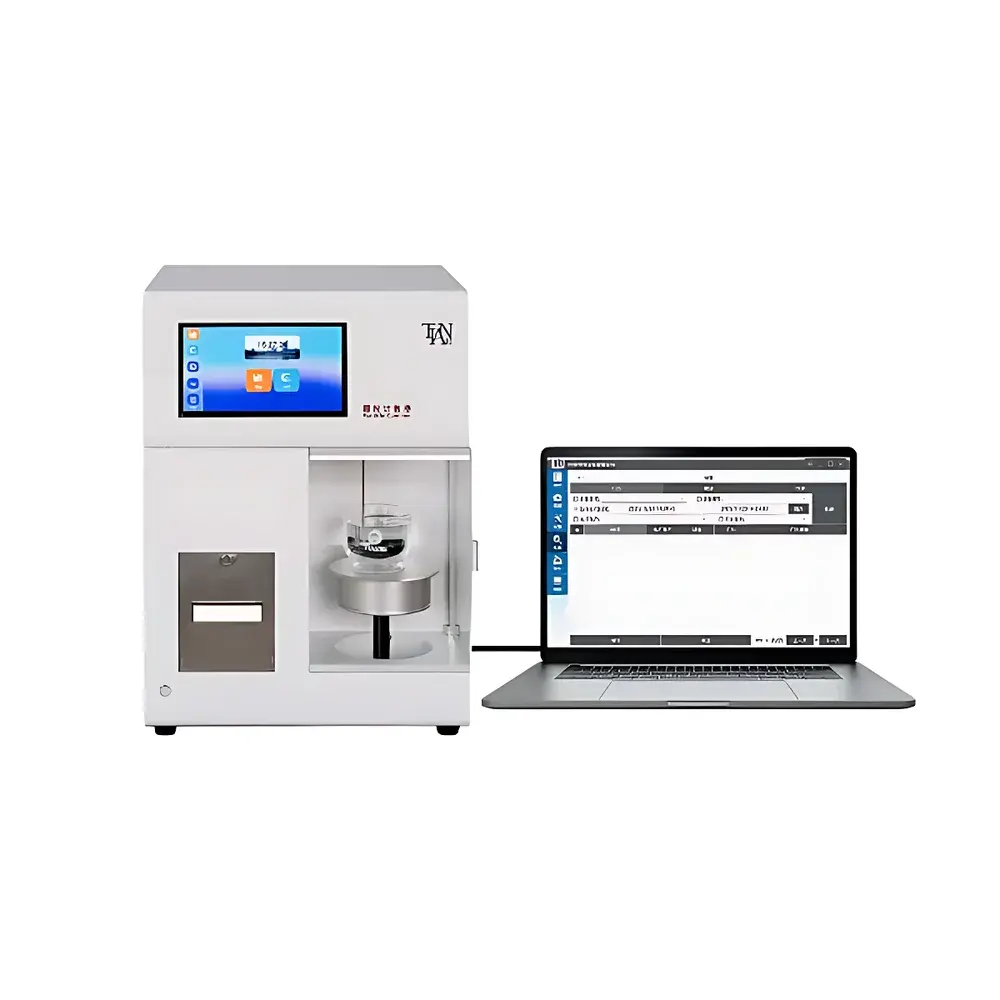
Tianhe SKJ-FS/F Optical Liquid Particle Counter
| Brand | Tianhe |
|---|---|
| Origin | Tianjin, China |
| Manufacturer Type | Authorized Distributor |
| Instrument Type | Optical Particle Counter |
| Model | SKJ-FS/F |
| Operating System | Android-based Embedded Platform |
| Detection Principle | Light Obscuration (LO) / Single-Particle Optical Sizing (SPOS) |
| Particle Channel Resolution | 0.1 µm |
| Size Range Options | 1–150 µm, 2–150 µm, 5–200 µm, or 25–500 µm (sensor-dependent selection) |
| Counting Channels | 64 user-configurable bins |
| Counting Range | 0–9,999,999 particles per sample |
| Sample Volume | 0.2–1000 mL (0.1 mL resolution) |
| Volume Accuracy | ±3% |
| Flow Rate | 5–80 mL/min |
| Counting Accuracy | ±20% of reference value |
| Precision (RSD) | ≤2% (for standard latex particles ≥1000 particles/mL) |
| Maximum Detectable Concentration | 18,000 particles/mL |
| Stirring Speed | 0–1000 rpm (step-adjustable) |
| Operating Temperature | 10–40 °C |
| Power Supply | AC 220 V, 50/60 Hz, ≤80 W |
| Sample Path Materials | 316L stainless steel + PTFE |
| Data Integrity Features | Audit Trail, Role-Based Access Control (RBAC), Electronic Signature Support |
| Connectivity | RS232, USB host/device |
| Storage | Internal database with statistical analysis engine |
| Enclosure | Dust-protected transparent access door |
| Calibration | Fully automated on-board calibration routine |
Overview
The Tianhe SKJ-FS/F Optical Liquid Particle Counter is an industrial-grade, light obscuration (LO)-based particle detection system engineered for high-reliability particulate contamination monitoring in critical liquid process streams. Designed specifically for applications in semiconductor fabrication, lithium-ion battery electrolyte quality control, pharmaceutical excipient suspensions, and advanced material dispersion R&D, the instrument operates on the principle of single-particle optical sizing (SPOS). As particles suspended in a liquid medium pass through a precisely defined laser interrogation zone, each event generates a pulse proportional to its cross-sectional area. These pulses are digitized across 64 programmable size channels with 0.1 µm resolution, enabling quantitative differentiation between sub-micron debris and coarse agglomerates. Unlike imaging-based or dynamic light scattering methods, LO provides direct, absolute counting—making it the preferred technique for compliance with USP , ISO 11171, and ASTM F312-22 for visible particle enumeration in clear and moderately colored liquids.
Key Features
- High-stability 650 nm laser source with real-time optical power compensation ensures consistent sensitivity across diverse sample matrices—including water, IPA, NMP, ethylene carbonate, and weakly acidic/basic solvents.
- Chemically inert fluid path constructed from electropolished 316L stainless steel and PTFE tubing minimizes adsorption, leaching, and corrosion—critical for long-term stability in aggressive organic media.
- Dedicated ARM-based embedded processor supports concurrent data acquisition, real-time histogram generation, and onboard statistical evaluation without external PC dependency.
- Android-based HMI delivers intuitive touchscreen navigation, multi-language support (EN/CN/JP/KO), and responsive workflow guidance—from method setup to report export.
- Automated calibration verification using NIST-traceable polystyrene latex standards reduces operator intervention and eliminates manual alignment drift over time.
- Full 21 CFR Part 11 readiness: electronic signatures, immutable audit trail (timestamped user actions, parameter changes, and result modifications), and hierarchical role-based access control (administrator, analyst, reviewer).
Sample Compatibility & Compliance
The SKJ-FS/F accommodates a broad spectrum of liquid samples ranging from ultrapure deionized water (used in wafer rinse validation) to viscous battery electrolytes (e.g., LiPF6 in EC/DMC blends) and nanoparticle colloids in catalysis research. Its modular sensor architecture allows field-selectable optical configurations to match required size ranges—1–150 µm for parenteral drug inspection, 25–500 µm for slurry homogeneity assessment in electrode coating processes, or intermediate ranges for cleanroom coolant monitoring. The system meets ISO 21501-4 for light extinction particle counters and supports traceable compliance with ICH Q5A(R2), USP , and JIS Z 8827. All firmware and calibration records are stored internally with SHA-256 hashing for integrity verification during GMP audits.
Software & Data Management
Data handling is governed by a dual-mode architecture: standalone operation via the built-in 7-inch capacitive display, or network-integrated deployment via USB or RS232 serial interface. Raw pulse data, cumulative histograms, and summary statistics (mean, median, mode, % >X µm) are retained in an encrypted SQLite database supporting >100,000 test records. Export formats include CSV, PDF (with embedded metadata), and XML for LIMS integration. Advanced filtering enables retrospective analysis by date range, operator ID, method name, or custom tags. All exported files retain cryptographic hashes and digital timestamps to satisfy ALCOA+ principles (Attributable, Legible, Contemporaneous, Original, Accurate, Complete, Consistent, Enduring, Available).
Applications
- Semiconductor: Monitoring rinse water purity post-etching, detecting metallic residues in CMP slurries, and qualifying photoresist filtrate integrity.
- Battery Manufacturing: Quantifying cathode/anode slurry particle agglomeration, verifying separator pore clogging thresholds, and assessing electrolyte filtration efficiency pre-filling.
- Pharmaceuticals: USP testing of injectables, visual particle enumeration in lyophilized reconstitution solutions, and stability-indicating studies of protein aggregates.
- Advanced Materials: Characterizing dispersion uniformity in quantum dot inks, carbon nanotube suspensions, and metal-organic framework (MOF) colloids.
- Energy: Inspecting transformer oil per ASTM D6786, evaluating hydraulic fluid cleanliness (ISO 4406), and validating fuel filter performance.
FAQ
What regulatory standards does the SKJ-FS/F support for GxP environments?
It complies with FDA 21 CFR Part 11 requirements for electronic records and signatures, including audit trail generation, role-based access, and data immutability—validated for use in GLP and GMP workflows.
Can the instrument detect transparent or low-refractive-index particles?
Yes—its optimized 650 nm laser wavelength and high signal-to-noise photodiode array enable reliable detection of silica, polymers, and cellulose particles in aqueous and organic carriers, provided refractive index contrast exceeds Δn ≥ 0.02.
Is sensor interchangeability supported for different size ranges?
Yes—optical modules for 1–150 µm, 5–200 µm, and 25–500 µm are mechanically and electrically compatible; switching requires only firmware reconfiguration and recalibration using certified reference standards.
How is data integrity maintained during power interruption?
All active measurements are buffered in non-volatile memory; upon recovery, the system resumes logging with continuity markers and preserves original timestamps without data loss.
Does the system support remote diagnostics or firmware updates?
Firmware updates are performed via authenticated USB drive import; remote diagnostic access is available through optional Ethernet module (sold separately) with TLS 1.2-secured API endpoints.



