
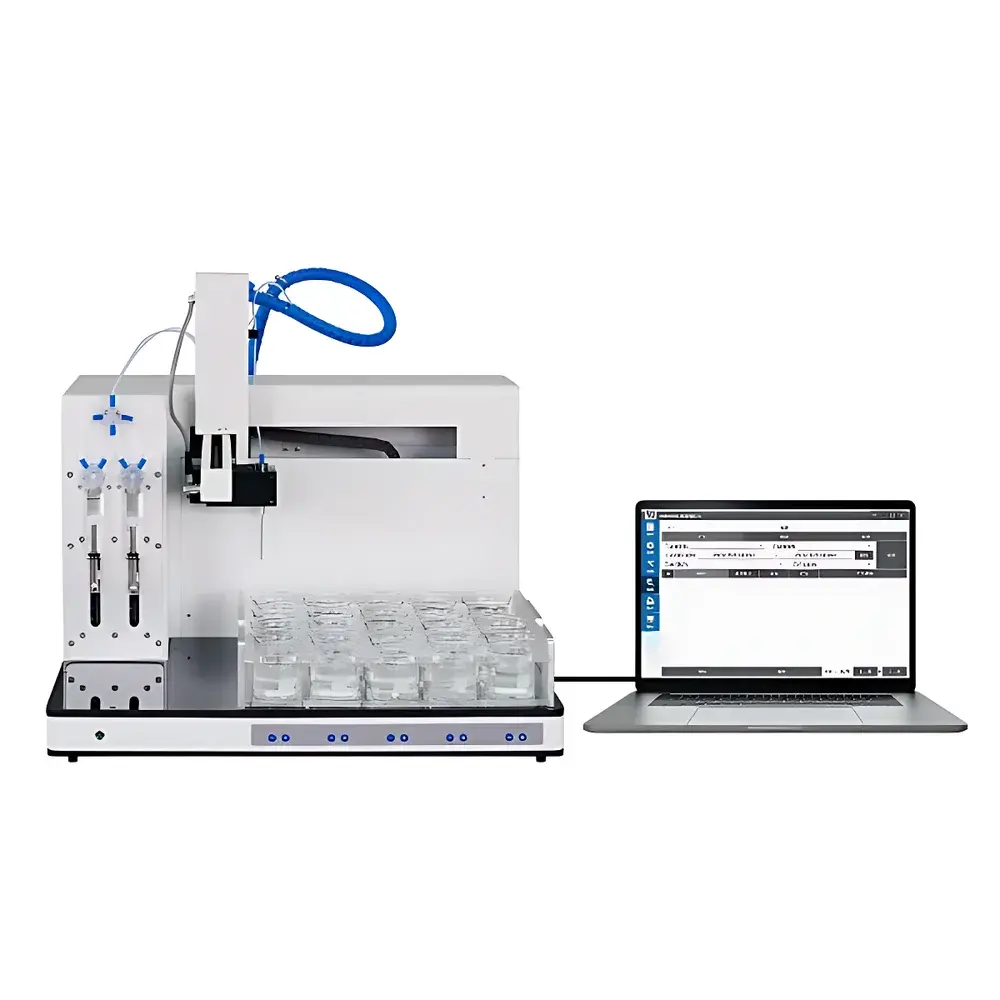
Tianhe SKJ-A Optical Liquid Particle Counter
| Brand | Tianhe |
|---|---|
| Origin | Tianjin, China |
| Manufacturer Type | Authorized Distributor |
| Region | Domestic (China) |
| Model | SKJ-A |
| Instrument Type | Optical Particle Counter |
| Particle Size Channels | 64 (0.001 µm resolution) |
| Size Ranges (Selectable) | 0.5–25 µm, 1–150 µm, 2–150 µm, 5–200 µm, or 10–500 µm |
| Count Range | 0–9,999,999 particles per sample |
| Sample Volume | 0.2–6500 mL (0.1 mL resolution) |
| Sampling Volume Error | ≤ ±3% at 5 mL |
| Flow Rate | 5–80 mL/min |
| Counting Accuracy | ≤ ±20% of reference value |
| Relative Standard Deviation (RSD) | ≤ 2% (for standard particles ≥1000 particles/mL) |
| Maximum Detectable Concentration | 18,000 particles/mL |
| Operating Temperature | 10–40 °C |
| Power Supply | AC 220 V, 50/60 Hz, ≤80 W |
| Material Compatibility | 316L stainless steel + PTFE wetted path |
| Data Interface | RS232, USB |
| Compliance Features | Audit trail, user permission management, automated calibration & cleaning |
Overview
The Tianhe SKJ-A Optical Liquid Particle Counter is a high-precision, laboratory-grade instrument engineered for quantitative particulate contamination analysis in ultraclean liquid media. It operates on the principle of light obscuration (also known as single-particle optical sensing, SPOS), where particles suspended in a liquid stream pass through a focused laser beam; each particle generates a transient reduction in detected light intensity proportional to its cross-sectional area. This analog signal is digitized and classified across up to 64 user-configurable size channels with 0.001 µm resolution, enabling trace-level detection and statistical characterization of submicron contaminants critical to electronic, semiconductor, battery electrolyte, and advanced material processing workflows.
Key Features
- Laser-based light obscuration detection with energy-compensated optics, ensuring consistent sensitivity across colorless, colored, and optically translucent samples—including organic solvents, hydrocarbon oils, and weakly acidic or alkaline process fluids.
- Chemically inert fluidic path constructed from imported 316L stainless steel and PTFE components, certified for compatibility with aggressive media commonly encountered in wafer fab chemical delivery systems and lithium-ion battery electrolyte QC.
- Automated three-axis robotic sampling stage enabling unattended sequential analysis of multiple vials or bottles—reducing operator variability and supporting high-throughput batch release testing.
- High-fidelity syringe-driven sampling system with volumetric accuracy of ±0.1 mL and programmable draw volumes from 0.2 mL to 6500 mL, supporting both micro-volume validation and large-batch monitoring protocols.
- Dedicated embedded processor with >10,000 real-time counting bins, delivering high-resolution size distribution histograms without data interpolation or post-acquisition binning artifacts.
- Fully automated calibration routine using NIST-traceable polystyrene latex (PSL) standards, with built-in verification checks to confirm optical alignment, flow stability, and sensor linearity prior to each analytical run.
- Integrated ultrasonic or recirculating rinse cycle between samples, minimizing carryover risk and maintaining measurement integrity across heterogeneous sample sets.
- Role-based access control with full audit trail functionality compliant with GLP and GMP documentation requirements, including timestamped operator logins, parameter changes, calibration events, and raw data export actions.
Sample Compatibility & Compliance
The SKJ-A accommodates a broad range of low-viscosity liquids used in precision manufacturing environments, including deionized water, IPA, acetone, NMP, DMC/EMC carbonate blends, HF-based etchants, and amine-functionalized slurries. Its wetted-path materials meet ASTM F51-22 specifications for biocompatibility and corrosion resistance. The system supports method validation per ISO 21501-4 (determination of particle size distribution by light extinction), USP and for injectables and ophthalmics, and JEDEC JESD22-A107 for semiconductor process chemicals. Full 21 CFR Part 11 readiness is enabled via optional software modules that enforce electronic signatures, secure data archiving, and immutable audit logs.
Software & Data Management
The instrument is operated via a dedicated Windows-based application offering intuitive method setup, real-time scatter plot visualization, cumulative/differential distribution plots, and customizable reporting templates. All raw count data—including pulse height histograms, timestamps, flow rate logs, and environmental metadata—are stored in structured binary format with SHA-256 checksums. Export options include CSV, PDF, and XML formats compatible with LIMS integration. Optional RFID reader support enables automatic sample ID capture during loading, eliminating manual entry errors. Data backups are encrypted and version-controlled, with configurable retention policies aligned with internal QA SOPs.
Applications
- Final rinse water monitoring in photolithography tool maintenance cycles
- Electrolyte purity screening for LiCoO₂ and solid-state battery cell production
- Quality control of CMP slurries, photoresist developers, and etch inhibitors
- Validation of filter integrity in ultrapure chemical distribution lines
- Stability assessment of nanomaterial dispersions in conductive inks and quantum dot formulations
- Contamination forensics in failure analysis labs investigating dielectric breakdown or gate oxide defects
FAQ
What particle size standards are supported for calibration?
NIST-traceable PSL suspensions (e.g., 1.0 µm, 3.0 µm, 5.0 µm, 10 µm) are recommended; calibration can be performed across any two points within the selected size range.
Can the SKJ-A measure opaque or highly viscous fluids?
No—it is optimized for transparent to semi-transparent liquids with kinematic viscosity ≤20 cSt; turbid or gel-like samples require dilution or filtration prior to analysis.
Is remote diagnostics or firmware update capability available?
Yes—via secure HTTPS-enabled service portal with authenticated technician access; updates preserve all validated method configurations and audit history.
How is carryover mitigated during high-concentration sample analysis?
The integrated cleaning cycle uses programmable solvent flush volume, dwell time, and flow velocity; residual particle recovery tests demonstrate <0.1% carryover at 18,000 particles/mL challenge levels.
Does the system support IQ/OQ/PQ documentation packages?
Yes—comprehensive qualification kits are provided, including test protocols, acceptance criteria, blank templates, and example reports aligned with ISO/IEC 17025 and pharmaceutical validation guidelines.



