
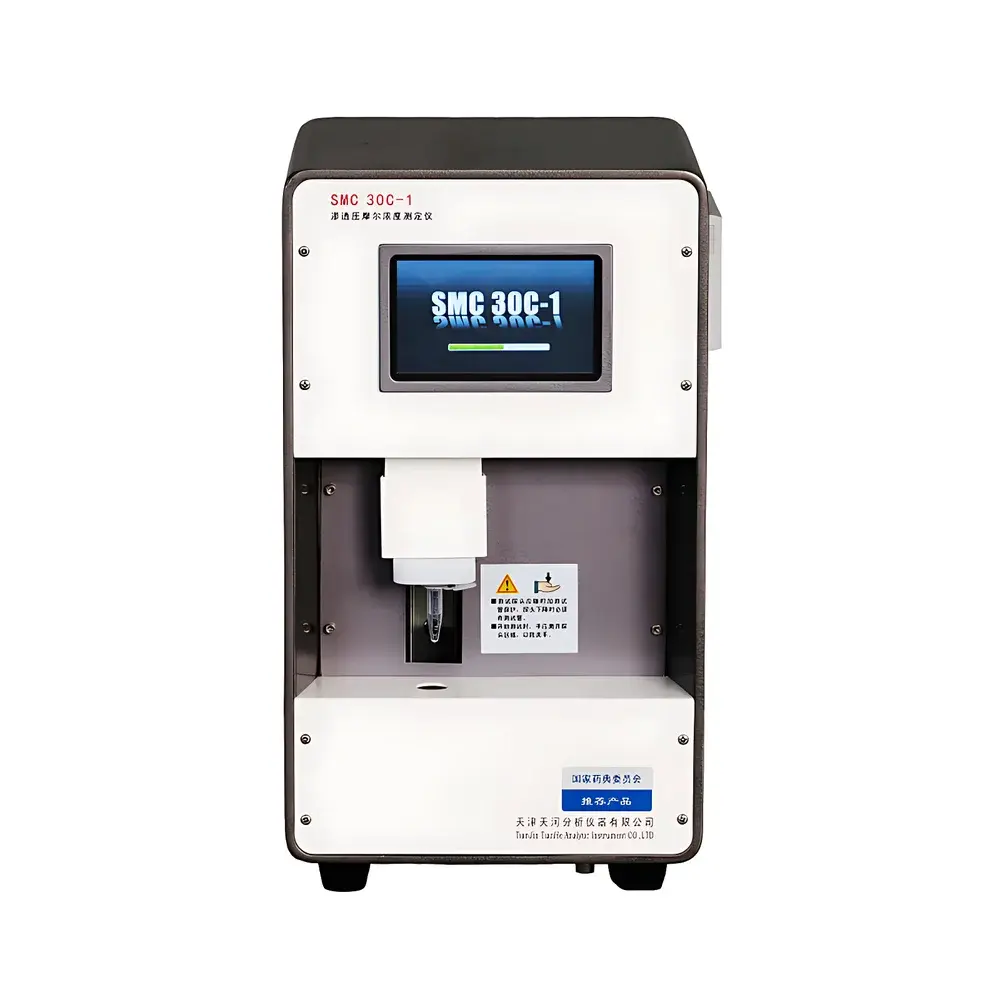
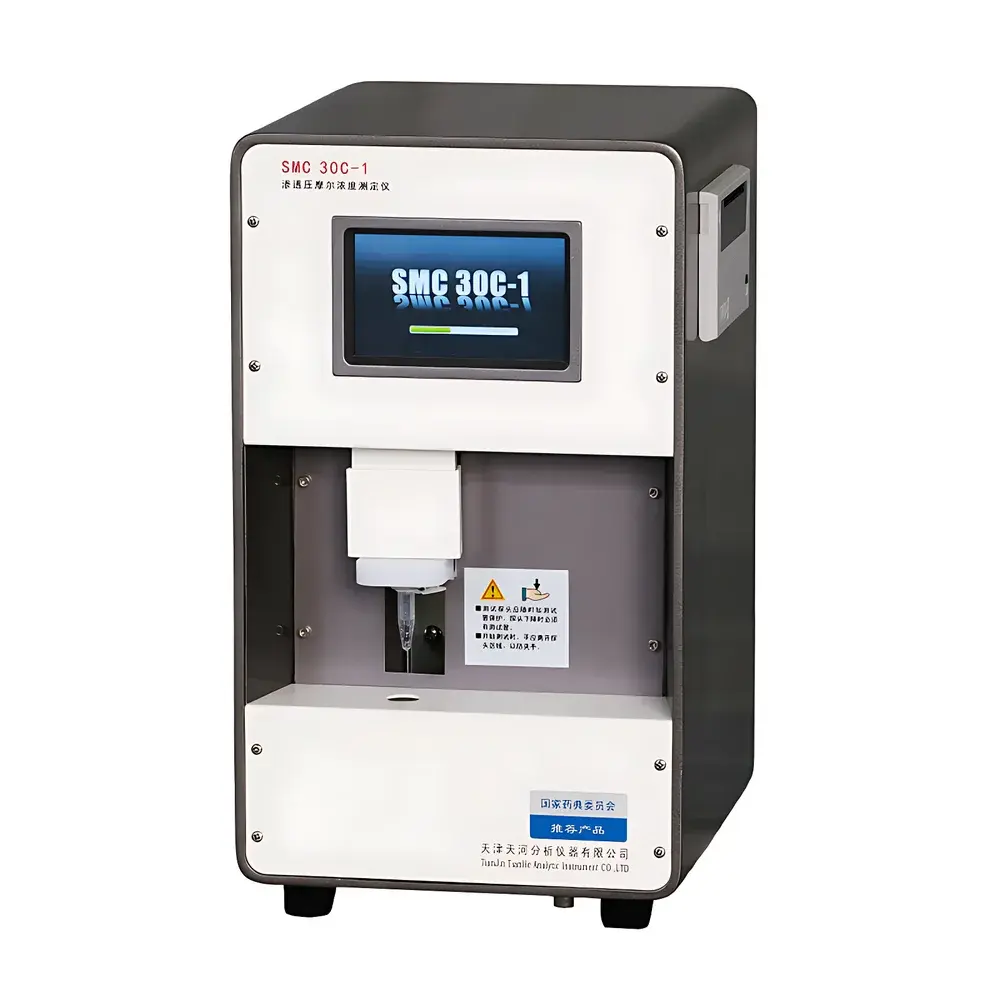
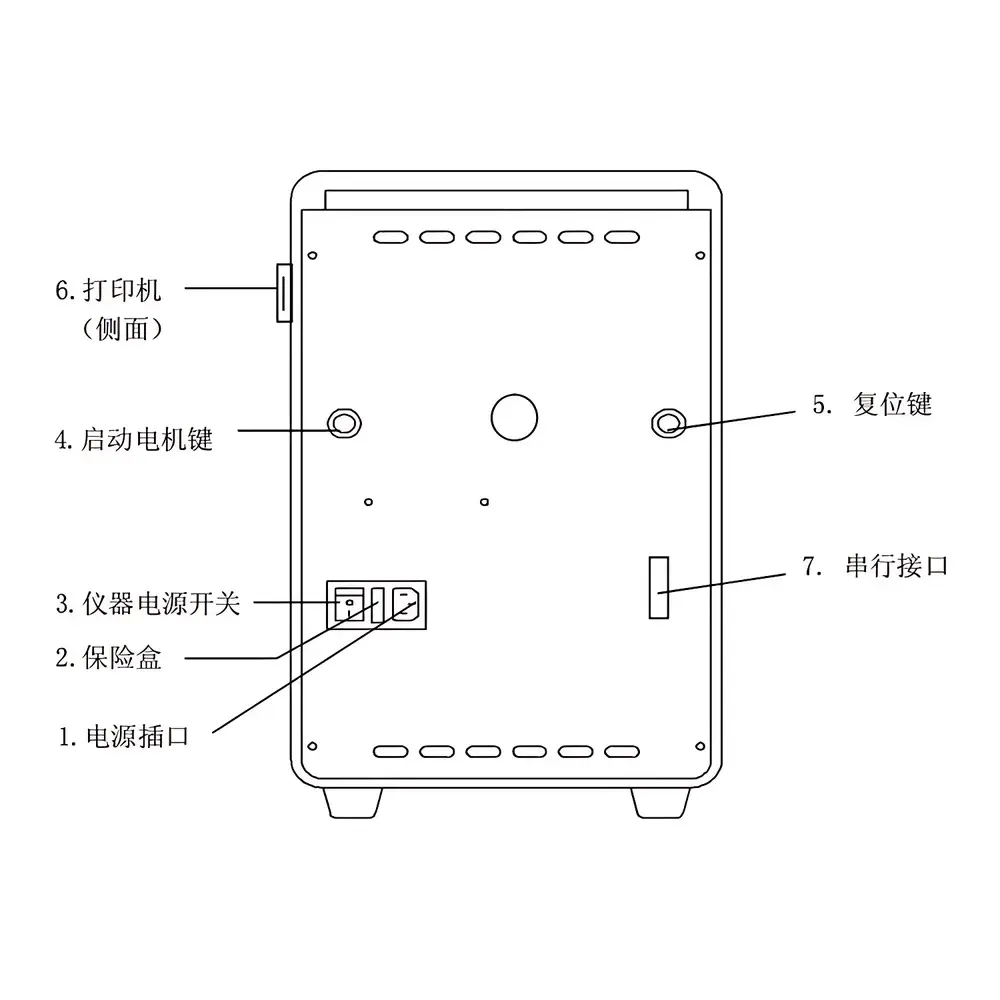

Tianhe SMC 30C-1 Cryoscopic Osmometer
| Brand | Tianhe |
|---|---|
| Origin | Tianjin, China |
| Model | SMC 30C-1 |
| Measurement Principle | Freezing Point Depression |
| Range | 0–3000 mOsmol/kg H₂O |
| Sample Volume | 50–70 µL |
| Test Time | < 2 min |
| Pre-cooling Time | ≤ 3 min |
| Repeatability | RSD ≤ ±1% (at 300 mOsmol/kg) |
| Accuracy | ±2 mOsmol/kg (≤ 400 mOsmol/kg) |
| Resolution | 1 mOsmol/kg |
| Linearity | < 1% deviation from linear fit |
| Ambient Temp. | 10–30 °C |
| Ambient Humidity | 5–80% RH |
| Power Supply | AC 220 V ±10%, 80 W |
| Dimensions | 220 × 210 × 360 mm |
Overview
The Tianhe SMC 30C-1 Cryoscopic Osmometer is a benchtop analytical instrument engineered for precise and reproducible measurement of osmolality in aqueous pharmaceutical solutions, biological fluids, and cell culture media. It operates on the fundamental thermodynamic principle of freezing point depression—a colligative property directly proportional to the total concentration of solute particles in solution. By detecting the temperature at which a sample transitions from liquid to solid phase with high-resolution thermal sensing, the SMC 30C-1 calculates osmotic concentration in milliosmoles per kilogram of water (mOsmol/kg H₂O). Designed specifically for compliance-driven environments—including QC laboratories in biopharmaceutical manufacturing, contract testing organizations (CTOs), and academic research facilities—the instrument delivers regulatory-grade data integrity without requiring cryogenic refrigerants or complex maintenance protocols.
Key Features
- Integrated dual-stage thermoelectric cooling system enabling rapid pre-cooling (≤ 3 minutes) and consistent sub-zero measurement stability—eliminating reliance on external coolant loops or hazardous heat-transfer fluids.
- High-precision platinum resistance thermometer (PRT) sensor with 1 mOsmol/kg resolution and validated accuracy per ISO 17511 and USP <785> guidelines.
- Intuitive 7-inch capacitive touchscreen interface with native Chinese language support and context-aware navigation—optimized for operator efficiency in GMP-aligned workflows.
- Motor-assisted probe lift mechanism ensures repeatable sample immersion depth and minimizes mechanical drift during freeze-point detection cycles.
- Onboard calibration management supporting multi-point linear verification (2-point and extended n-point) with traceable reference standards (e.g., NaCl and sucrose solutions).
- Built-in pharmacopeial database containing over 300 injectable drug monographs from the Chinese Pharmacopoeia (ChP), enabling rapid method setup and batch-specific parameter recall.
- Automated data logging with time-stamped records, audit trail capability, and configurable export formats (CSV, PDF, XML) compliant with FDA 21 CFR Part 11 requirements when deployed with validated LIMS integration.
Sample Compatibility & Compliance
The SMC 30C-1 accommodates low-volume samples (50–70 µL), making it suitable for precious clinical specimens (e.g., cerebrospinal fluid, tear film, small-volume parenteral preparations) and early-stage formulation candidates. Its measurement range (0–3000 mOsmol/kg H₂O) covers physiological fluids (275–295 mOsmol/kg), hypertonic IV solutions (up to 1200+ mOsmol/kg), and lyophilized reconstitution buffers. The system conforms to key international standards including ISO 29990:2010 (for osmometer validation), USP <785> “Osmolality”, EP 2.2.35, and ChP General Chapter 0412. All firmware and software modules are designed to support GLP/GMP documentation practices, including electronic signature capture, user access control, and change history tracking.
Software & Data Management
Embedded microcontroller architecture supports real-time signal processing, automatic baseline correction, and dynamic noise filtering during crystallization event detection. Data storage includes internal non-volatile memory (≥ 10,000 test records) with optional USB export or Ethernet connectivity for centralized laboratory information management systems (LIMS). Software features include customizable report templates (A4/Letter), barcode-assisted sample ID entry, and seamless synchronization with enterprise platforms via HL7 or ASTM E1384-compliant interfaces. Audit trails record all critical events—including calibration actions, user logins, parameter modifications, and result exports—with immutable timestamps and operator attribution.
Applications
- Quality control release testing of sterile injectables, ophthalmic solutions, and dialysis fluids per pharmacopeial specifications.
- Stability-indicating assay for freeze-thaw cycle evaluation of monoclonal antibody formulations and viral vector suspensions.
- Osmolality profiling during buffer optimization in upstream and downstream bioprocessing stages.
- Clinical research applications including renal function assessment, dehydration monitoring, and neonatal electrolyte balance studies.
- Academic and regulatory method development where traceable, first-principle-based osmolality quantification is required over vapor pressure or membrane-based alternatives.
FAQ
What measurement principle does the SMC 30C-1 use?
It employs cryoscopic (freezing point depression) analysis, a primary reference method recognized by USP, EP, and ChP for osmolality determination.
Is the instrument compliant with FDA 21 CFR Part 11?
Yes—when configured with enabled electronic signature, audit trail, and role-based access controls, it meets Part 11 requirements for electronic records and signatures in regulated environments.
Can it measure viscous or protein-rich samples?
Yes—its optimized thermal kinetics and adaptive crystallization detection algorithm accommodate samples with moderate viscosity (up to ~25 cP) and protein concentrations typical of therapeutic mAb formulations (≤ 150 mg/mL).
Does it require routine recalibration with certified standards?
Calibration verification using NIST-traceable osmotic reference materials is recommended before each analytical session or per SOP-defined intervals (e.g., daily or per batch), in accordance with ISO/IEC 17025 and ICH Q2(R2).
How is data integrity ensured during networked operation?
All network communications utilize TLS 1.2 encryption; data packets are digitally signed, and server-side backups enforce version-controlled retention policies aligned with ALCOA+ principles (Attributable, Legible, Contemporaneous, Original, Accurate, Complete, Consistent, Enduring, Available).





