
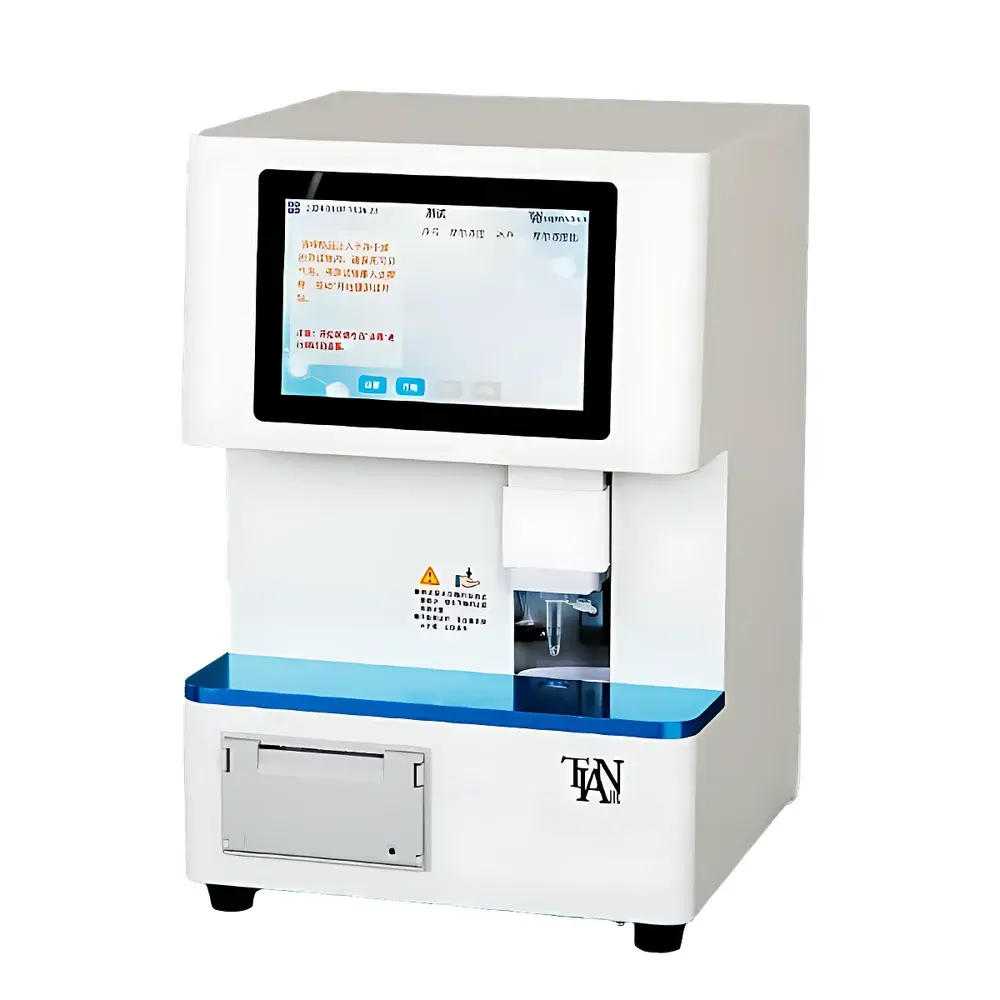
Tianhe SMC 30FS Freezing Point Osmometer
| Brand | Tianhe |
|---|---|
| Origin | Tianjin, China |
| Model | SMC 30FS |
| Measurement Principle | Freezing Point Depression |
| Temperature Control System | Dual-stage Peltier Cooling |
| Sample Volume | 50–100 µL |
| Calibration | Multi-point, User-defined Calibration Curves |
| Operating System | Android-based Embedded OS |
| Data Storage | Internal SSD with >100,000 Test Record Capacity |
| Compliance Features | Audit Trail, Electronic Signature (21 CFR Part 11 Ready), Role-Based Access Control |
| Connectivity | RS232, USB Host (for keyboard/mouse/scanner), Built-in Thermal Printer |
| Noise Level | <45 dB(A) |
| Pharmacopeia Integration | Preloaded Chinese Pharmacopoeia (ChP) Monographs for >300 Injectable Products |
| Maintenance | Dry-Cooling Architecture (No Heat Transfer Fluid Required) |
Overview
The Tianhe SMC 30FS Freezing Point Osmometer is a fully automated, regulatory-compliant instrument engineered for precise and reproducible osmolality measurement in pharmaceutical quality control, clinical laboratories, and biologics development. It operates on the thermodynamic principle of freezing point depression—a colligative property directly proportional to solute concentration—enabling accurate quantification of total osmotically active particles in aqueous solutions. Designed specifically for parenteral drug products, sterile injectables, ophthalmic solutions, and cell culture media, the SMC 30FS delivers high-resolution detection down to 1 mOsm/kg with excellent inter- and intra-run repeatability (CV < 1.5% at 300 mOsm/kg). Its dual-stage Peltier cooling architecture eliminates reliance on volatile or maintenance-intensive heat transfer fluids, ensuring stable thermal equilibrium and minimizing drift during extended operation.
Key Features
- Android-based embedded operating system offering intuitive touchscreen navigation, secure firmware updates, and long-term OS stability without third-party dependencies.
- Dual independent Peltier modules enable rapid sample pre-cooling (<90 seconds to −7 °C) and precise freezing point determination with ±0.002 °C temperature resolution.
- Motorized probe lift mechanism ensures consistent immersion depth and eliminates manual handling errors—critical for GLP/GMP environments.
- Real-time graphical display of cooling curve, nucleation event, and crystallization plateau allows visual verification of assay integrity during each run.
- Dry-cooling design removes requirement for silicone oil or glycol circulation, eliminating contamination risk, fluid degradation, and scheduled maintenance downtime.
- Preloaded ChP database includes over 300 monograph entries for injectables (e.g., sodium chloride injection, glucose injection, heparin sodium), enabling one-touch method selection and batch-specific parameter recall.
- Role-based user authentication with configurable permission levels (Administrator, Analyst, Reviewer) enforces data governance and operational accountability.
Sample Compatibility & Compliance
The SMC 30FS accommodates standard 1.5 mL microcentrifuge tubes and custom-labeled vials, supporting sample volumes from 50 µL to 100 µL—ideal for precious biologics formulations and small-volume clinical specimens. It complies with core pharmacopeial requirements including ChP General Chapter 0632, USP , and EP 2.2.36. Audit trail functionality records all critical events—including user logins, method edits, calibration actions, result modifications, and electronic signature application—with immutable timestamps and operator IDs. The system supports 21 CFR Part 11 readiness through integrated electronic signature workflows, mandatory reason-for-change fields, and exportable audit logs in CSV or PDF/A format.
Software & Data Management
Data integrity is maintained via local SSD storage capable of retaining ≥100,000 test records with full metadata (sample ID, operator, timestamp, raw cooling curve, calibration ID, instrument status flags). Export options include CSV (for LIMS integration), PDF reports with embedded chromatograms, and XML formatted outputs compatible with enterprise QMS platforms. RS232 serial output enables direct connection to laboratory information systems (LIS) or supervisory SCADA networks. USB host ports support peripheral expansion—including barcode scanners for sample ID capture, external keyboards for alphanumeric entry, and wireless mice for ergonomic operation in laminar flow hoods.
Applications
- Final product release testing of IV admixtures, lyophilized reconstituted drugs, and monoclonal antibody formulations.
- In-process monitoring of buffer exchange steps during downstream purification (e.g., dialysis, TFF).
- Stability study support per ICH Q5C, tracking osmolality shifts across accelerated and real-time storage conditions.
- Clinical lab quantification of serum, urine, and cerebrospinal fluid osmolality for diagnostic evaluation of electrolyte imbalance and renal function.
- Raw material qualification of excipients such as glycine, trehalose, and polysorbates where residual solvent or counterion content affects tonicity.
FAQ
Does the SMC 30FS support multi-point calibration with non-linear curve fitting?
Yes—it allows up to five user-defined calibration standards, with automatic quadratic or cubic regression applied to generate sample-specific response curves.
Is the instrument suitable for ISO 17025-accredited laboratories?
Yes—its documented traceable calibration procedure, uncertainty budgeting tools, and full audit trail meet ILAC-G8 and ISO/IEC 17025:2017 clause 7.7 requirements for measurement traceability and data integrity.
Can historical data be migrated to a new instrument or central server?
Yes—exported datasets retain native structure and metadata; batch migration tools are available via Tianhe’s LabLink utility software (v3.2+).
What validation documentation is supplied with the system?
Factory-issued IQ/OQ protocols, certified reference material certificates (CRM), and a complete Design Qualification (DQ) summary are included in the delivery package.
How often does the system require recalibration or performance verification?
Per ChP and internal SOP guidance, daily system suitability testing using two certified reference standards (e.g., 0 mOsm/kg and 300 mOsm/kg) is recommended prior to use.




