
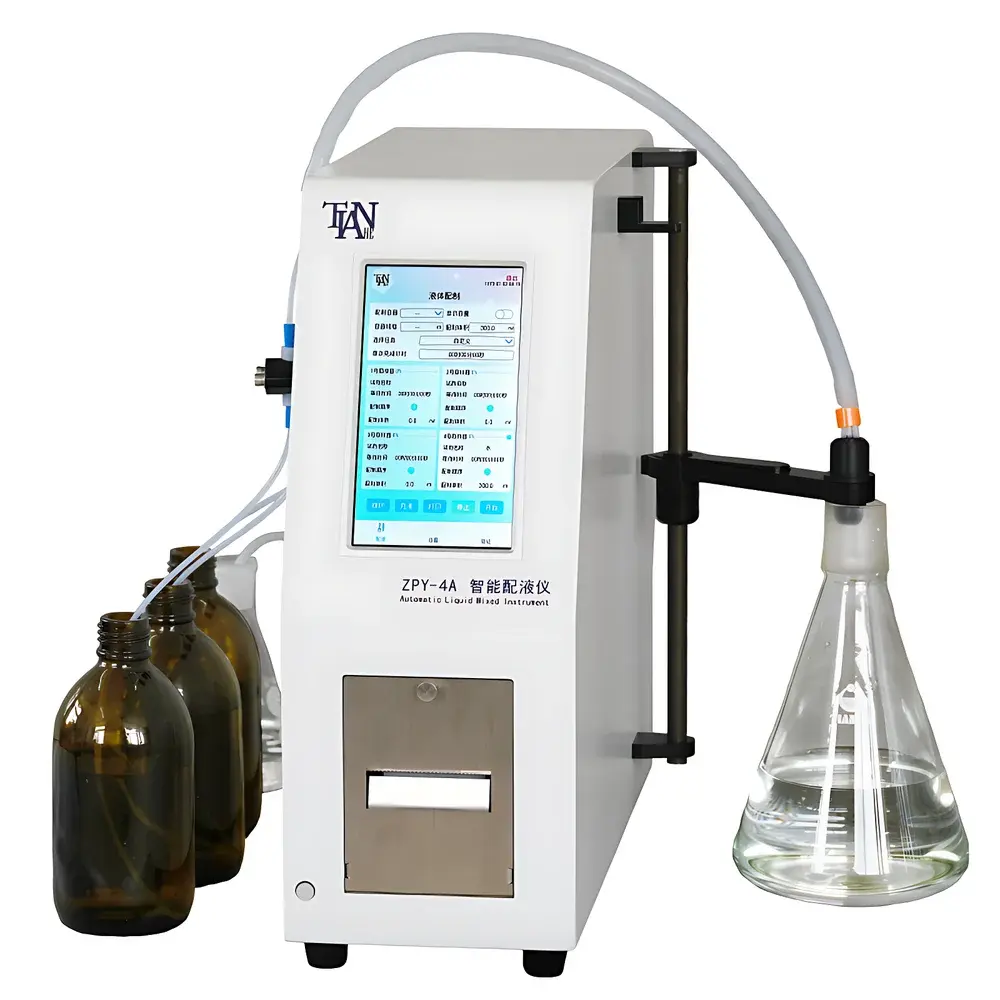
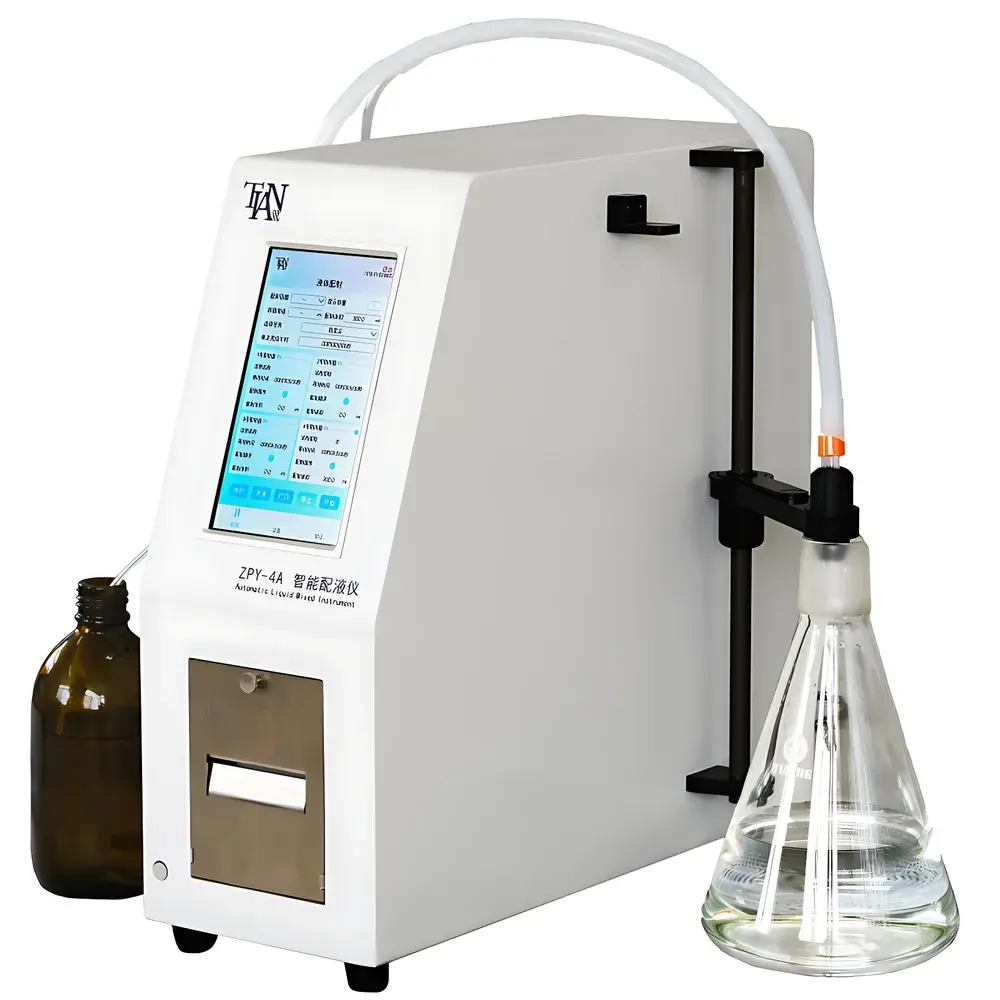
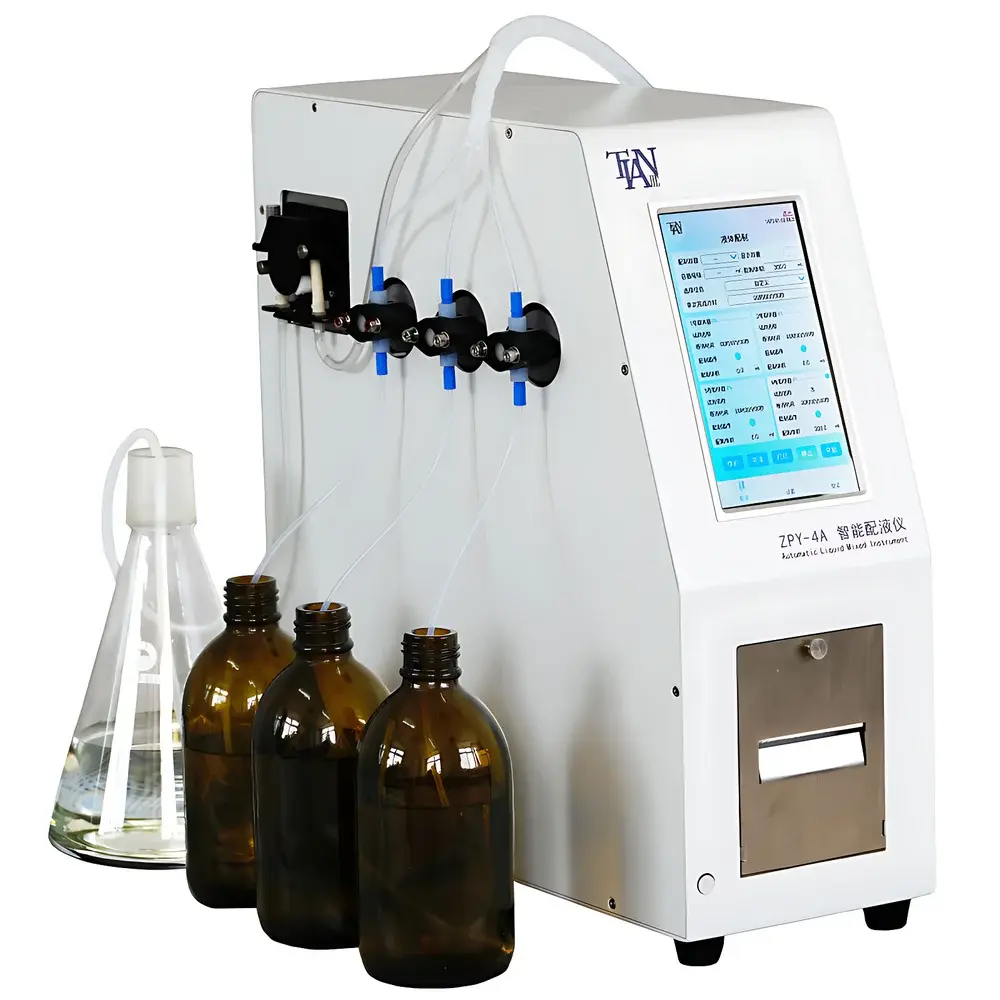

Tianhe ZPY-4A Automated Liquid Dispensing Workstation
| Brand | Tianhe |
|---|---|
| Origin | Tianjin, China |
| Model | ZPY-4A |
| Dispensing Accuracy | ±1% (at 5 mL, metering pump) |
| Dispensing Range | 100 µL – 9999 mL |
| Sample Throughput | 1–3 independent metering pump channels + 1 peristaltic pump channel |
| Dispensing Volume Resolution | 10 µL |
| Pump Speed | Metering Pump: 0.5–200 mL/min |
| Peristaltic Pump | 100–500 mL/min |
| Power Supply | 100–240 VAC, 50/60 Hz, 75 W |
| Operating Temperature | 10–40 °C |
| Fluid Compatibility | Organic and inorganic solvents (compatible with PTFE, PVDF, 316L stainless steel, and zirconia ceramic wetted materials) |
| System OS | Android-based embedded interface |
| Wetted Materials | PTFE, PVDF, 316L SS, zirconia ceramic |
Overview
The Tianhe ZPY-4A Automated Liquid Dispensing Workstation is an engineered solution for precise, repeatable, and scalable liquid handling in analytical, formulation, and quality control laboratories. Designed around a dual-pump architecture—integrating high-accuracy metering pumps with a robust peristaltic pump—the system supports volumetric dispensing across four orders of magnitude (10 µL to 9999 mL) while maintaining traceable calibration and consistent fluid path integrity. Its operation is grounded in positive displacement volumetric delivery, where metering pumps provide gravimetrically verified accuracy (±1% at 5 mL), and the peristaltic pump delivers higher-flow, lower-precision transfers (±3%) suitable for bulk diluent or wash steps. The workstation operates under an embedded Android-based HMI, enabling intuitive touchscreen navigation, protocol storage, and real-time status monitoring without reliance on external PCs. All fluidic pathways are constructed from chemically inert, USP Class VI–compliant materials—including PTFE tubing, PVDF manifolds, 316L stainless steel fittings, and zirconia ceramic valves—ensuring long-term compatibility with aggressive organic solvents (e.g., DMSO, acetone, THF), strong acids (HCl, HNO₃), and alkaline solutions (NaOH, KOH).
Key Features
- Modular dual-pump architecture: Configurable with 1–3 independently controlled metering pump channels and one dedicated peristaltic pump channel for parallel or sequential dispensing workflows.
- Chemically resistant fluid path: Full-wetted components certified for continuous exposure to corrosive, volatile, and high-viscosity liquids—validated per ASTM D543 and ISO 10993-5 biocompatibility guidelines.
- Android-based embedded control system: 7-inch capacitive touchscreen with offline protocol editing, versioned method storage (up to 200 user-defined methods), and USB export of audit-ready logs.
- Independent sample routing: Each metering pump features isolated inlet/outlet tubing paths with non-return valves and air-gap aspiration logic to eliminate carryover and cross-contamination between samples.
- Flexible dispensing modes: Supports single-step volume delivery, multi-step serial dilution, gradient mixing, and fixed-ratio reagent blending—all programmable via intuitive drag-and-drop interface.
- Thermal and electrical safety compliance: CE-marked per IEC 61010-1; meets EN 61326-1 for electromagnetic compatibility in laboratory environments.
Sample Compatibility & Compliance
The ZPY-4A accommodates a broad spectrum of liquid samples—from aqueous buffers and cell culture media to anhydrous organics and concentrated electrolytes—without degradation of accuracy or tubing integrity. Its material set conforms to FDA-recommended contact surfaces for pharmaceutical manufacturing (21 CFR Part 211), and its closed-loop dispensing design supports GLP-compliant documentation when paired with external LIMS integration. While not inherently 21 CFR Part 11–compliant out-of-the-box, the system’s timestamped log files (including operator ID, method name, start/stop time, and dispense volume per channel) can be exported in CSV or PDF format for manual audit trail reconstruction. It meets ISO/IEC 17025 requirements for volumetric measurement uncertainty when calibrated using NIST-traceable standards.
Software & Data Management
The onboard Android OS hosts a purpose-built application supporting method creation, parameter validation, and execution logging. Users define dispensing sequences with up to 99 steps per protocol, assign pump-specific flow rates and pause durations, and enable automatic priming and purge cycles. All executed runs generate immutable records containing date/time stamps, actual delivered volumes (calculated from pump encoder counts and factory calibration curves), and system health flags (e.g., pressure anomaly, tubing occlusion). Data export occurs via USB 2.0 or optional Wi-Fi module (IEEE 802.11 b/g/n); no cloud synchronization is performed by default, preserving data sovereignty. Audit trails comply with ALCOA+ principles when exported and archived externally.
Applications
- Standard solution preparation for HPLC, GC, and ICP-MS calibration curves.
- Formulation development in pharmaceutical R&D, including buffer exchange, excipient blending, and dose-linearity testing.
- QC lab workflows requiring reproducible dilution series for ELISA, spectrophotometry, and titration.
- Automated reagent loading for automated analyzers (e.g., clinical chemistry platforms) and microplate-based assays.
- Environmental testing labs preparing spiked wastewater or soil extract standards across wide concentration ranges.
FAQ
Is the ZPY-4A compatible with viscous liquids such as glycerol or ethylene glycol?
Yes—metering pump performance has been validated up to 1000 cP at 25 °C using calibrated viscosity standards; reduced flow rates and extended dwell times are recommended above 500 cP.
Can dispensing accuracy be verified in-house without external calibration services?
Yes—gravimetric verification is supported using Class A volumetric flasks and analytical balances (0.1 mg resolution); built-in calibration mode guides users through multi-point volume checks per channel.
Does the system support integration with laboratory information management systems (LIMS)?
Direct API integration is not provided, but CSV-formatted run logs and method definitions can be imported/exported for manual LIMS ingestion or custom middleware deployment.
What maintenance intervals are recommended for tubing and seals?
PTFE tubing should be inspected every 200 hours of operation and replaced every 500 hours under continuous use; zirconia ceramic valves require no scheduled replacement but benefit from quarterly cleaning with isopropanol.
Is remote monitoring or control possible?
Remote access is limited to local network file transfer (SFTP or SMB) for log retrieval; no VNC or web-based remote desktop functionality is implemented for security and regulatory reasons.



