
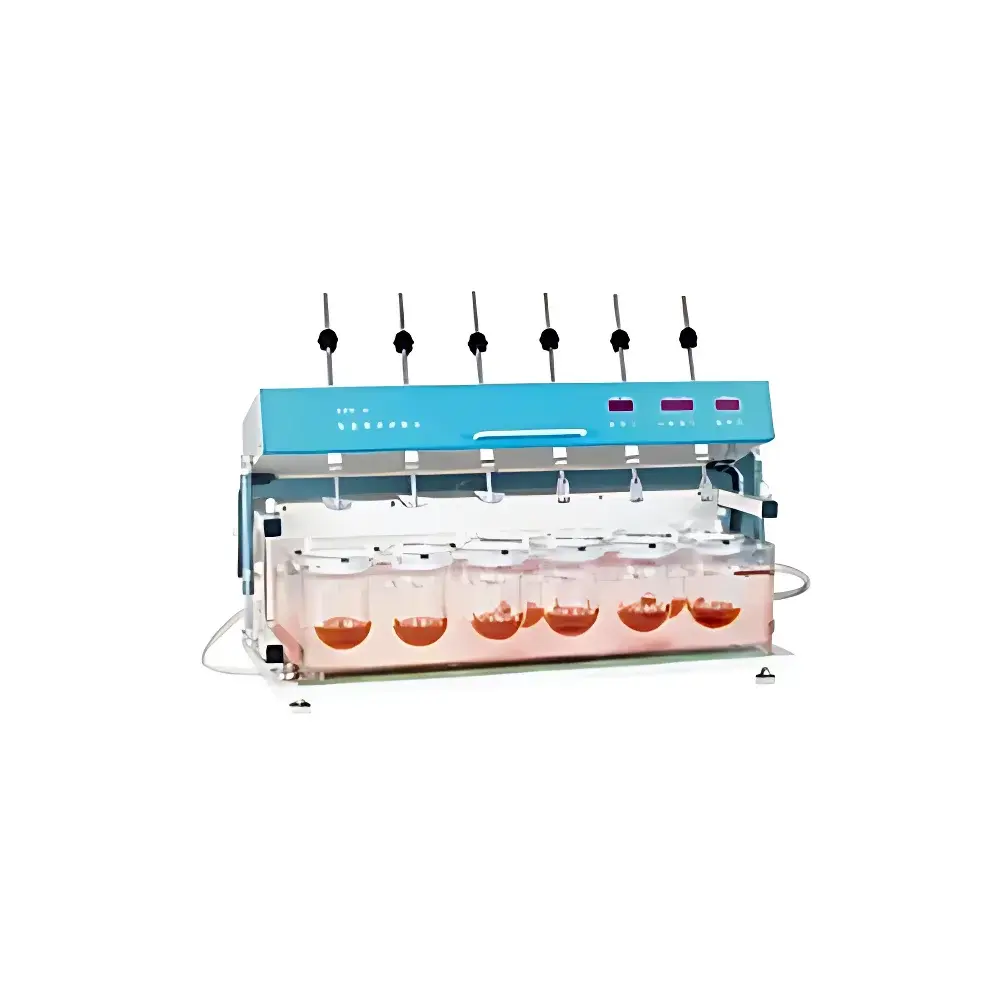

Tianhe ZRS-8G Offline Dissolution Tester
| Brand | Tianhe |
|---|---|
| Origin | Tianjin, China |
| Model | ZRS-8G |
| Instrument Type | Offline Dissolution Tester |
| Number of Vessels | 6 |
| Temperature Range | 5.0 °C (ambient) to 45.0 °C |
| Temperature Accuracy | ≤ ±0.3 °C |
| Temperature Resolution | 0.1 °C |
| Rotational Speed Range | 25–200 rpm |
| Speed Resolution | 1 rpm |
| Speed Stability Error | ≤ ±4% |
| Paddle Wobble Amplitude | ≤ 0.5 mm |
| Basket Wobble Amplitude | ≤ 1.0 mm |
| Shaft-to-Vessel Axis Offset | ≤ 2.0 mm |
| Timer Duration | Up to 99 h 59 min (forward count) |
| Sampling Cycles | Up to 9 programmable cycles |
| Sampling Interval per Cycle | Up to 9 h 59 min (countdown) |
Overview
The Tianhe ZRS-8G is a benchtop offline dissolution tester engineered for compliance with pharmacopeial standards including USP , EP 2.9.3, and JP 17 General Chapter 6.1. It operates on the principle of paddle or basket agitation within standardized dissolution vessels, enabling quantitative assessment of drug release kinetics from solid oral dosage forms—including tablets, capsules, and controlled-release formulations—under controlled hydrodynamic and thermal conditions. Designed for routine quality control laboratories in pharmaceutical manufacturing and contract research organizations (CROs), the ZRS-8G delivers reproducible mechanical performance across all six vessels without integrated sampling or UV analysis, requiring manual sample collection at predefined time points. Its architecture prioritizes mechanical stability, thermal uniformity, and operational traceability—critical attributes for regulatory submissions and batch release testing under GMP environments.
Key Features
- Six independent dissolution vessels accommodates either paddle or basket assemblies, supporting concurrent multi-formulation or multi-timepoint studies.
- Height-optimized vessel chamber accepts standard 185 mm-tall USP-compliant dissolution cups, ensuring full immersion of baskets and proper paddle clearance.
- Intuitive membrane keypad interface with LCD display enables direct parameter entry; all settings—including speed, temperature, timer, and sampling schedule—are non-volatile and retained after power cycling.
- Precision-machined drive shafts and low-backlash gear trains minimize mechanical wobble: paddle radial deviation ≤ 0.5 mm, basket radial deviation ≤ 1.0 mm, and shaft-to-vessel centerline offset ≤ 2.0 mm—meeting USP mechanical calibration requirements.
- Microprocessor-controlled PID heating system maintains bath temperature within ±0.3 °C across the full 5.0–45.0 °C range, with 0.1 °C resolution and uniformity verified per USP .
- Programmable timing engine supports up to nine discrete sampling cycles, each configurable with independent countdown intervals (max 9 h 59 min), facilitating complex release profile protocols such as delayed-onset or pulsatile dissolution.
Sample Compatibility & Compliance
The ZRS-8G is validated for use with USP Apparatus 1 (basket) and Apparatus 2 (paddle), accommodating dosage forms up to 25 mm in diameter and standard gelatin or HPMC capsules. Vessel geometry conforms to USP-specified dimensions (1000 mL capacity, cylindrical shape, flat bottom), and the system supports deaerated dissolution media preparation per USP guidance. While the instrument itself does not perform analytical quantification, its mechanical and thermal outputs are fully compatible with downstream HPLC, UV-Vis, or LC-MS workflows. Documentation packages—including IQ/OQ templates, mechanical verification checklists, and calibration logs—align with FDA 21 CFR Part 11 data integrity expectations when paired with controlled laboratory procedures and audit-trail-enabled electronic records.
Software & Data Management
The ZRS-8G operates as a standalone hardware platform with no embedded PC or proprietary software stack. All operational parameters are configured locally via the front-panel interface, and no data export capability is built-in—consistent with its classification as an offline tester. Users maintain test records manually or integrate the device into broader LIMS or ELN ecosystems through external time-stamped logbooks and procedural SOPs. For laboratories implementing computerized systems, the ZRS-8G’s deterministic behavior (e.g., fixed timer resolution, repeatable speed ramps, stable thermal setpoints) supports validation under ICH Q9 and ASTM E2500-18. Calibration certificates for temperature probes and tachometers are recommended annually and traceable to NIST or equivalent national metrology institutes.
Applications
- Comparative dissolution profiling of generic versus reference listed drugs (RLD) per FDA guidance.
- In-process testing during formulation development to assess excipient effects on release rate.
- Stability-indicating dissolution method verification for extended-release products.
- Batch release testing in compliance with pharmacopeial monographs and internal quality specifications.
- Supporting ANDA submissions with documented mechanical calibration, temperature mapping, and system suitability data.
- Training platforms for USP dissolution methodology in academic and regulatory training programs.
FAQ
Is the ZRS-8G compliant with USP and ?
Yes—the mechanical tolerances, vessel geometry, and thermal performance meet all mandatory criteria specified in USP General Chapters (Dissolution) and (Drug Release).
Does it support automatic sampling?
No. The ZRS-8G is strictly an offline dissolution apparatus; sample collection must be performed manually at user-defined intervals.
Can it be used with sinkers or special accessories?
Yes—provided accessories comply with USP dimensional and material specifications (e.g., stainless steel sinkers, conical baskets), and do not exceed the maximum vessel height or interfere with paddle/basket clearance.
What documentation is provided for qualification?
Standard delivery includes mechanical verification tools, operation manual, and factory calibration reports for temperature and rotational sensors—sufficient for IQ/OQ execution per GMP Annex 15.
Is temperature mapping required for validation?
Yes. Per USP , spatial temperature uniformity across all six vessels must be verified at operating setpoints (e.g., 37.0 °C); a minimum of nine-point mapping per vessel is recommended.





