
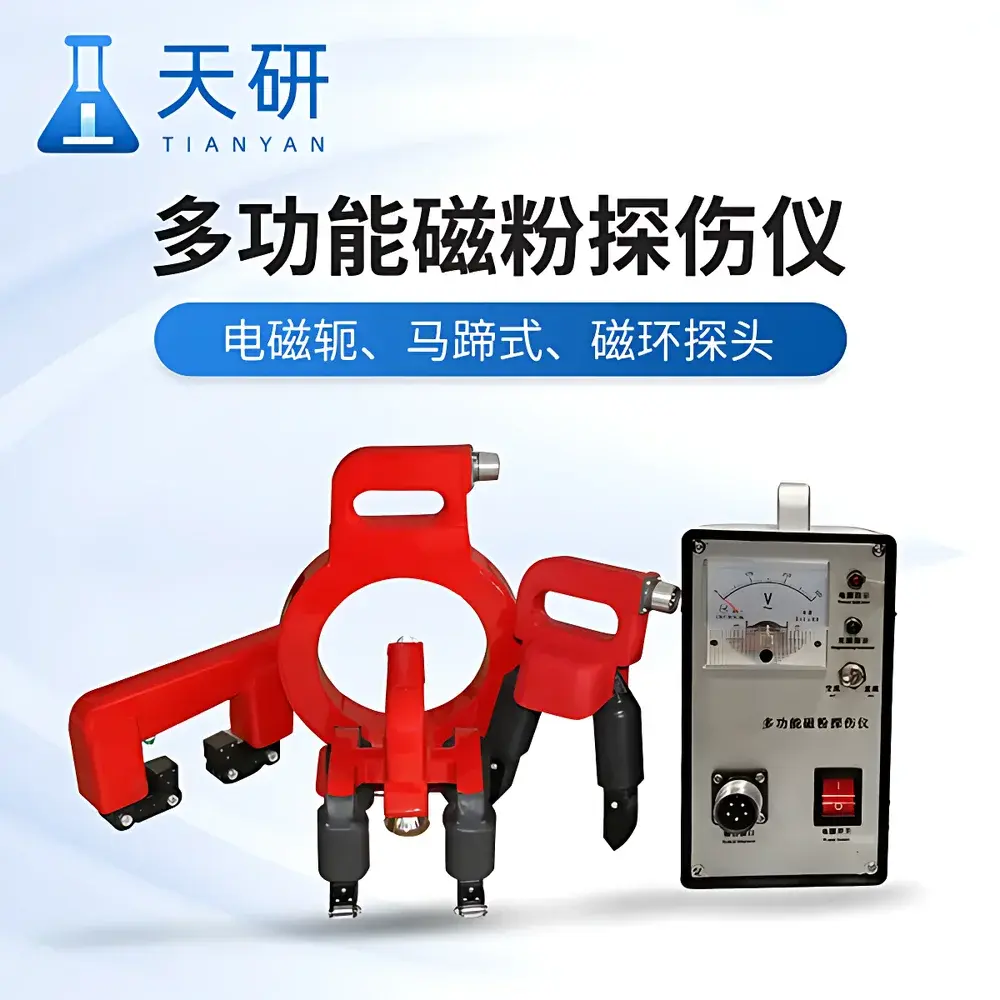
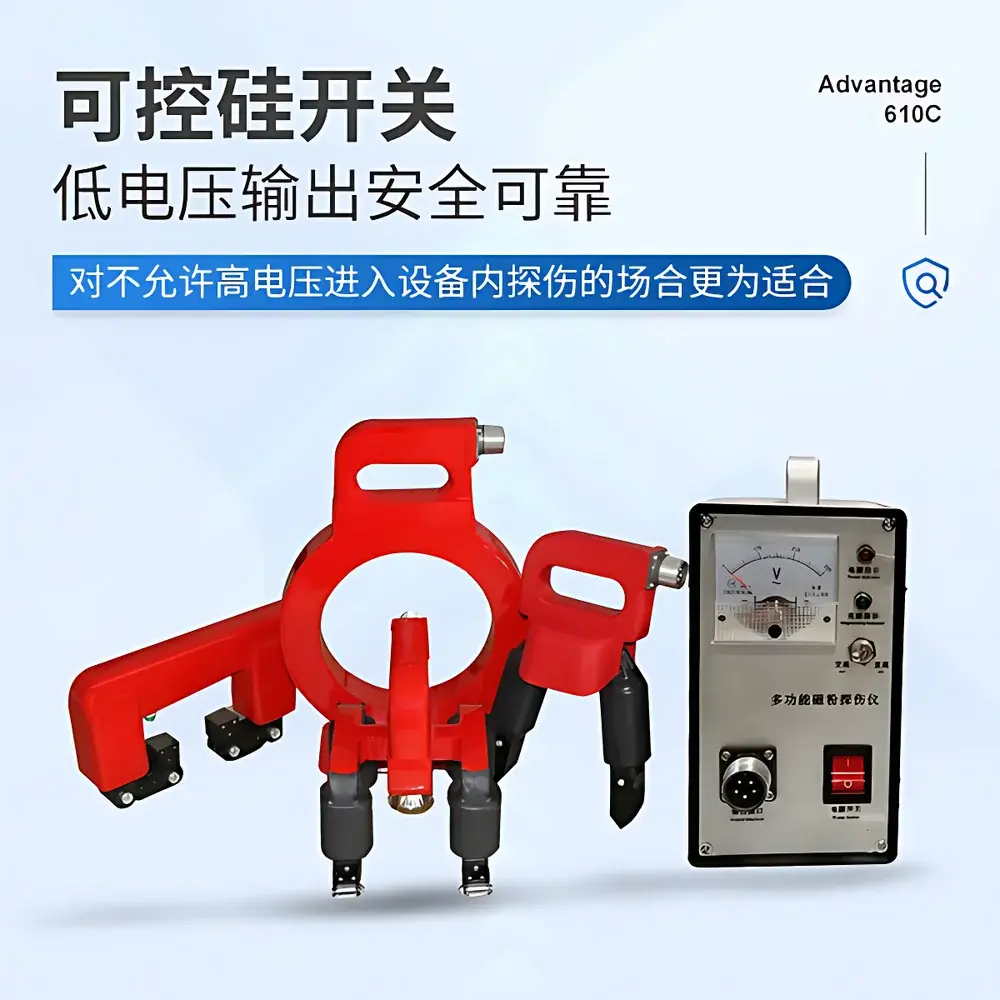
Tianyan TY-610C Portable Electromagnetic Yoke & Magnetic Ring MPI Unit
| Brand | Tianyan |
|---|---|
| Origin | Shandong, China |
| Manufacturer Type | Direct Manufacturer |
| Model | TY-610C |
| Input Voltage | AC 220 V ±10% |
| Output Voltage | AC 36 V |
| Output Current | >10 A |
| Lifting Force | ≥5 kgf |
| Duty Cycle | 50% |
| Sensitivity | Clear indication of ASTM E1444-compliant A1-30/100 shims |
| Yoke Pole Spacing | 0–250 mm (adjustable) |
| Hoof-Type Probe Pole Spacing | 0–160 mm |
| Magnetic Ring ID | Φ150 mm, 1800 TA |
| Dimensions (L×H×W) | 230 × 160 × 120 mm |
| Weight | 5 kg |
| Safety | Low-voltage isolated output, grounded chassis, SCR-based solid-state switching |
Overview
The Tianyan TY-610C is a compact, field-deployable electromagnetic yoke and magnetic ring unit designed for surface and near-surface discontinuity detection in ferromagnetic materials using the magnetic particle inspection (MPI) method. It operates on the principle of induced magnetization: when an alternating current passes through the electromagnetic yoke or magnetic ring coil, it generates a controlled, time-varying magnetic field within the test piece. Surface-breaking or subsurface flaws—such as fatigue cracks, grinding burns, or weld discontinuities—distort this field, forming leakage fields that attract ferromagnetic particles (dry or wet suspension), rendering defects visually detectable under appropriate lighting (white light or UV-A, depending on particle type). Unlike high-voltage AC units, the TY-610C employs a low-voltage (36 V AC) secondary output, eliminating risk of electric shock during contact inspection and enabling safe use in confined, grounded, or intrinsically hazardous environments—including pressure vessels, pipeline girth welds, and aerospace structural components where isolation from mains potential is mandated.
Key Features
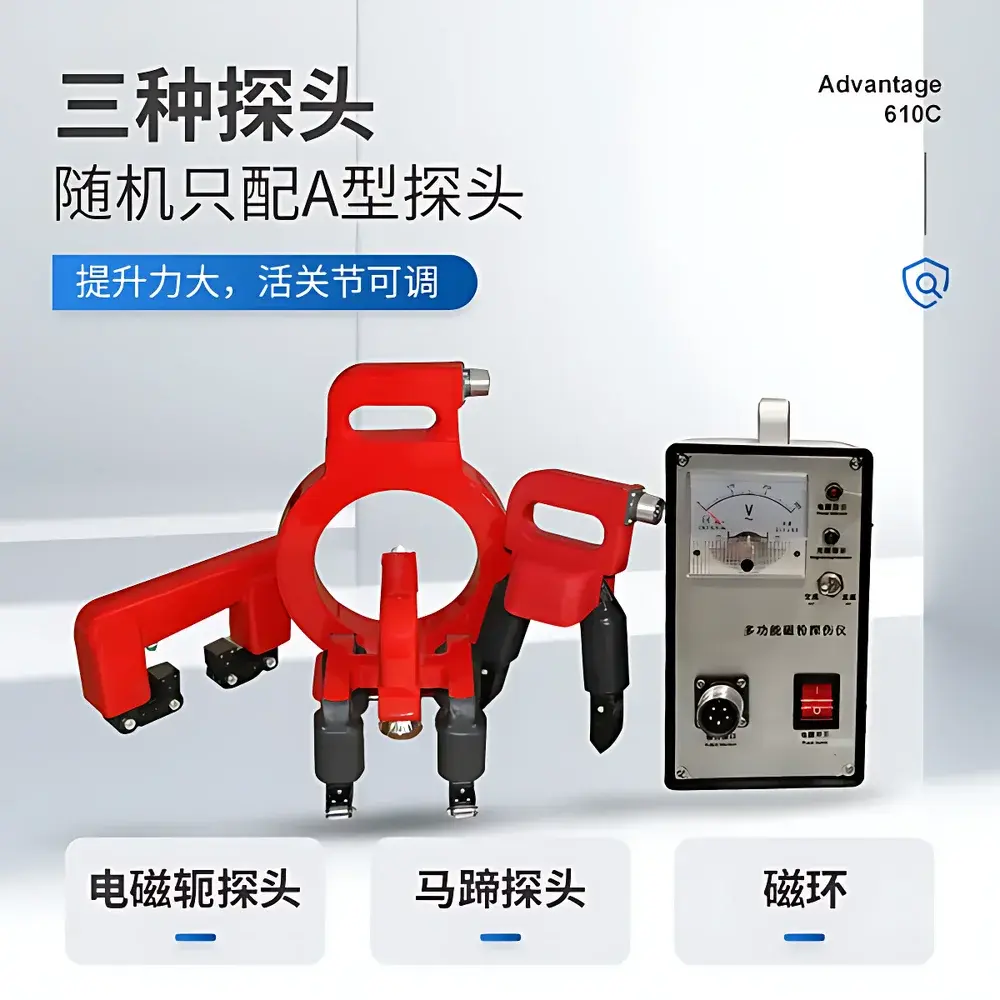
- Three interchangeable probe configurations: adjustable electromagnetic yoke (0–250 mm pole spacing), articulated hoof-type probe (0–160 mm), and fixed-diameter magnetic ring (Φ150 mm, 1800 ampere-turns), supporting both longitudinal and circular magnetization modes.
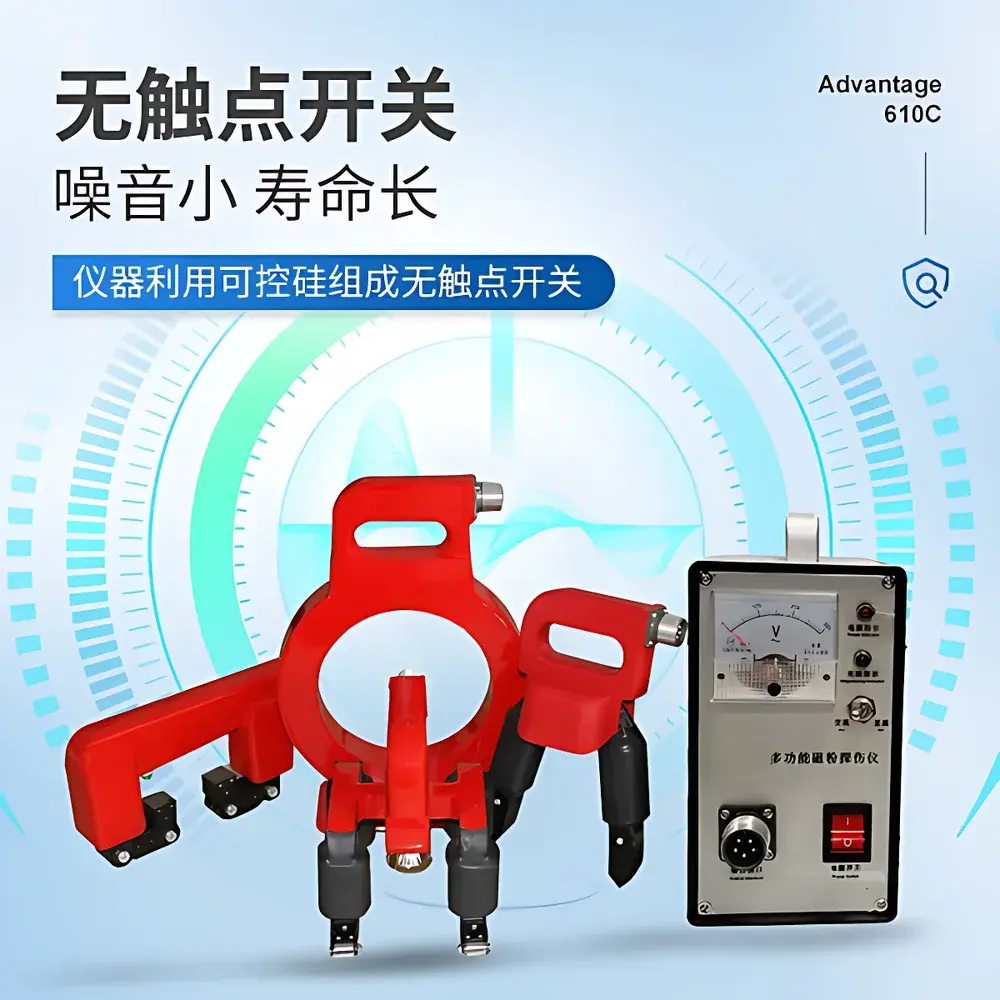
- SCR-controlled solid-state switching ensures silent operation, extended service life, and precise current regulation without mechanical arcing or contact wear.
- Integrated safety architecture: galvanically isolated 36 V AC output, mandatory grounding terminal, thermal-limited duty cycle (50%), and overcurrent protection via replaceable primary-side fuses.
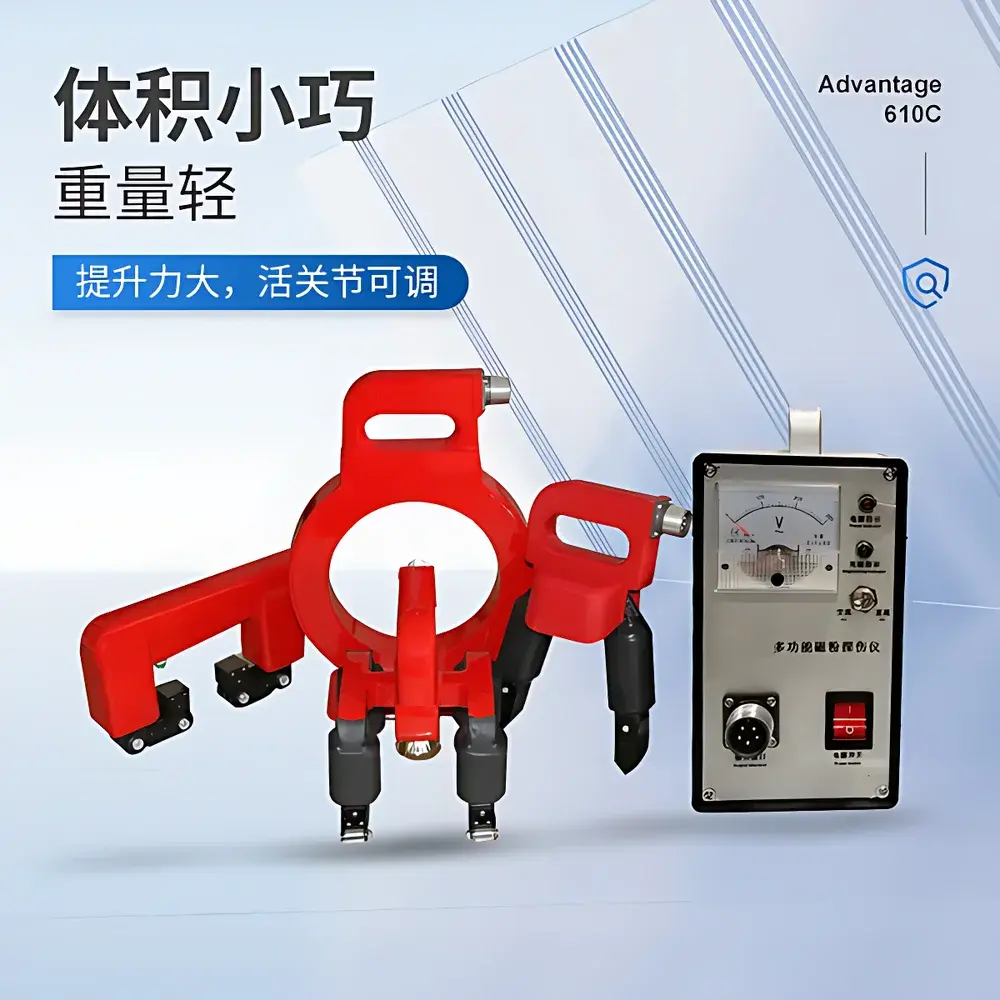
- Ergonomic design: lightweight (5 kg) chassis with reinforced handle, non-slip rubberized feet, and quick-connect aviation-style cable interfaces for rapid probe interchange in multi-site inspections.
- Field-validated lifting force ≥5 kgf at maximum pole spacing, meeting minimum performance thresholds defined in ASTM E709 and ISO 9934-1 for portable yoke systems.
Sample Compatibility & Compliance
The TY-610C is suitable for inspecting carbon steels, low-alloy steels, nickel alloys, and other ferromagnetic materials with permeability >300 µ₀. It accommodates flat, curved, angular, and irregular geometries—including fillet welds, nozzle-to-shell junctions, turbine blade roots, and rail web sections. The unit complies with core NDT procedural standards including ASTM E1444 (Standard Practice for Magnetic Particle Testing), ISO 9934-1 (Non-destructive testing — Magnetic particle testing — Part 1: General principles), and EN 1369 (Founding — Magnetic particle inspection). Its low-voltage architecture satisfies electrical safety requirements per IEC 61000-6-4 (EMC immunity) and supports GLP/GMP-aligned documentation workflows when paired with traceable particle batches and calibrated light meters.
Software & Data Management
As a hardware-only MPI excitation source, the TY-610C does not incorporate embedded firmware or onboard data logging. However, its consistent output waveform and stable amperage enable repeatable magnetization in manual or semi-automated inspection protocols. Users may integrate the unit into digital NDT reporting ecosystems via external cameras (for image capture of indications), calibrated UV-A radiometers (for fluorescent particle verification), and compliant document management systems that record operator ID, part number, inspection date, probe type, magnetization direction, and interpretation results—fulfilling audit requirements under ASME BPVC Section V, API RP 2X, and FDA 21 CFR Part 11 when combined with electronic signature-capable software.
Applications
- Aerospace: Inspection of landing gear components, engine mounts, and wing spar welds using residual (remanence) or continuous magnetization techniques.
- Railway infrastructure: In-service examination of rail joints, switch points, and axle shafts under field conditions without external power generation.
- Power generation: On-site assessment of turbine casings, generator rotor slots, and boiler tube welds during outage maintenance.
- Oil & gas: Weld integrity verification on offshore platform structural members and subsea piping flanges using the magnetic ring for circumferential crack detection.
- Heavy manufacturing: Quality control of forged crankshafts, cast valve bodies, and pressure vessel nozzles prior to hydrostatic testing.
FAQ
What magnetization methods does the TY-610C support?
It supports both continuous (wet/dry particle application during current flow) and residual (particle application after current cessation) techniques, configurable via probe selection and timing control.
Is the unit certified to international NDT standards?
While the TY-610C itself is not individually certified, its performance parameters—including lifting force, output stability, and voltage isolation—meet the minimum functional requirements specified in ASTM E709, ISO 9934-1, and EN 1369 for portable AC yoke equipment.
Can the magnetic ring be used for demagnetization?
Yes—the Φ150 mm ring supports far-field demagnetization by slowly withdrawing the part from the coil while energized, reducing residual field strength in accordance with ASTM E1558.
Does the instrument require calibration traceable to national standards?
Per ISO/IEC 17025, the TY-610C’s output current and lifting force must be verified annually using NIST-traceable ammeters and calibrated weights; full system validation includes sensitivity checks with standardized A1-30/100 shims.
What safety precautions are essential during operation?
Always ensure secure grounding of the instrument chassis, verify probe-to-part metal contact before actuation, avoid prolonged activation beyond 50% duty cycle, and never operate with damaged cables or compromised insulation—particularly in humid or conductive environments.



