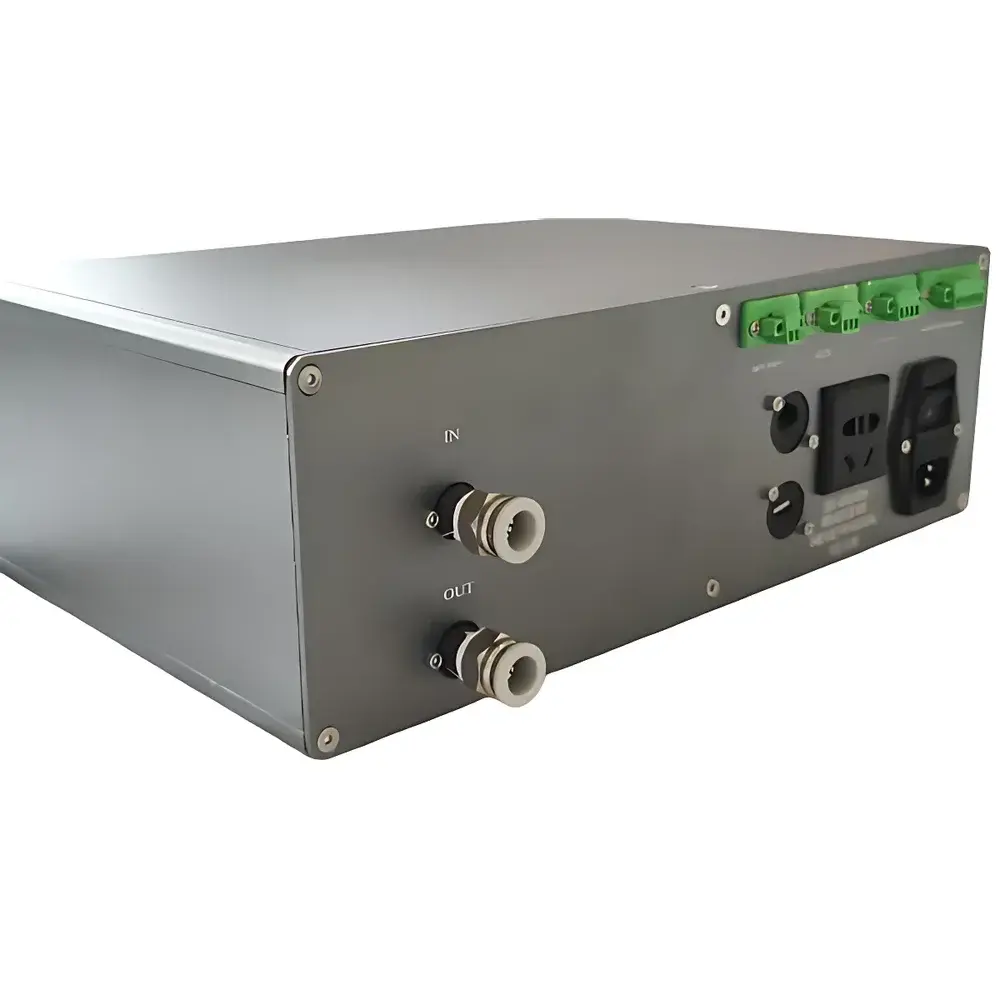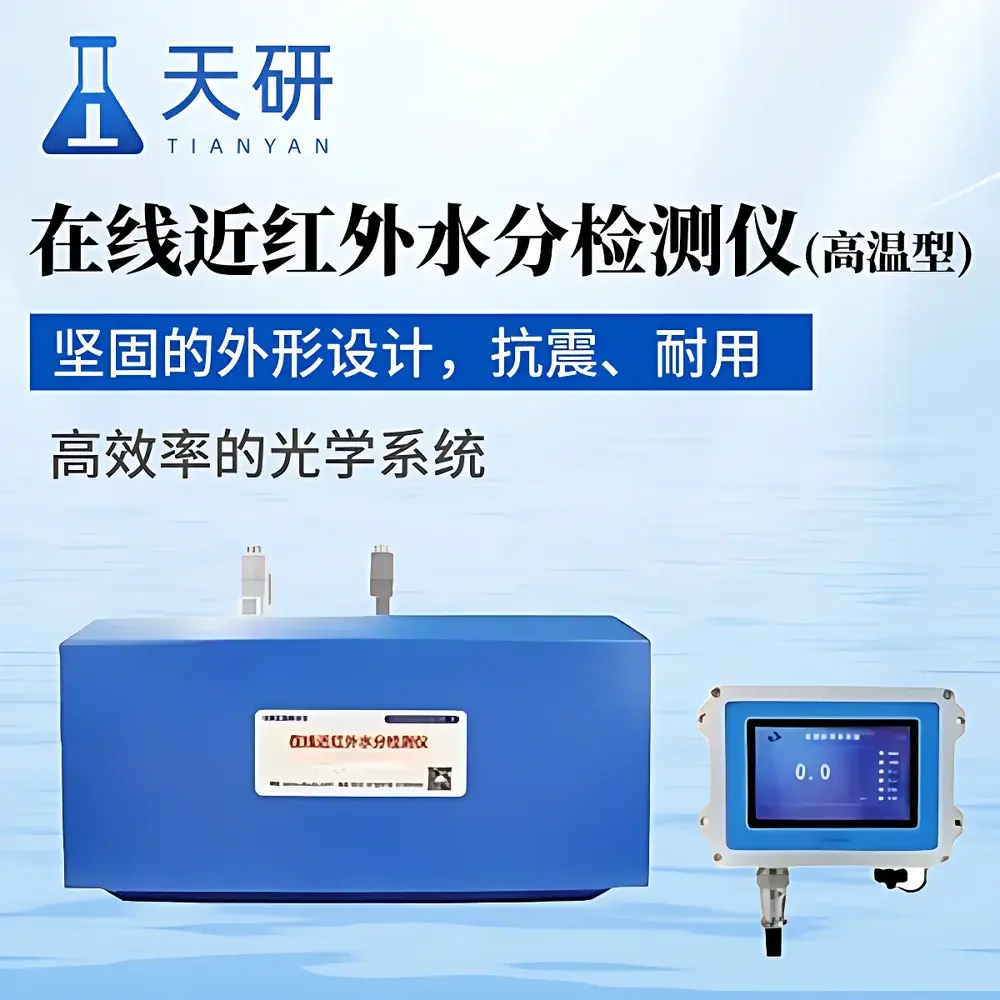
Tianyan TY-NIR-HT Online Near-Infrared Moisture Analyzer
| Brand | Tianyan |
|---|---|
| Origin | Shandong, China |
| Model | TY-NIR-HT |
| Measurement Principle | Near-Infrared Reflectance Spectroscopy (NIRS) |
| Moisture Range | 0–100% w/w |
| Moisture Accuracy | ±0.2% (dependent on material composition stability) |
| Temperature Monitoring | Integrated infrared port, range 0–500 °C, accuracy ±1% FS or ±1.5 °C |
| Optical Spot Diameter | 60–75 mm |
| Installation Height Range | 350 mm ± 100 mm |
| Sampling Channels | 50 |
| Light Source | Imported high-efficiency NIR source |
| Filter Cycle | 1–60 s adjustable |
| Optical Window | High-borosilicate quartz glass |
| Power Supply | 220 VAC, 50 Hz |
| Power Consumption | 60 W |
| Enclosure Rating | IP65 |
| Calibration Support | Auto-calibration with ≥10 user-defined moisture calibration points |
| Operating Environment | High-temperature industrial settings |
Overview
The Tianyan TY-NIR-HT Online Near-Infrared Moisture Analyzer is an industrial-grade, non-contact process analyzer engineered for continuous, real-time moisture quantification in bulk solid and granular materials. It operates on the principle of near-infrared reflectance spectroscopy (NIRS), leveraging the characteristic absorption bands of water molecules—particularly around 1450 nm and 1940 nm—in the NIR spectrum (780–2500 nm). When broadband NIR radiation is directed onto a moving or static material surface, the intensity of reflected light at water-sensitive wavelengths is attenuated proportionally to moisture content. This attenuation is captured by a high-sensitivity InGaAs detector array and converted into quantitative moisture values via multivariate regression models. Unlike contact-based sensors, the TY-NIR-HT eliminates mechanical wear, sample preparation, and cross-contamination risks. Its thermally robust enclosure—constructed from high-conductivity, high-temperature-resistant alloys—ensures stable internal thermal equilibrium even in ambient environments up to 80 °C, making it suitable for deployment adjacent to dryers, kilns, pelletizers, and hot conveying systems.
Key Features
- Thermally isolated optical housing with passive heat dissipation architecture, enabling reliable operation in ambient temperatures up to 80 °C
- High-stability imported NIR light source with spectral output optimized for water absorption band detection
- Optimized optical path design featuring high-borosilicate quartz window—resistant to thermal shock, dust adhesion, and condensation
- Adjustable measurement cycle (1–60 s) to match conveyor belt speed, feed rate, or process dynamics
- Integrated infrared temperature monitoring port (0–500 °C), supporting simultaneous moisture–temperature correlation analysis
- 50-channel spectral acquisition capability for enhanced signal-to-noise ratio and robustness against heterogeneity
- IP65-rated enclosure with vibration-damped mounting interface, certified for industrial plant floor deployment
- Non-invasive measurement over distances of 350 mm ± 100 mm—compatible with belt conveyors, screw feeders, hoppers, chutes, and pneumatic pipelines
Sample Compatibility & Compliance
The TY-NIR-HT delivers consistent performance across heterogeneous, flowing, or static materials including wood flour, sawdust, biomass pellets, cereals, feedstuffs, tobacco, tea leaves, dairy powders, pharmaceutical excipients, mineral ores, cement clinker, foundry sands, and ceramic slurries. Its calibration framework supports matrix-specific modeling using ≥10 user-defined reference points, accommodating variations in particle size distribution, density, and spectral interference from lignin, starch, or ash. While not pre-certified to ISO/IEC 17025, the instrument’s data traceability, calibration logging, and parameter audit trail align with GLP and GMP documentation requirements. Optional integration with SCADA or DCS platforms supports compliance with ISA-88/ISA-95 process control frameworks. All firmware and configuration changes are timestamped and logged—supporting basic FDA 21 CFR Part 11 readiness when deployed with external electronic signature and access control layers.
Software & Data Management
The analyzer interfaces via RS485 Modbus RTU or optional Ethernet TCP/IP to centralized process control systems. Embedded firmware includes real-time spectral preprocessing (baseline correction, Savitzky–Golay smoothing, multiplicative scatter correction) and on-device PLS regression inference. Moisture trend logs, raw spectra snapshots, temperature co-readings, and calibration history are exportable in CSV or OPC UA-compliant formats. The configuration utility supports password-protected user roles (operator, engineer, administrator), version-controlled method storage, and automated backup to external USB media. All calibration curves are stored with metadata—including reference method (e.g., ASTM D4442 oven-dry), date, operator ID, and standard deviation of residuals—enabling full metrological traceability.
Applications
This analyzer is deployed in continuous manufacturing lines where moisture control directly impacts product quality, energy efficiency, and downstream processing safety. Key use cases include: real-time adjustment of dryer setpoints in wood composite plants (MDF, particleboard); closed-loop control of steam injection in feed pelleting; moisture feedback for blender discharge consistency in food powder blending; inline verification of tablet granule moisture prior to compression in pharmaceutical wet granulation; and optimization of calcination temperature in cement raw meal homogenization. Its tolerance to ambient light, dust, humidity, and mechanical vibration ensures uninterrupted operation in harsh environments without routine optical recalibration.
FAQ
Does the TY-NIR-HT require periodic optical recalibration?
No—its high-borosilicate quartz window and thermally stabilized source/detector assembly minimize drift. However, annual validation against gravimetric reference methods (e.g., AOAC 950.46 or ISO 658) is recommended for critical applications.
Can it measure moisture in layered or coated materials?
It measures surface-weighted moisture within the optical penetration depth (~0.5–2 mm for most organics). For stratified materials, complementary cross-sectional validation is advised.
Is spectral library transfer between instruments supported?
Yes—calibration models exported in .nirs format can be loaded onto other TY-NIR-HT units after hardware-specific gain normalization.
What maintenance intervals are specified?
Visual inspection of optical window cleanliness every 72 operating hours; compressed-air purge recommended if installed in high-dust zones; no consumables or moving parts require scheduled replacement.
How is temperature compensation handled during moisture calculation?
Dual-wavelength ratio algorithms and embedded temperature co-reading enable real-time thermal offset correction within the PLS model—reducing thermal-induced error to <±0.05% moisture per 10 °C ambient shift.
Related Products