
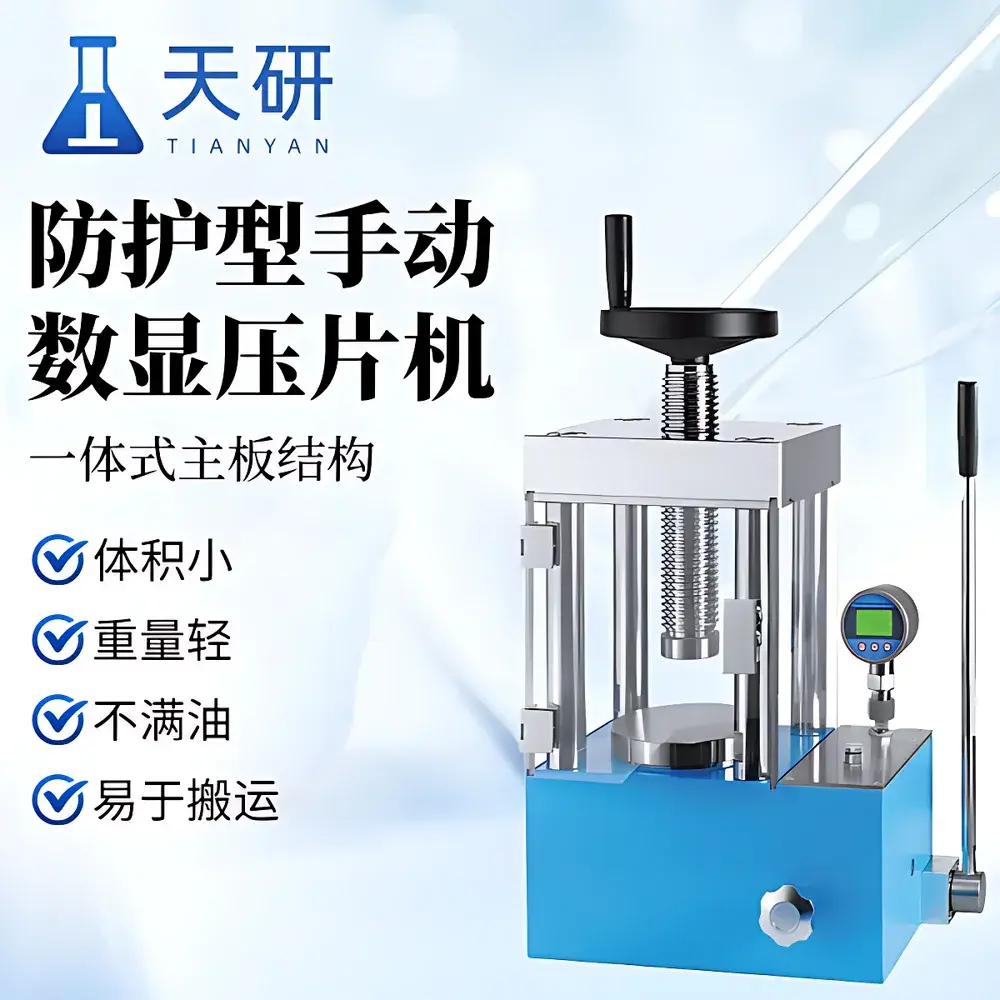
Tianyan TY-SSY-24F Protective Four-Column Manual Hydraulic Press with Digital Pressure Display
| Brand | Tianyan |
|---|---|
| Origin | Shandong, China |
| Model | TY-SSY-24F |
| Maximum Pressure | 0–24 metric tons (235.2 kN) |
| Piston Diameter | φ95 mm |
| Max Piston Stroke | 30 mm |
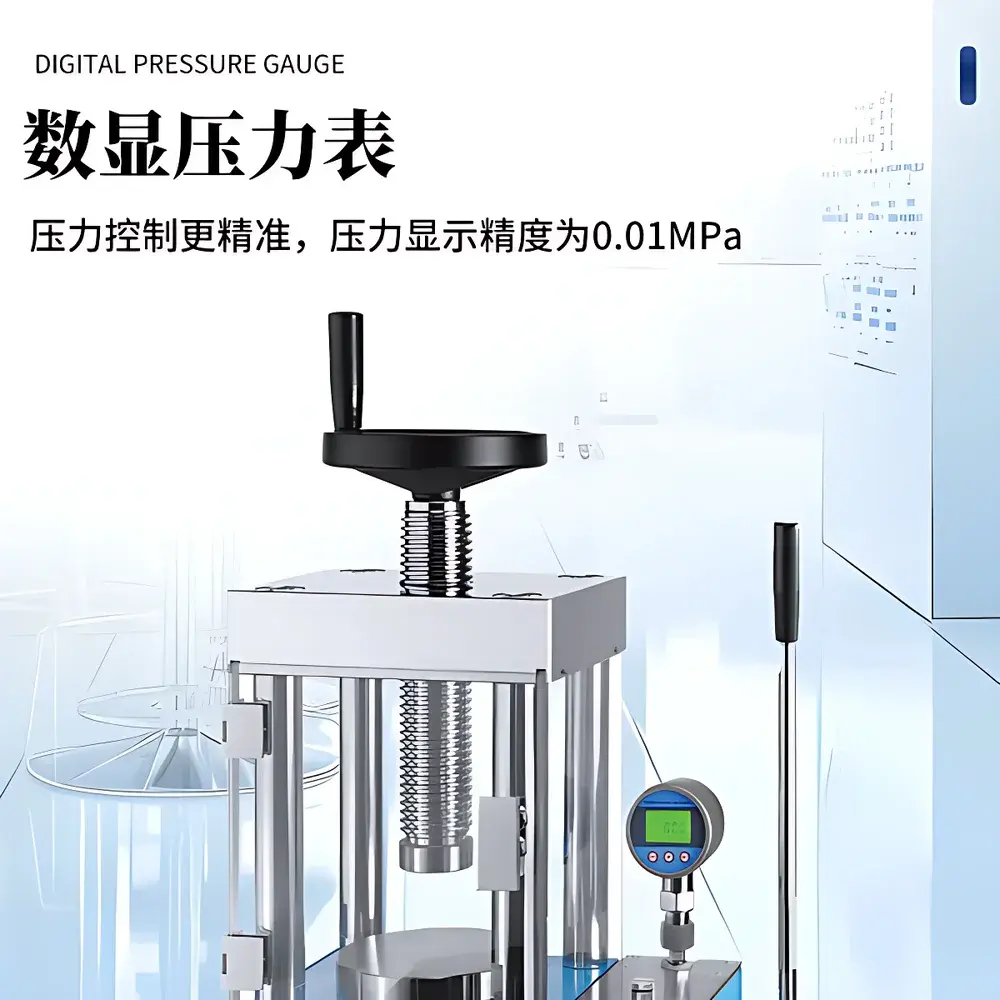
| Pressure Display Resolution | 0.01 MPa (equivalent to 0.102 ton-force) |
| Pressure Stability | ≤1 MPa per 10 minutes |
| Worktable Diameter | Φ105 mm |
| Column Spacing | 112 × 160 mm |
| Overall Dimensions | 305 × 200 × 440 mm (L×W×H) |
| Net Weight | 65 kg |
| Protective Shield | Transparent Acrylic |
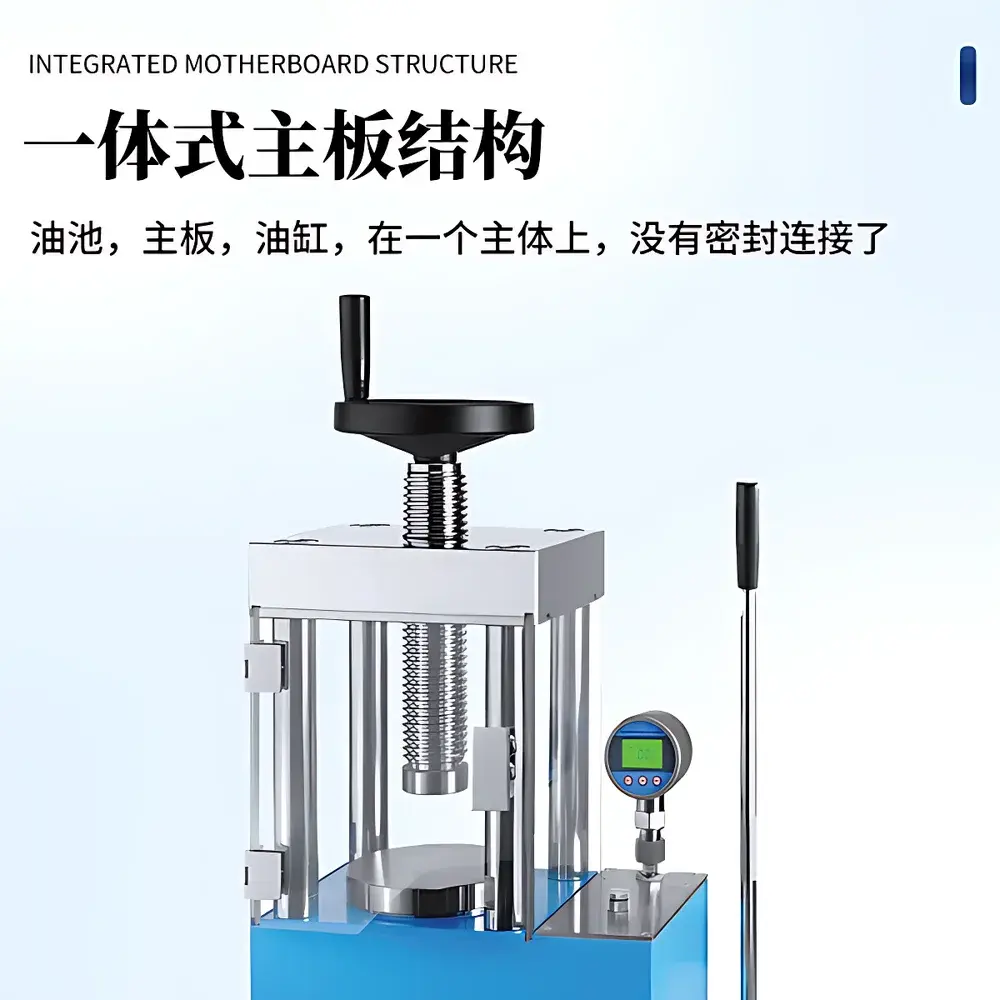
| Structural Design | Monolithic Mainframe (integrated oil reservoir, baseplate, and chrome-plated cylinder |
| Hydraulic System | Filtered oil circuit, custom piston seal, extended-life tension spring (30 mm stroke retention), aluminum alloy handwheel |
Overview
The Tianyan TY-SSY-24F is a precision-engineered, four-column manual hydraulic press designed for reproducible, contamination-controlled sample compaction in analytical and materials science laboratories. It operates on the principle of static hydraulic force transmission—where manual torque applied to an aluminum handwheel drives a piston within a monolithic chrome-plated cylinder, generating compressive load via incompressible hydraulic oil. The integrated mainframe eliminates interfacial seals between oil reservoir, baseplate, and cylinder—significantly reducing potential leakage points and enhancing long-term pressure stability (≤1 MPa drift over 10 minutes). Its compact footprint (305 × 200 × 440 mm) and 65 kg net weight enable seamless integration into inert-atmosphere gloveboxes, fume hoods, or benchtop FTIR/fluorescence spectrometer sample preparation workflows. Unlike conventional toggle or screw-type presses, this design delivers linear, calibrated force application—critical for preparing uniform KBr pellets, catalyst wafers, pharmaceutical tablets, or ceramic green bodies where density homogeneity directly affects spectral fidelity or mechanical test validity.
Key Features
- Monolithic structural architecture: Oil reservoir, baseplate, and chrome-plated cylinder are machined as a single unit—eliminating gasketed joints and minimizing hydraulic leakage risk.
- High-strength Japanese high-speed steel (HSS) die sets: Precision-ground, heat-treated to ≥62 HRC, ensuring dimensional stability and >10,000-cycle service life under 24-ton loading.
- Digital pressure monitoring: Dual-range digital pressure indicator (0.00–24.00 ton-force) with 0.01 MPa resolution—traceable to NIST-calibrated reference standards.
- Glovebox-compatible form factor: Compact dimensions and oil-free external surfaces allow safe operation inside argon- or nitrogen-purged environments without compromising atmosphere integrity.
- Optimized ergonomic actuation: Low-center-of-gravity lever arm placement minimizes operator fatigue and forward tilt during compression; extended high-tensile spring ensures consistent 30 mm piston retraction without plastic deformation.
- Maintenance-integrated hydraulics: Surface-mounted oil reservoir enables rapid oil replacement; built-in particulate filter extends fluid service interval and protects precision valve components.
- Corrosion-resistant surface engineering: Electroplated chromium cylinder bore (Ra ≤ 0.2 µm) paired with proprietary lip-seal geometry achieves zero observable leakage under ISO 1219-1 Class I hydraulic integrity testing.
Sample Compatibility & Compliance
The TY-SSY-24F supports standardized die geometries compliant with ASTM E3078 (for IR pellet preparation), USP <1051> (pharmaceutical tablet compaction), and ISO 14520-10 (powder densification protocols). Its Φ105 mm worktable accommodates industry-standard 13 mm, 25 mm, and 32 mm diameter dies—including custom cavity configurations for layered or multi-material compaction. The acrylic safety shield meets EN 13857 Category 2 guarding requirements for low-energy mechanical presses. All metallic contact surfaces conform to ISO 8502-3 cleanliness standards for residue-free sample handling. While not certified for GMP manufacturing, its pressure traceability, mechanical repeatability (<±0.3% full-scale), and documentation-ready operation support GLP-compliant QA/QC labs conducting method validation per ICH Q2(R2).
Software & Data Management
This is a manually operated, analog-hydraulic instrument with no embedded firmware or connectivity interfaces. Pressure values are displayed exclusively on the front-panel digital gauge—designed for direct visual verification and manual logging. For regulated environments requiring audit trails, users may integrate external USB data loggers (e.g., Omega OM-DAQPRO-5300) via the gauge’s 4–20 mA analog output (optional retrofit). All calibration certificates, maintenance logs, and die compatibility matrices are supplied in English PDF format—structured to align with FDA 21 CFR Part 11 electronic record retention guidelines when paired with validated document management systems.
Applications
- FTIR spectroscopy: Preparation of 1–2 mm thick KBr/NaCl pellets with ≤5% density variation across batch—reducing baseline scattering artifacts in mid-IR analysis.
- Pharmaceutical R&D: Compaction of API-excipient blends for dissolution rate correlation studies under controlled 5–20 ton loads.
- Heterogeneous catalysis: Fabrication of pressed catalyst wafers (e.g., Pt/Al₂O₃, Ni/MoO₃) with defined porosity gradients for reactor bed simulation.
- Materials science: Cold isostatic pressing of metal oxide powders (LiCoO₂, TiO₂) prior to sintering—enabling grain-size control in solid-state battery electrode development.
- Academic teaching labs: Demonstrating fundamental principles of powder rheology, Heckel analysis, and elastic/plastic deformation thresholds in undergraduate materials engineering curricula.
FAQ
What is the maximum recommended operating pressure for routine use?
For optimal longevity and repeatability, sustained operation above 20 tons is discouraged. The 24-ton rating represents ultimate mechanical limit—not continuous-duty specification.
Can this press be used with corrosive or moisture-sensitive samples?
Yes—provided appropriate die material (e.g., stainless steel 316 or tungsten carbide) is selected and the acrylic shield remains intact. No internal electronics or hygroscopic components are present.
Is calibration certification included with shipment?
Yes—a factory-issued pressure calibration report (traceable to CNAS-accredited metrology lab) is provided, covering 0–24 ton range at 5-point intervals.
What maintenance schedule is recommended for the hydraulic system?
Hydraulic oil replacement every 12 months or 500 operational cycles; filter element replacement every 6 months; visual inspection of piston seal integrity before each high-load session.
Does the press comply with CE or UL safety directives?
It carries no CE marking, as it falls outside EU Machinery Directive scope for manually actuated equipment below 1 kW input. UL listing is not applicable due to absence of electrical power supply.





