
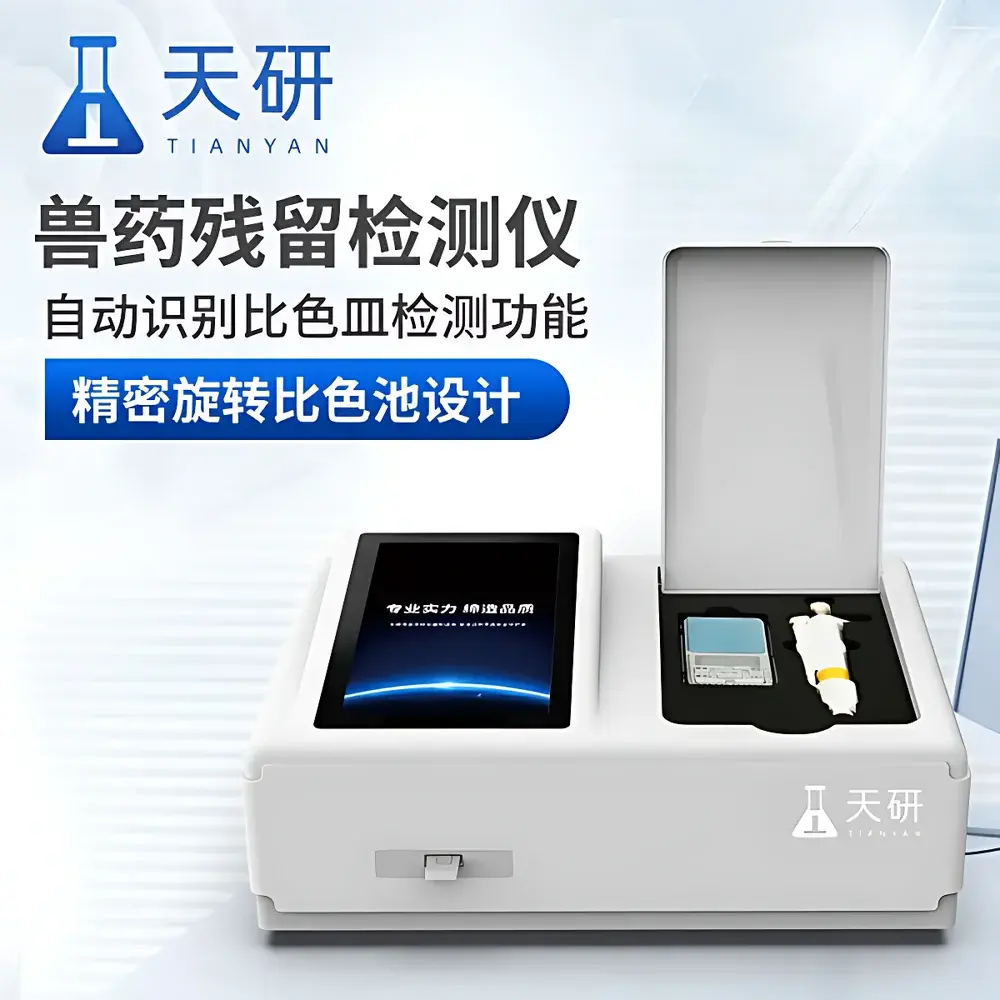
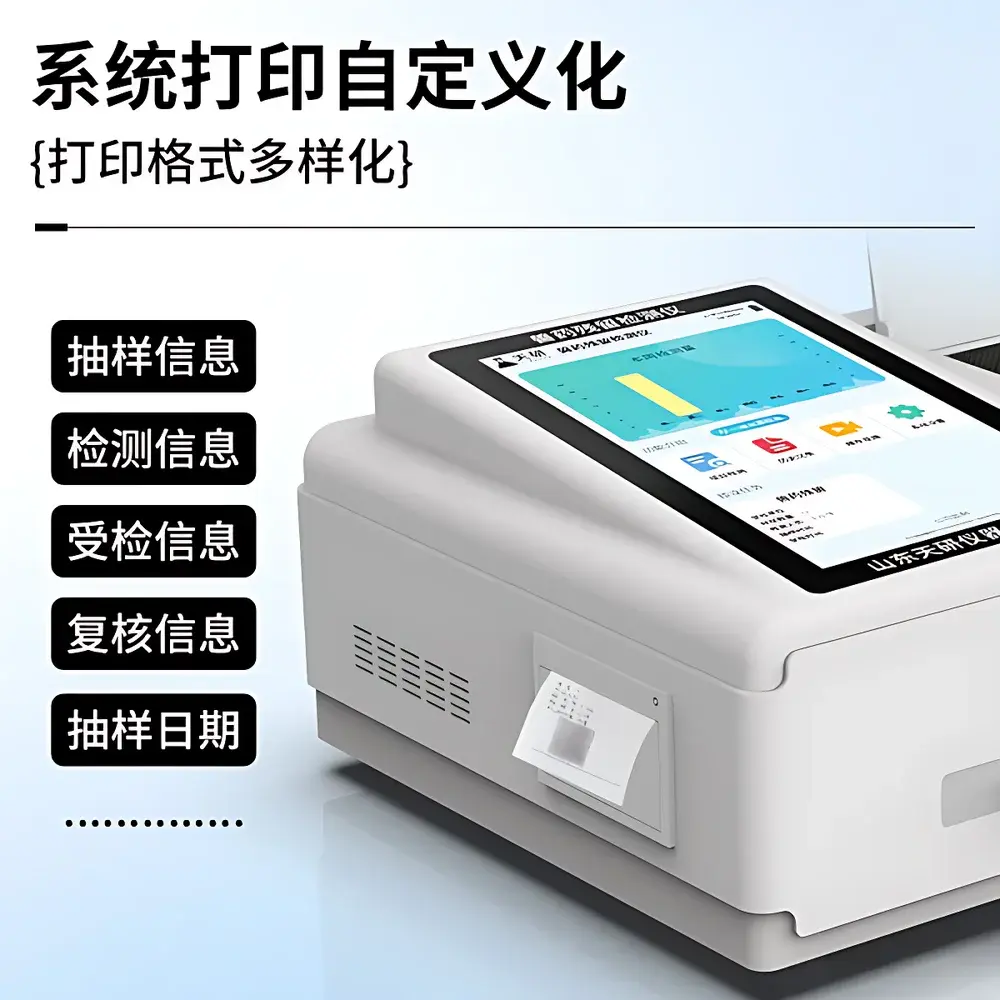
Tianyan TY-SYJCT Veterinary Drug Residue Rapid Tester for Egg and Food Safety Analysis
| Brand | Tianyan |
|---|---|
| Origin | Shandong, China |
| Manufacturer Type | Direct Manufacturer |
| Country of Origin | China |
| Model | TY-SYJCT |
| Price | USD 1,380 (approx.) |
| Display | 10.1" capacitive touchscreen |
| OS | Android-based embedded system |
| Processor | ARM Cortex-A7 RK3288, quad-core @ 1.88 GHz |
| Power Supply | AC/DC dual-mode, 6 Ah Li-ion battery |
| Dimensions | 43 × 35 × 20 cm |
| Net Weight | 5.1 kg |
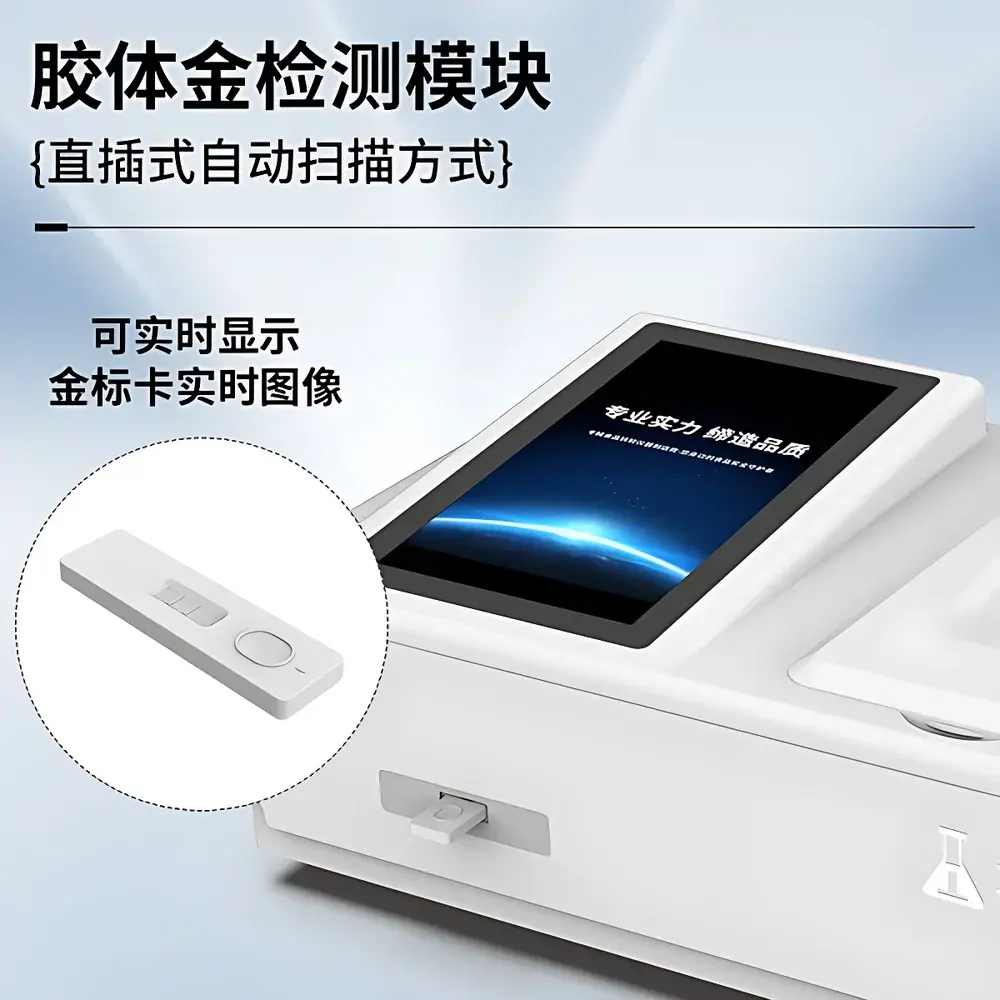
| Detection Modules | Colloidal gold immunochromatographic assay (CGIA) reader with auto-scanning track, integrated data management & cloud synchronization |
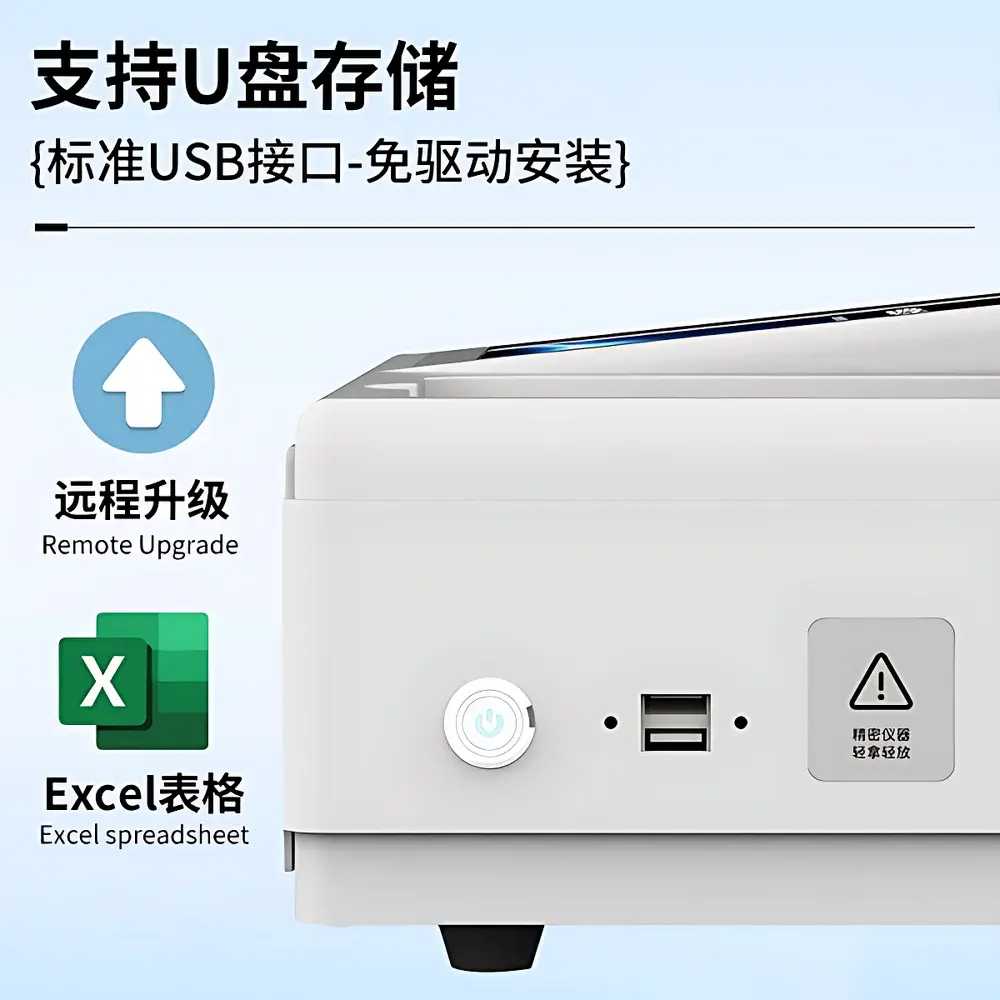
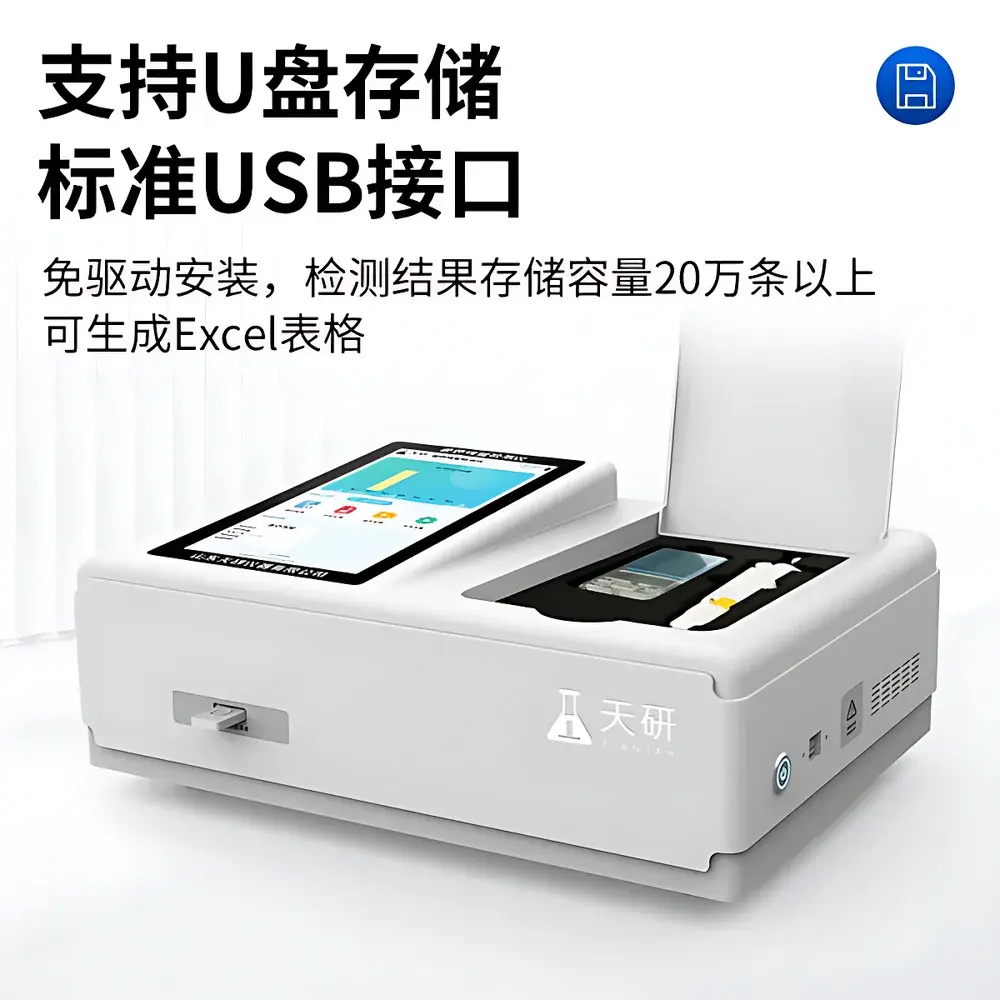
| Data Storage | >200,000 records, USB exportable to Excel |
| Connectivity | Wi-Fi, RJ45 Ethernet, optional A4 thermal printer support |
| Compliance | Designed for alignment with GB/T 22286–2008, GB/T 21312–2007, NY/T 2129–2012, and compatible with national food safety surveillance platforms per SAMR requirements |
Overview
The Tianyan TY-SYJCT Veterinary Drug Residue Rapid Tester is a field-deployable, integrated immunoassay platform engineered for quantitative and qualitative screening of veterinary drug residues in food matrices—specifically optimized for egg, poultry, meat, aquatic products, and feed samples. It operates on the principle of colloidal gold immunochromatography (CGIA), a well-established lateral-flow assay technology widely accepted by regulatory laboratories for its speed, specificity, and operational simplicity. The instrument combines optical signal acquisition, real-time image processing, and algorithm-driven C/T line recognition to deliver objective, operator-independent results within 5–10 minutes per test strip. Its architecture adheres to the functional design principles outlined in ISO/IEC 17025 for testing laboratories and supports traceability frameworks required under China’s Food Safety Law (2015) and the State Administration for Market Regulation (SAMR) supervision protocols.
Key Features
- 10.1-inch high-resolution capacitive touchscreen with intuitive Android-based UI, powered by an ARM Cortex-A7 RK3288 quad-core processor (1.88 GHz) for responsive multi-tasking and concurrent module operation.
- Dedicated CGIA detection module with motorized track-driven card transport, enabling automatic scanning, real-time image capture, CT curve generation, and dynamic threshold-based line recognition—eliminating manual interpretation bias.
- Modular software architecture supporting over 80 analytes across six residue categories: β-agonists (e.g., clenbuterol, ractopamine), antibiotics (tetracyclines, sulfonamides, fluoroquinolones, chloramphenicol), mycotoxins (aflatoxin B1/M1, zearalenone, deoxynivalenol), veterinary biologics (avian influenza, Newcastle disease, porcine reproductive and respiratory syndrome virus), and illegal additives (malachite green, diethylstilbestrol).
- Onboard data aggregation engine that auto-generates weekly/monthly compliance dashboards—including total tests, pass/fail counts, and comparative bar charts—accessible directly from the home screen without external PC dependency.
- Pre-configurable task templates for sample ID, target analyte, submitting unit, and testing protocol—reducing entry errors and accelerating throughput during high-volume field deployment.
- Full data sovereignty: local storage capacity exceeding 200,000 records; USB 2.0 interface for driver-free Excel export; password-protected user roles (admin/operator/auditor); firmware upgradability via OTA or local package installation.
Sample Compatibility & Compliance
The TY-SYJCT is validated for use with homogenized egg yolk extracts, muscle tissue homogenates, aquaculture product supernatants, milk filtrates, and feed extracts following standardized pretreatment procedures per GB/T 21312–2007 (determination of clenbuterol in animal tissues) and NY/T 2129–2012 (screening of sulfonamides in eggs). It accepts commercially available colloidal gold test strips from multiple domestic and international manufacturers—ensuring compatibility with third-party CE-IVD and NMPA-registered kits. While not itself a certified reference method, the system meets the performance criteria for rapid screening tools defined in SAMR Technical Guidance Document No. 2021-017 and aligns with the verification requirements for on-site enforcement tools under the National Food Safety Risk Monitoring Program.
Software & Data Management
The embedded software includes a relational database for sample metadata, assay parameters, and result logs—all timestamped and digitally signed. Audit trails record user login/logout events, calibration actions, and configuration changes—supporting GLP-aligned documentation practices. Data synchronization occurs via encrypted HTTPS POST to provincial or municipal food safety information platforms (e.g., Shandong Provincial Food Safety Supervision System), enabling real-time dashboarding and cross-jurisdictional trend analysis. Optional A4 report generation includes QR-coded result verification, sampling details, analyst ID, and regulatory reference numbers—formatted to meet GB 4789.1–2016 documentation standards. All exported files comply with UTF-8 encoding and CSV/Excel (.xlsx) schema conventions for interoperability with LIMS environments.
Applications
This instrument serves as a frontline screening tool in regulatory inspection workflows, including routine monitoring at egg collection centers, slaughterhouse ante-mortem checkpoints, cold-chain distribution hubs, and border inspection posts. It is routinely deployed by provincial CDC laboratories for outbreak investigation triage, by agricultural extension services for farm-level residue education programs, and by university food science departments for method validation studies. Its portability and battery endurance make it suitable for mobile food safety units operating under China’s “Four-Not-Two-Direct” (no notice, no greeting, no listening to reports, no escorts; direct to grassroots, direct to scene) inspection policy. In academic research, it functions as a teaching platform for immunoassay kinetics, signal-to-noise optimization in lateral flow systems, and digital image analysis of chromatographic bands.
FAQ
Does the TY-SYJCT require daily calibration?
No—calibration is performed during initial setup and after major firmware updates. Routine verification uses built-in reference strips with known positive/negative controls before each batch of samples.
Can test results be integrated into national food safety databases?
Yes—via configurable API endpoints compliant with the SAMR Unified Food Safety Information Platform data schema (v3.2), supporting both HTTP and MQTT protocols.
Is the device suitable for untrained personnel in rural settings?
Yes—the UI follows WCAG 2.1 AA accessibility guidelines, with icon-based navigation, voice-assisted prompts (optional), and context-sensitive help overlays.
What is the shelf life of stored test data when power is disconnected?
All critical configuration parameters and historical records are retained in non-volatile flash memory; no data loss occurs during power interruption or battery depletion.
Are software updates provided free of charge post-purchase?
Yes—Tianyan provides lifetime firmware updates at no additional cost, delivered remotely with version-controlled release notes and backward-compatible binary packages.





