
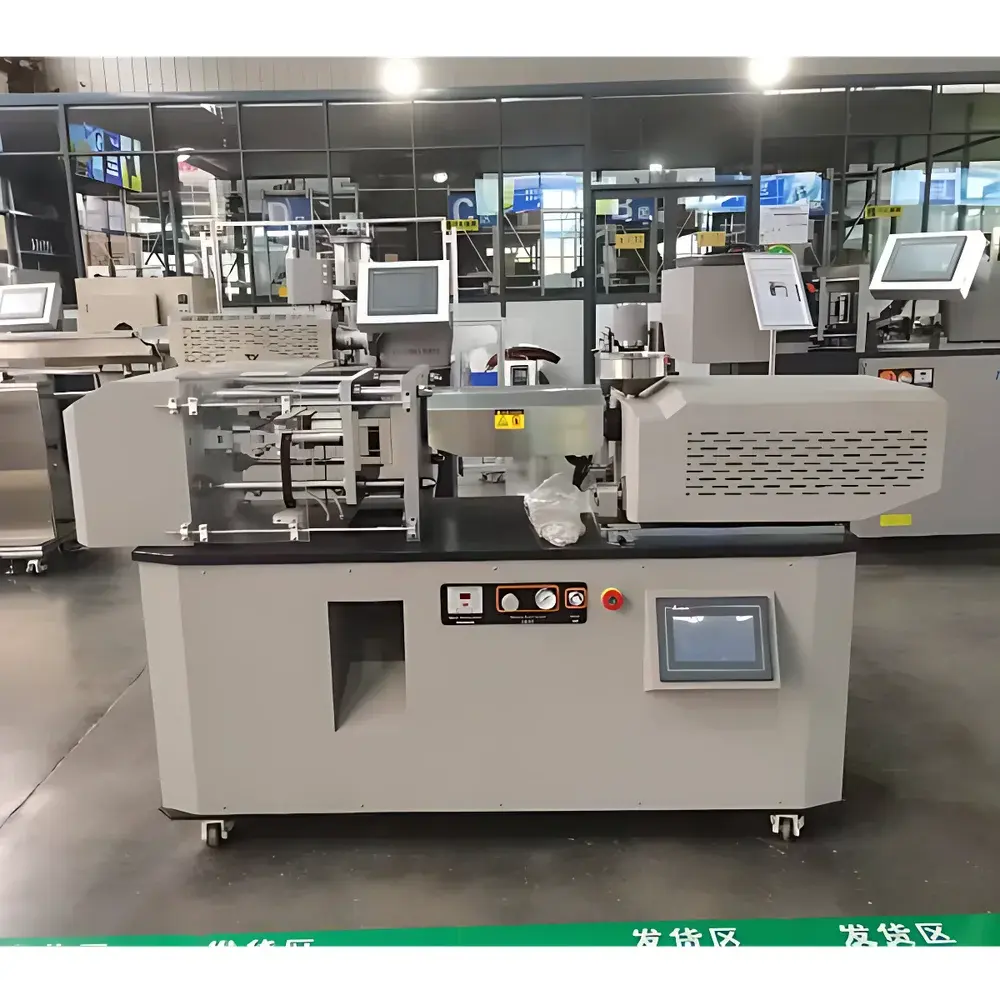
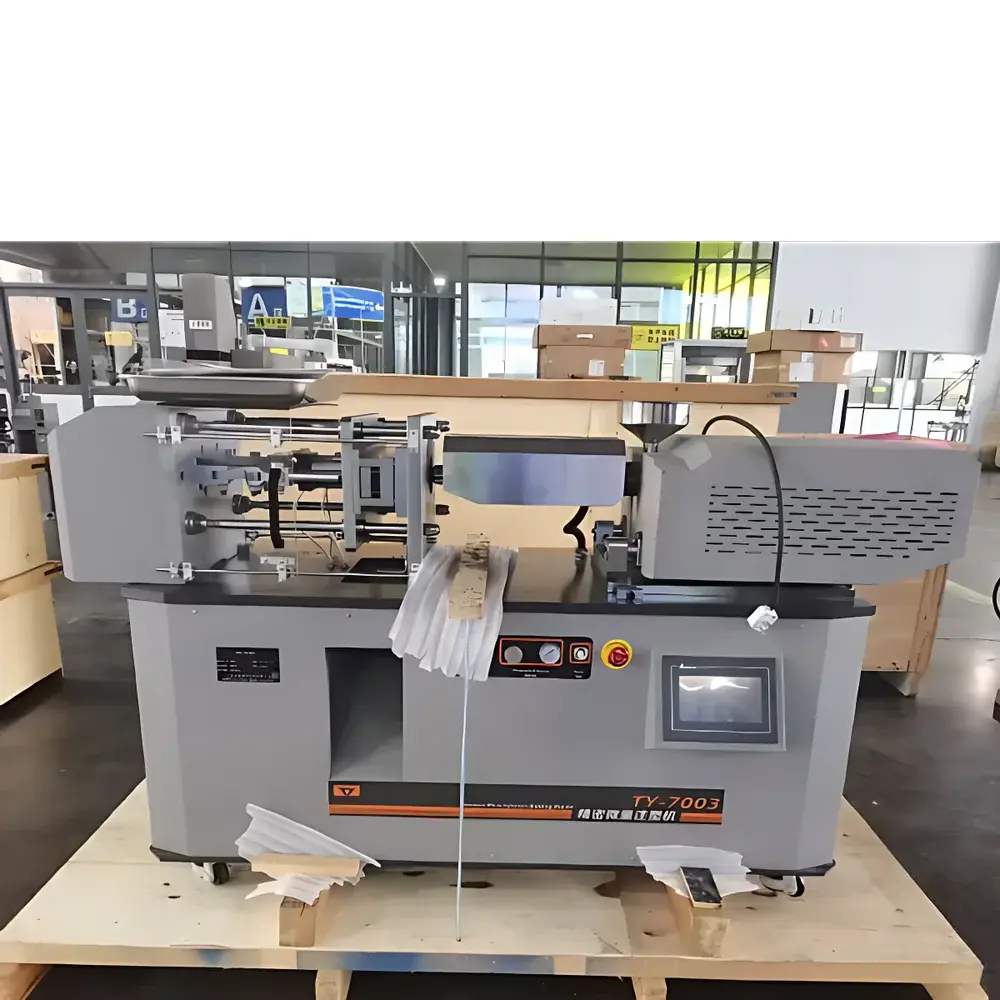
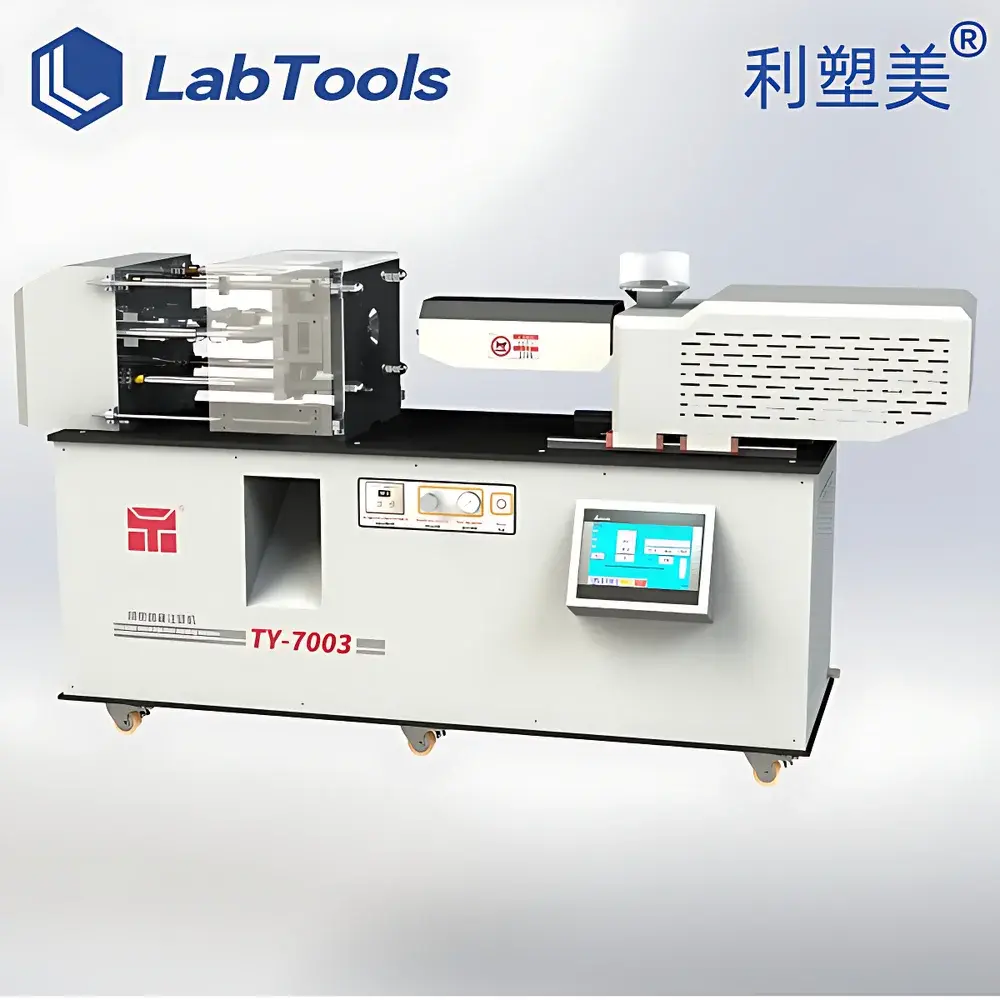
TianYuan TY-7003 Laboratory-Scale Injection Molding Machine for Specimen Preparation
| Brand | TianYuan |
|---|---|
| Origin | Jiangsu, China |
| Manufacturer Type | Direct Manufacturer |
| Country of Origin | China |
| Model | TY-7003 |
| Screw Diameter | 20 mm |
| Clamping Force | 5 T (adjustable up to 5 T via dual-toggle mechanism) |
| Maximum Shot Volume | 25 cm³ |
| Barrel Temperature Range | Up to 360 °C (3-zone heating) |
| Temperature Control Accuracy | ±0.5 °C (steady-state) |
| Power Supply | Single-phase AC 220 V ±10%, 50 Hz, 2.2 kW |
| Overall Dimensions | 1700 × 500 × 950 mm (L×W×H) |
| Length-to-Diameter Ratio | 20:1 |
| Injection Pressure | Up to 57 MPa (113 MPa with force-multiplying system) |
| Mold Opening Stroke | 70 mm (excluding mold thickness) |
| Hopper Capacity | 0.2 L |
| Injection Stroke Range | 0–80 mm |
| Injection Resolution | 0.1 mm |
| Feed Speed | 0.1–60 rpm (max 100 rpm, torque reduced beyond 60 rpm) |
| Safety | Dual mechanical & electronic interlock with acrylic safety guard |
Overview
The TianYuan TY-7003 is a compact, benchtop-scale injection molding machine engineered specifically for standardized specimen preparation in polymer research laboratories, quality control environments, and academic teaching settings. Unlike industrial-scale machines, the TY-7003 implements a scaled-down yet fully functional implementation of the reciprocating screw injection process—where thermoplastic resin is plasticized by shear and conductive heating within a 20 mm diameter barrel (L/D = 20:1), then injected under precise pressure into small-format molds (e.g., ASTM D638 Type I dumbbell, ISO 527-2, or color plaques). Its design prioritizes operational safety, electrical compatibility with standard laboratory infrastructure (single-phase 220 V), and repeatability for comparative material testing. The machine complies with fundamental mechanical safety principles per ISO 13857 and integrates fail-safe interlocks aligned with EN 60204-1 requirements for low-voltage equipment.
Key Features
- Compact footprint (1700 × 500 × 950 mm) and mobility-friendly construction—ideal for shared lab spaces, teaching labs, and R&D pilot lines.
- AC 220 V-powered operation eliminates dependency on three-phase industrial supply; full functionality at ≤2.2 kW load.
- Integrated planetary servo drive system delivers high-torque plasticization (105 N·m) with smooth, programmable feed control (0.1–60 rpm), enabling consistent melt homogeneity across diverse polymers including PP, PE, PA6/66, ABS, TPU, and PLA.
- Three-zone independently controlled barrel heating (up to 360 °C per zone) with ±0.5 °C steady-state stability ensures accurate thermal profiling for heat-sensitive or high-melt-temperature resins.
- PLC-based human-machine interface (HMI) with color touchscreen enables one-touch cycle initiation, parameter logging, and real-time monitoring of injection stroke, pressure, temperature, and clamp status.
- Dual safety architecture: mechanical limit switches + electronic proximity sensors automatically halt all motion when the transparent acrylic safety guard is opened—meeting basic risk reduction criteria per ISO 12100.
- Force-multiplying toggle clamping system provides adjustable clamping force up to 5 metric tons, compatible with standard small-frame molds (max mold size: 360 × 90 × 72 mm).
Sample Compatibility & Compliance
The TY-7003 supports preparation of standardized test specimens conforming to ASTM D638, ASTM D790, ISO 527-2, ISO 178, and ISO 1873-2 for tensile, flexural, and impact property evaluation. It accommodates common mold configurations—including ASTM Type I dumbbell, 80 × 10 × 4 mm plaques, and 60 × 60 × 2 mm color discs—with mold thickness ranging from 0 to 25 mm. All thermal and mechanical parameters are traceable and reproducible under GLP-aligned operating conditions. While not certified to UL or CE as a standalone medical device, its control architecture supports audit-ready data integrity when used in conjunction with validated SOPs and external calibration records. Optional water-cooling integration allows extended operation with high-viscosity or thermally sensitive formulations.
Software & Data Management
The embedded PLC controller logs cycle-by-cycle operational data—including melt temperature profiles, injection pressure curves, clamp tonnage, and shot volume—to internal non-volatile memory. Data export is supported via USB port in CSV format for post-processing in MATLAB, Excel, or LIMS-compatible platforms. The HMI firmware supports user-defined recipe storage (up to 50 profiles), password-protected parameter modification, and time-stamped event logging (e.g., guard open/close, alarm triggers). For regulated environments, optional firmware upgrade enables 21 CFR Part 11-compliant electronic signatures, audit trails, and role-based access control—facilitating alignment with GMP/QSR documentation requirements during material qualification studies.
Applications
- Routine preparation of mechanical test specimens for polymer formulation screening and batch release testing.
- Academic instruction in polymer processing fundamentals—including melt viscosity behavior, thermal degradation thresholds, and mold-filling dynamics.
- Preparation of color-matched plaques for spectrophotometric analysis (ASTM D2244, ISO 11664).
- Small-batch prototyping of micro-components requiring tight dimensional tolerance (±0.05 mm typical with calibrated molds).
- Processing trials for biodegradable resins (e.g., PLA, PHA) and engineering composites (glass-/carbon-filled PA, PEEK blends) where thermal history control is critical.
- Supporting ISO/IEC 17025-accredited labs in generating reference materials for inter-laboratory comparison programs.
FAQ
What power supply is required?
A single-phase AC 220 V ±10%, 50 Hz supply with minimum 10 A circuit capacity and dedicated grounding is mandatory. No three-phase input is needed.
Is compressed air required—and what specifications?
Yes. Clean, dry compressed air at 0.8–1.3 MPa is required. Minimum flow rate: 0.17 m³/min. Air line must use reinforced 8 mm OD tubing rated for ≥1.5 MPa.
Can the machine process high-temperature engineering plastics like PEEK or PPS?
Yes—provided molds are preheated externally and residence time is minimized. The 360 °C barrel limit supports most semi-crystalline and amorphous engineering thermoplastics, though thermal degradation risk requires strict adherence to manufacturer-recommended processing windows.
Does it support automated data export for LIMS integration?
Raw cycle data exports via USB in CSV format. For direct LIMS API integration or secure network transfer, contact TianYuan Engineering Services for OEM-level communication protocol licensing (Modbus TCP or OPC UA options available).
What maintenance intervals are recommended?
Daily: Visual inspection of barrel cleanliness, lubrication of toggle pins, and mold surface inspection. Quarterly: Calibration verification of temperature sensors and pressure transducers using NIST-traceable references. Annual: Full gearmotor oil replacement and servo drive diagnostic review.





