
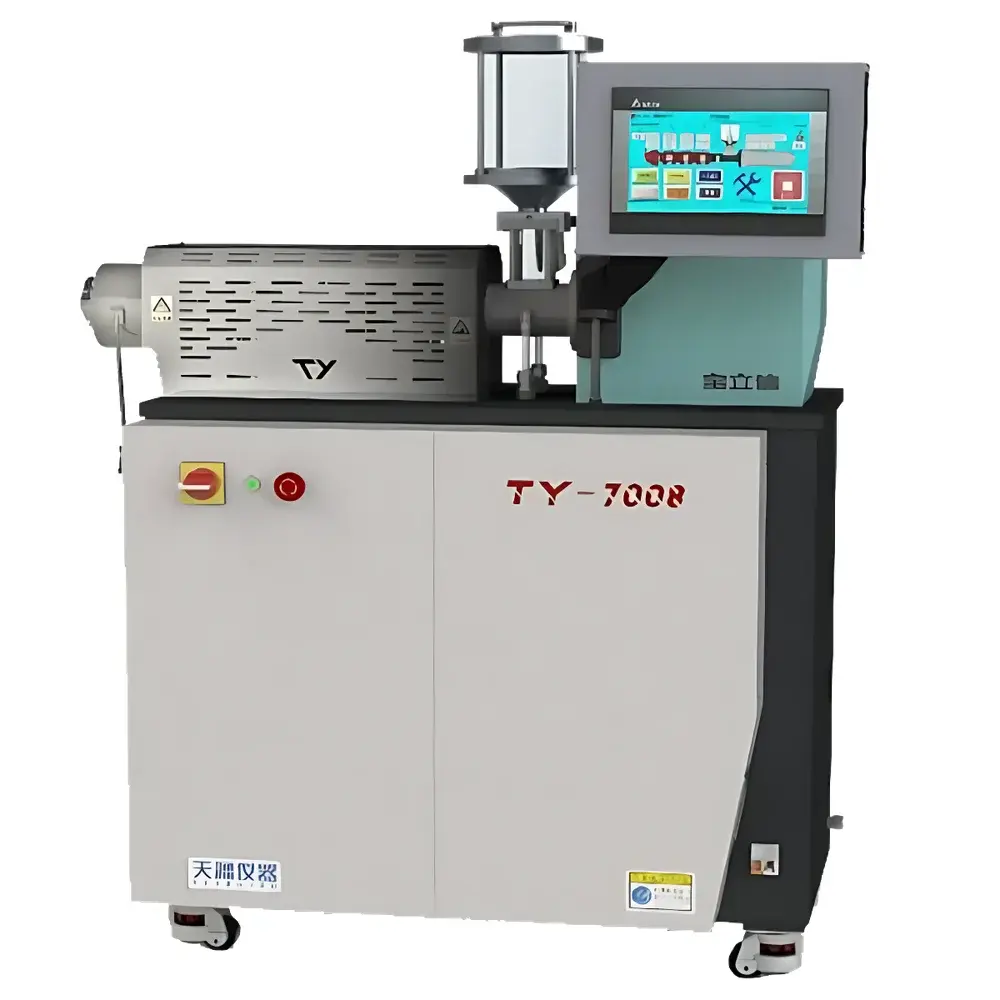
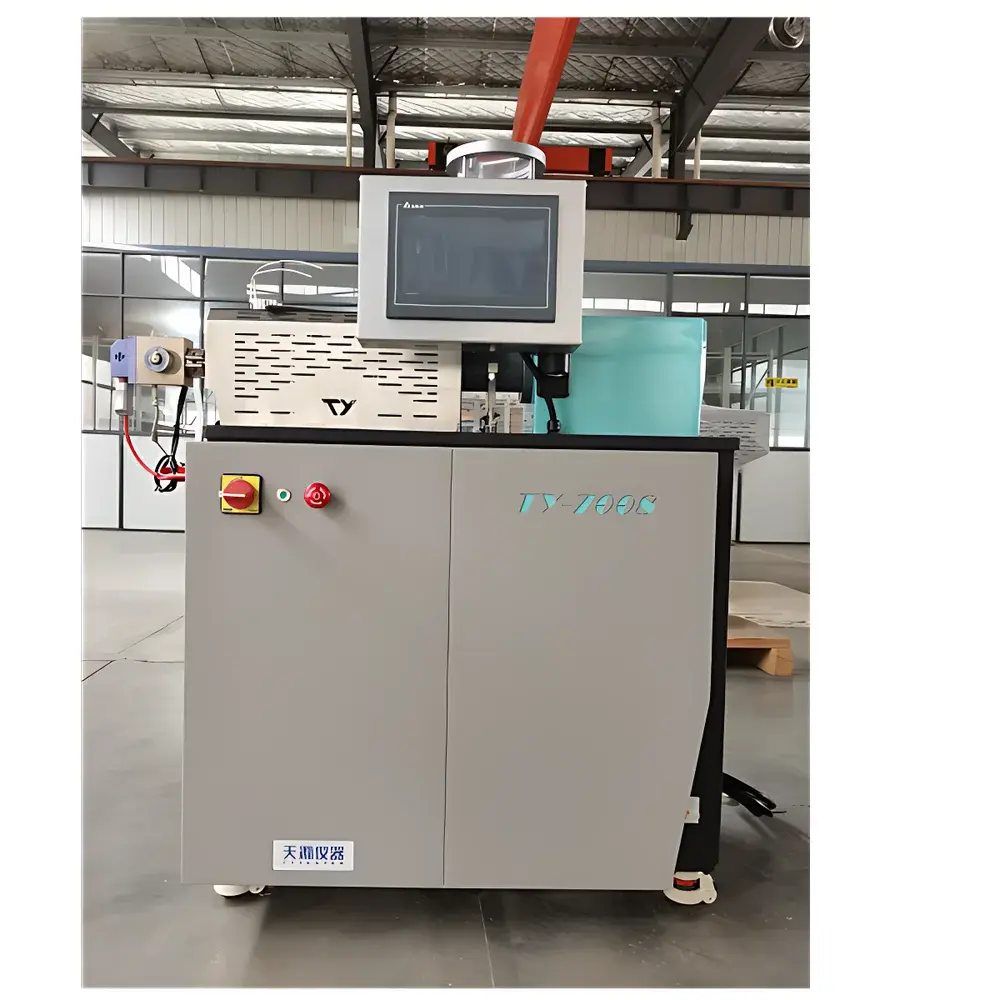
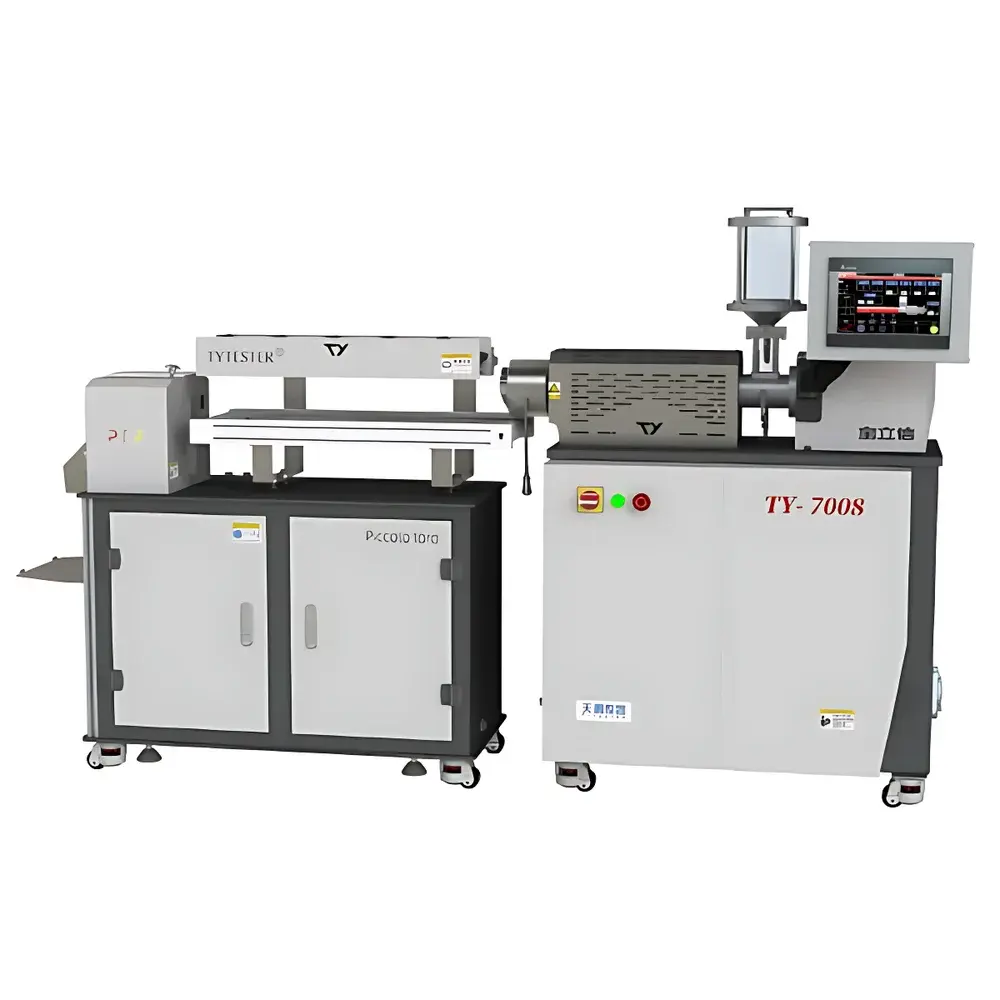
TianYuan TY-7008 Laboratory Single-Screw Extruder
| Brand | TianYuan |
|---|---|
| Origin | Jiangsu, China |
| Manufacturer Type | Direct Manufacturer |
| Country of Origin | China |
| Model | TY-7008 |
| Screw Diameter | 20 mm |
| Length-to-Diameter Ratio | 1:25 |
| Overall Dimensions | 390 mm × 1500 mm × 1100 mm |
| Drive Power | 2.2 kW |
| Heating Zones | 5 (4 barrel + 1 die) |
| Screw Speed Range | 0–80 rpm (variable-frequency control) |
| Screw Material | 38CrMoAlA alloy steel, nitrided surface hardness HRC 55–60, surface roughness Ra < 0.4 µm, nitrided layer depth > 0.6 mm |
| Barrel Material | 38CrMoAlA alloy steel, same surface treatment as screw |
| Melt Pressure Range | 0–35 MPa |
| Filtration Mesh | 5–40 µm |
| Cooling System | 4-channel forced-air cooling with multi-wing fans |
| Gearbox | Hardened gear reducer, reduction ratio 18:1 |
| Motor | Panasonic servo motor |
| Gearbox Supplier | LIMIN (Taiwan) |
| Weight | 380 kg |
| Electrical Supply | AC 380 V, 50 Hz, 3-phase 5-wire |
Overview
The TianYuan TY-7008 Laboratory Single-Screw Extruder is an engineered platform for controlled melt processing of thermoplastic polymers in research and development laboratories. Designed around classical single-screw extrusion principles—based on drag flow, pressure flow, and leakage flow mechanisms—it delivers reproducible residence time distribution, consistent shear history, and stable melt temperature profiles across its 25:1 L/D barrel assembly. This architecture enables precise simulation of industrial-scale compounding, color masterbatch dispersion, filler incorporation, and polymer modification under laboratory conditions. Its modular thermal zoning (five independent heating/cooling zones), high-precision melt pressure transduction, and servo-driven speed control allow users to isolate and quantify process variables such as shear rate dependency, thermal degradation onset, and dispersion efficiency—critical for formulation validation prior to pilot or production scale-up.
Key Features
- 20 mm screw diameter with 25:1 length-to-diameter ratio, optimized for balanced conveying, melting, and mixing performance in small-batch R&D workflows
- 38CrMoAlA alloy steel screw and barrel—nitrided to HRC 55–60, surface-finished to Ra < 0.4 µm, with nitrided case depth exceeding 0.6 mm for wear resistance and dimensional stability
- Five-zone thermal management: four barrel zones plus one die zone, each equipped with mica heaters, copper heat-sink fins, and stainless-steel safety shrouds
- Four-channel forced-air cooling system using low-noise multi-wing fans, enabling rapid thermal response and accurate temperature gradient control
- High-torque hardened gearbox (18:1 reduction ratio), precision-ground gear surfaces, and Panasonic servo motor for smooth, repeatable speed regulation from 0 to 80 rpm
- Integrated dual-pressure monitoring (pre- and post-filter) with 0–35 MPa range transducers, supporting real-time pressure differential analysis for filter clogging assessment and rheological consistency tracking
- Standard filtration module with interchangeable mesh inserts (5–40 µm), compliant with ISO 1133-2 and ASTM D2563 for melt filtration evaluation
Sample Compatibility & Compliance
The TY-7008 accommodates a broad spectrum of thermoplastic resins—including polyethylene (LDPE, HDPE), polypropylene (PP), polystyrene (PS), ABS, PC, PET, and engineering grades such as PEEK and PPS—as well as filled systems (e.g., CaCO₃-, talc-, or glass-fiber-reinforced compounds) and pigment-dispersed masterbatches. All wetted components conform to ISO 80000-1 for SI unit labeling and meet mechanical integrity requirements per ISO 12100 for machinery safety. The electrical design complies with IEC 60204-1 for industrial control panels, while thermal control firmware supports configurable ramp/soak profiles traceable to NIST-traceable reference standards. For regulated environments, the system’s analog pressure outputs and digital speed feedback signals are compatible with third-party data acquisition systems validated under FDA 21 CFR Part 11 and GLP/GMP audit frameworks.
Software & Data Management
While the TY-7008 operates via an integrated PLC-based HMI panel with local parameter storage, it provides analog (4–20 mA) and digital (RS485 Modbus RTU) interfaces for integration into centralized lab informatics platforms. Real-time operational parameters—including screw speed, zone temperatures, melt pressure differentials, and motor current—are timestamped and exportable in CSV format. When paired with optional SCADA or LIMS-compatible middleware, the extruder supports automated batch logging, electronic signature capture, and audit trail generation aligned with ALCOA+ (Attributable, Legible, Contemporaneous, Original, Accurate, Complete, Consistent, Enduring, Available) data integrity principles.
Applications
- Rheological screening of virgin and recycled polymer melts under defined shear and thermal histories
- Quantitative assessment of pigment dispersion quality and thermal stability in color masterbatches
- Optimization of filler loading ratios and coupling agent dosage in mineral-filled composites
- Pre-compounding trials for reactive extrusion formulations (e.g., grafting, crosslinking)
- Validation of melt filtration performance per ISO 1133-2 Annex C for quality assurance protocols
- Correlation studies between lab-scale extrusion output and twin-screw or industrial single-screw production data
FAQ
What is the maximum recommended throughput for the TY-7008 at 80 rpm?
Typical throughput ranges from 0.8 to 2.5 kg/h depending on material density, melt viscosity, and feed geometry—consistent with standard lab-scale single-screw extrusion practice for 20 mm diameter systems.
Is the barrel temperature control capable of sub-1°C stability?
Yes—each of the five heating zones maintains ±0.5°C setpoint accuracy under steady-state operation, verified using calibrated PT100 sensors and PID tuning optimized for polymer melt thermal inertia.
Can the system be configured for vacuum venting or side feeding?
The base TY-7008 configuration does not include vent ports or auxiliary feeders; however, custom barrel modifications (e.g., vent-zone machining or gravimetric side feeder integration) are available upon request and subject to mechanical compatibility review.
Does the pressure transducer support calibration traceability to national standards?
All melt pressure sensors are supplied with factory calibration certificates traceable to CNAS-accredited laboratories; end-user recalibration services are supported through authorized service partners.
What maintenance intervals are recommended for the nitrided screw and barrel?
Under normal R&D usage (≤4 h/day, non-abrasive materials), inspection is advised every 500 operational hours; replacement is typically required after 3,000–5,000 hours depending on abrasive filler content and thermal cycling frequency.





