
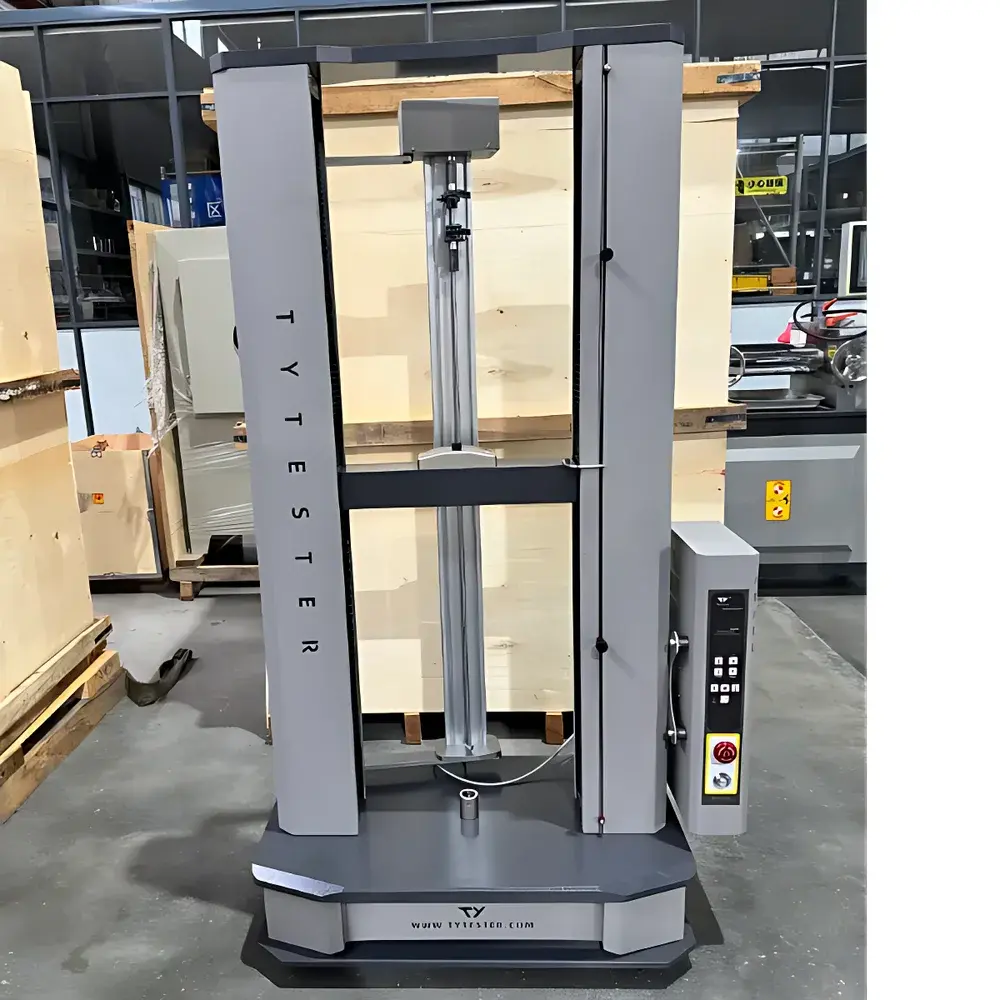
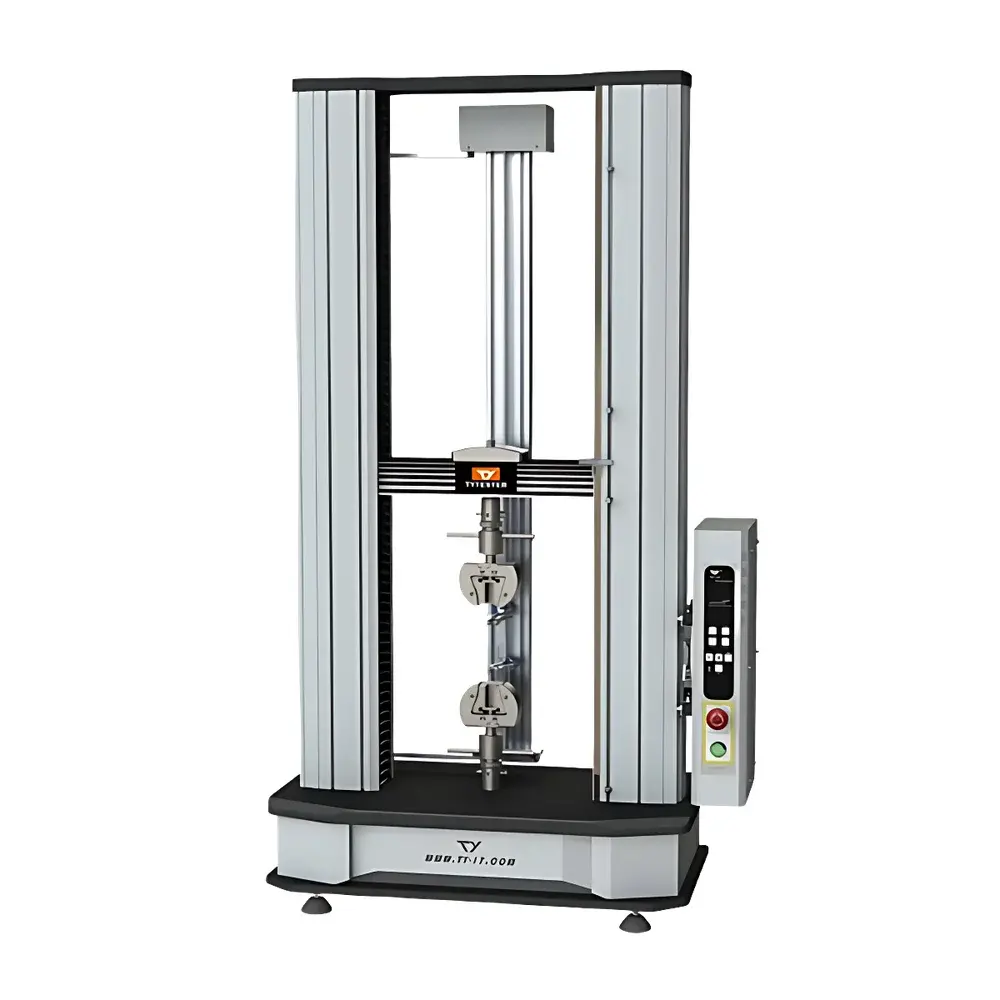
TianYuan TY-8000A 5 kN Electromechanical Universal Testing Machine
| Brand | TianYuan |
|---|---|
| Origin | Jiangsu, China |
| Manufacturer Type | Direct Manufacturer |
| Model | TY-8000A 5 kN |
| Load Capacity | 20 N to 5 kN |
| Load Accuracy | ±0.5% |
| Force Resolution | 1/500,000 FS |
| Force Measurement Range | 0.4–100% FS |
| Displacement Resolution | 0.01 mm |
| Crosshead Travel | 1000 mm (excluding grip length) |
| Effective Test Width | 420 mm |
| Test Speed Range | 0.001–1000 mm/min |
| Speed Accuracy | ≤±0.3% |
| Deformation Measurement Range | 0.2–100% FS |
| Strain Control Rate Accuracy | ±1% of set value |
| Constant Load/Strain/Displacement Control Range | 0.5–100% FS |
| Sampling Frequency (optional) | up to 1000 Hz |
| Power Supply | 220 V ±10%, 500 W |
| Dimensions (W×D×H) | 800 × 500 × 1600 mm |
| Weight | 260 kg |
Overview
The TianYuan TY-8000A is a high-precision electromechanical universal testing machine engineered for static mechanical property characterization of metallic and non-metallic materials under tension, compression, bending, shear, peel, tear, and puncture loading conditions. It operates on a closed-loop servo-controlled architecture, utilizing a high-rigidity planetary gear reducer coupled with a preloaded ball screw drive system to ensure minimal backlash, high positional repeatability, and long-term torque stability. The system implements a full-digital triple-closed-loop control strategy—simultaneously regulating force, displacement, and strain—based on a DSP + MCU real-time processing platform. This architecture enables precise execution of ISO 527, ASTM D638, ASTM E8, ISO 6892-1, and GB/T 228.1 compliant test protocols, including ramp-to-load, constant-rate-of-travel (CRT), constant-rate-of-extension (CRE), and multi-step cyclic loading sequences (e.g., low-cycle fatigue simulation via load/displacement/strain waveform control).
Key Features
- High-torque servo motor paired with a maintenance-free planetary gearbox delivering exceptional torsional stiffness, sub-arcminute positioning accuracy, and rated output torque scalability without lubrication intervals.
- Preloaded precision-ground ball screw transmission system ensuring axial runout < 5 µm and repeatable crosshead positioning within ±0.005 mm over full stroke.
- DSP + MCU-based tri-closed-loop controller supporting simultaneous real-time regulation of force, displacement, and strain at sampling rates up to 1000 Hz (custom-configurable).
- Dynamic graphical interface with synchronized multi-channel plotting (force vs. time, stress vs. strain, load vs. extension), real-time digital readouts, and configurable axis scaling and annotation.
- Post-test graphical analysis module enabling curve re-baselining, yield point interpolation (0.2% offset method), modulus calculation (tangent/secant), energy integration (area under curve), and hysteresis loop quantification.
- Native Excel export capability with user-defined report templates; direct thermal or laser printing of ASTM/ISO-compliant test certificates including raw data tables, statistical summaries, and traceable calibration metadata.
Sample Compatibility & Compliance
The TY-8000A accommodates standard tensile specimens (e.g., ISO 527 Type 1BA, ASTM D638 Type I), compression blocks (ASTM C39, ISO 7500-1), three- and four-point bend fixtures (ASTM D790, ISO 178), peel grips (ASTM D903), and shear fixtures per ISO 3597. It meets structural and metrological requirements defined in GB/T 16491–2008 (equivalent to ISO 7500-1:2018 Class 0.5), GB/T 2611, and JJG 475–2008 verification standards. Calibration traceability follows ISO/IEC 17025 guidelines, with optional factory-certified verification against NIST-traceable deadweight standards. The system supports audit-ready operation under GLP and GMP environments, including configurable user access levels, electronic signature support, and 21 CFR Part 11–compliant audit trails when integrated with validated software modules.
Software & Data Management
The embedded control and analysis software provides role-based access control (operator, technician, administrator), automated calibration logging, and timestamped parameter versioning. All test configurations—including control mode, rate profiles, hold durations, and safety limits—are stored as reusable method files with SHA-256 checksum integrity verification. Raw data is saved in binary .tdms format (NI Technical Data Management Streaming) with embedded metadata (operator ID, environmental conditions, fixture ID, extensometer serial number). Export options include CSV, XLSX, PDF, and XML formats compliant with LIMS integration requirements. Optional cloud synchronization enables centralized fleet monitoring, remote diagnostics, and predictive maintenance alerts based on motor current harmonics and thermal drift trends.
Applications
This system serves quality control laboratories in automotive component suppliers (e.g., polymer gaskets, composite leaf springs), aerospace Tier-1 manufacturers (carbon-fiber laminates, titanium fasteners), medical device firms (sutures, balloon catheters, orthopedic polymers), and academic materials science departments conducting fundamental deformation mechanism studies. Typical use cases include determining Young’s modulus of thermoplastic elastomers, evaluating creep resistance of PEEK under sustained load, validating weld joint integrity in stainless steel tubing, quantifying interlaminar shear strength of prepreg composites, and characterizing adhesion performance of pressure-sensitive tapes per PSTC-107.
FAQ
What standards does the TY-8000A comply with for force calibration?
It conforms to ISO 7500-1:2018 Class 0.5 and GB/T 16491–2008, with factory calibration traceable to national metrology institutes via certified deadweight systems.
Can the system accommodate extensometers for strain measurement?
Yes—it features dual analog inputs compatible with clip-on, video, and non-contact extensometers meeting GB/T 12160 and ISO 9513 specifications (Class 1 or better).
Is the controller capable of executing multi-segment cyclic tests?
Yes—the tri-closed-loop architecture supports programmable waveforms including sine, triangle, trapezoidal, and custom user-defined profiles for load, displacement, or strain control.
What is the maximum recommended sampling frequency for dynamic testing?
Standard configuration supports 100 Hz; 1000 Hz is available as an optional high-speed acquisition module with dedicated signal conditioning.
Does the software support automated pass/fail evaluation against specification limits?
Yes—users can define upper/lower tolerance bands per parameter (e.g., tensile strength ≥ 45 MPa, elongation at break ≥ 25%) with auto-flagging and summary reporting.



