
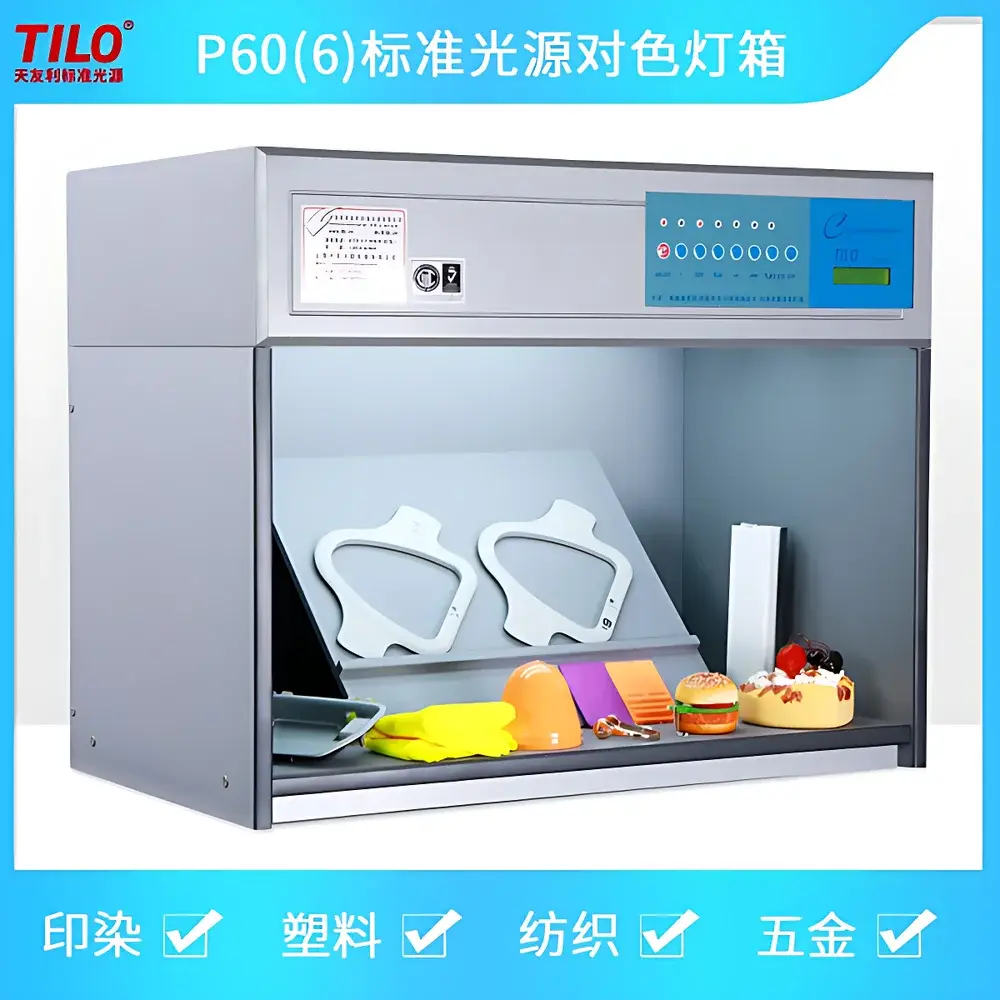
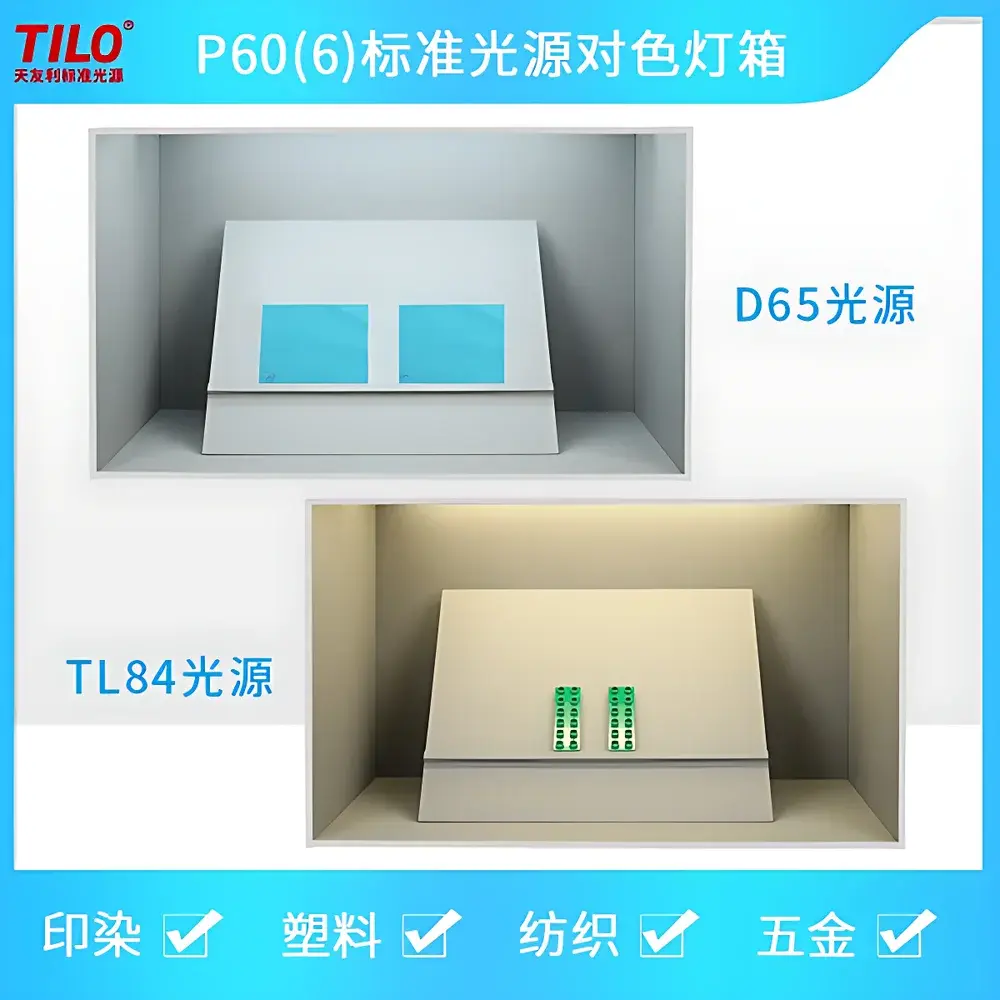
TILO P60(6) Six-Source Standard Light Booth
| Brand | TILO |
|---|---|
| Origin | Shenzhen, China |
| Model | P60(6) |
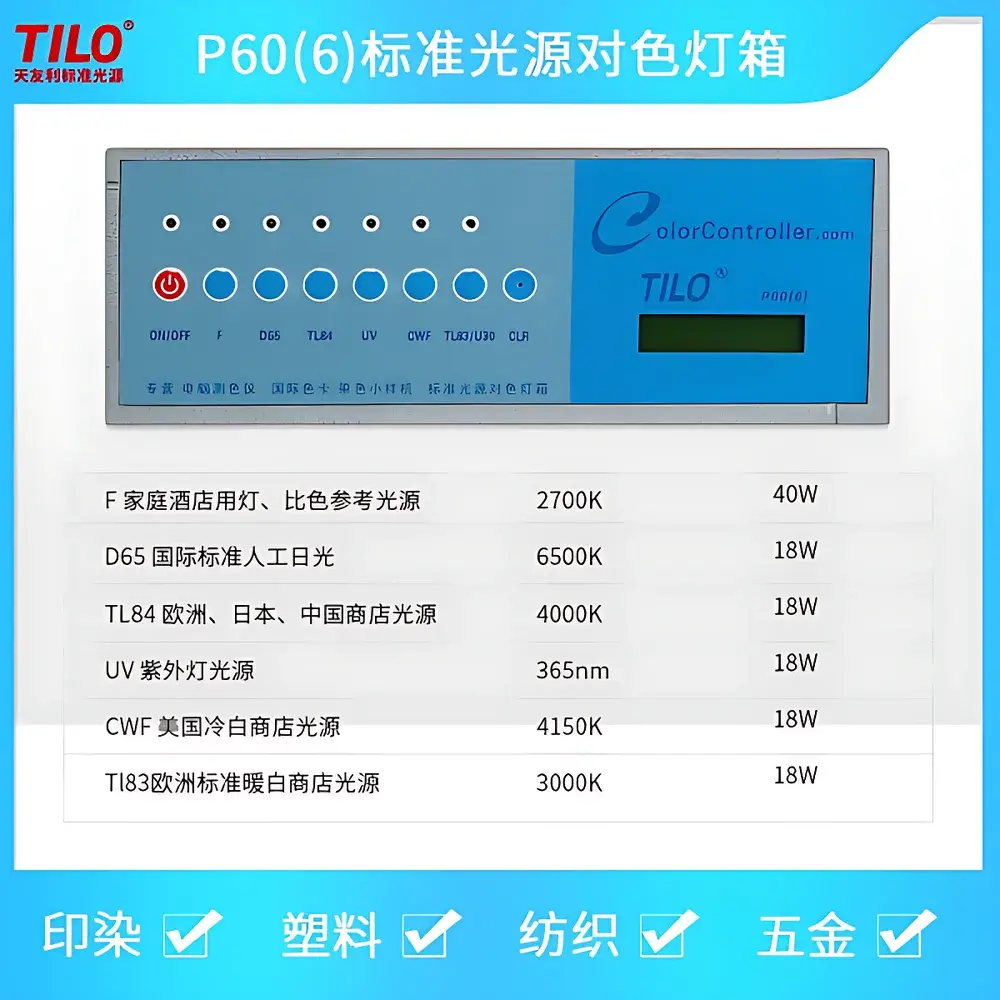
| Light Sources | D65, TL84, CWF, F, UV (365 nm), TL83 (U30) |
| External Dimensions | 712 × 535 × 545 mm |
| Internal Cavity Dimensions | 680 × 508 × 360 mm |
| Lamp Power | 18 W (D65, TL84, CWF, UV, TL83), 40 W (F) |
| Color Rendering Index (CRI) | ≥90 for all standard sources |
| Switching Method | Automatic sequential or manual selection |
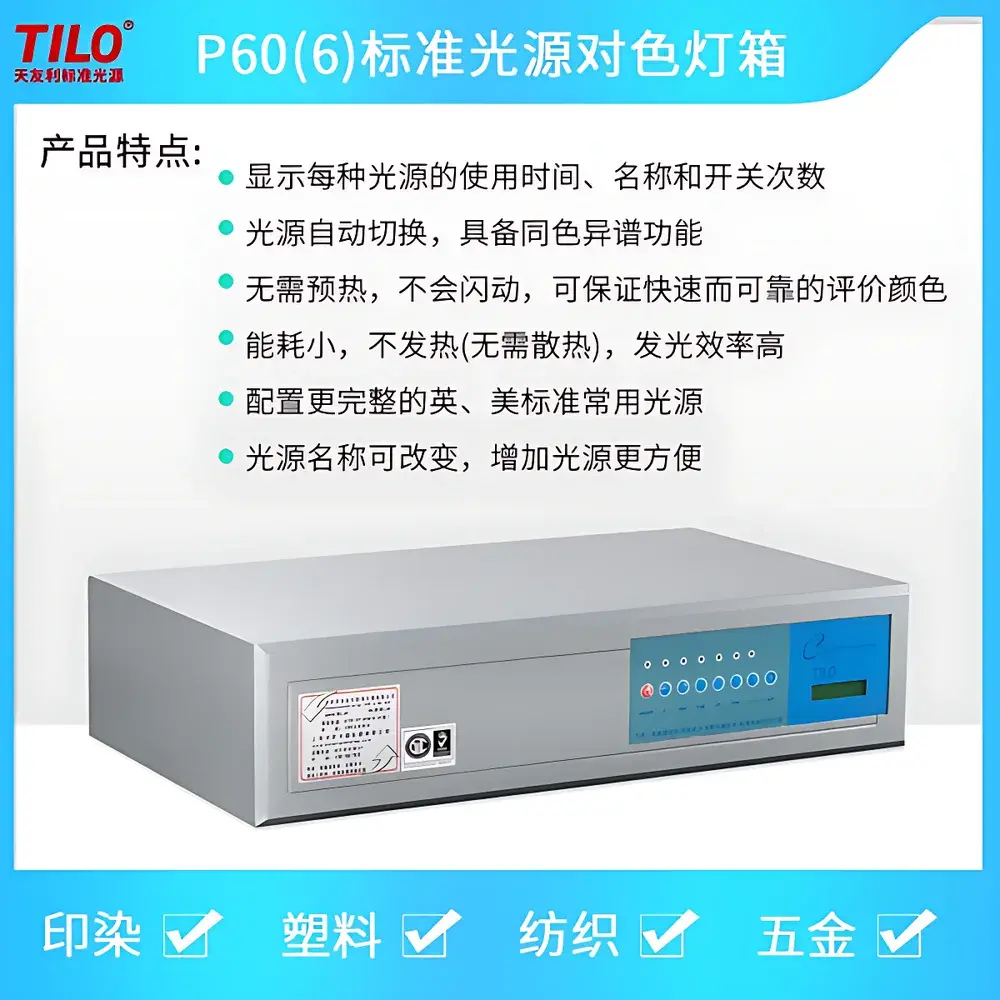
| Operational Status Display | Real-time source usage time, name, and activation count |
| Warm-up Time | 0 s (instant-on LED-compatible fluorescent lamps) |
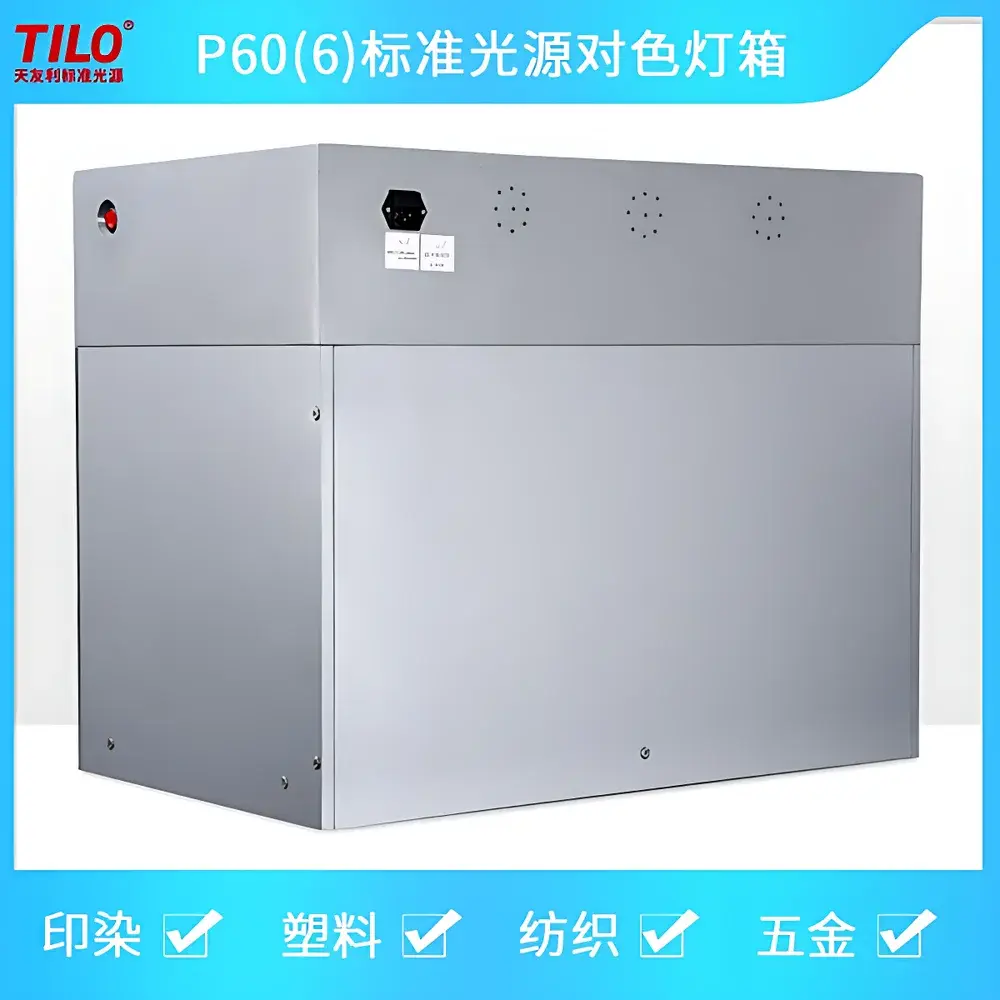
| Thermal Management | Passive cooling (no fan, no heat accumulation) |
| Compliance | Meets ISO 3664:2009, ASTM D1729–16, and GB/T 3978–2008 requirements for color evaluation environments |
Overview
The TILO P60(6) Six-Source Standard Light Booth is an engineered optical evaluation system designed to eliminate metamerism-induced color assessment errors in quality control, R&D, and production environments. It operates on the principle of standardized illuminant simulation—reproducing six internationally recognized light spectra under controlled geometric, photometric, and chromatic conditions. Unlike broadband or uncalibrated lighting setups, the P60(6) integrates spectrally optimized fluorescent tubes compliant with ISO 3664:2009 Annex A specifications for graphic technology and photography, ensuring traceable spectral power distribution (SPD) across D65 (6500 K daylight), TL84 (4000 K retail store), CWF (4150 K U.S. cool white), F (2700 K incandescent reference), UV (365 nm ultraviolet excitation), and TL83/U30 (3000 K warm white). Its instant-on capability, zero warm-up delay, and absence of flicker enable rapid, repeatable visual assessments without temporal drift—a critical requirement for high-throughput QC labs operating under GLP or ISO/IEC 17025 frameworks.
Key Features
- Simultaneous spectral fidelity: Each lamp meets minimum CRI ≥90 and SPD tolerances defined in ISO/CIE standards for critical color matching.
- Real-time operational telemetry: Onboard display logs cumulative usage time, source name, and switch count per lamp—supporting preventive maintenance scheduling and audit-ready documentation.
- Programmable illumination sequencing: Supports automatic cycling between sources at user-defined intervals (e.g., 5–30 s dwell), facilitating side-by-side metameric comparison without manual intervention.
- Thermally stable architecture: Fanless passive thermal design eliminates airflow-induced dust migration and vibration artifacts—preserving sample integrity during extended evaluations.
- Modular lamp interface: Standard G13 bi-pin sockets allow field replacement with certified lamps; firmware supports custom source naming and future expansion (e.g., adding A, D50, or Horizon sources).
- Ergonomic viewing geometry: Matte-black interior with 45°/0° viewing angle configuration minimizes specular reflection and glare, conforming to ISO 3664:2009 observer positioning guidelines.
Sample Compatibility & Compliance
The P60(6) accommodates flat, rigid, or flexible specimens up to 680 mm × 508 mm × 360 mm (L×W×H), including textiles, plastics, coatings, printed substrates, automotive trim, and cosmetic packaging. Its internal cavity meets ISO 3664:2009 luminance uniformity requirements (±20% across central 75% area) and illuminance stability (±5% over 1 h). All lamp types are validated against ASTM D1729–16 for colorimetric consistency and GB/T 3978–2008 for general color rendering. The booth is routinely deployed in laboratories subject to FDA 21 CFR Part 11-compliant workflows when paired with electronic logbook integration, and supports full traceability for ISO 9001:2015 clause 8.5.1 (control of production and service provision) and ISO 14001:2015 environmental labeling verification.
Software & Data Management
While the P60(6) operates as a standalone hardware platform, its telemetry interface (RS-232 or optional USB-to-serial) enables integration with laboratory information management systems (LIMS) or QC data repositories. Logged parameters—including lamp activation timestamps, total operational hours per source, and manual override events—are exportable as CSV for trend analysis. Firmware updates preserve backward compatibility and support configurable alert thresholds (e.g., lamp life >8,000 h), aligning with preventive maintenance schedules required under ISO/IEC 17025:2017 clause 6.4.2 (equipment calibration and verification). No proprietary software installation is required; raw serial output conforms to Modbus RTU protocol for third-party SCADA or MES ingestion.
Applications
- Textile dye lot approval against master standards under D65 and TL84 illumination.
- Detection of UV-fluorescent additives or optical brighteners using the 365 nm source.
- Metameric failure analysis in automotive OEM supply chains where parts must match under both daylight (D65) and showroom (TL84) conditions.
- Pharmaceutical packaging color verification per USP <661> and EU Annex 15 guidelines for container-closure system aesthetics.
- Graphic arts proof validation per ISO 12647-2:2013, requiring simultaneous evaluation under D50 (simulated by D65 + filter) and TL84.
- Plastic resin batch release testing where thermal history affects pigment dispersion—enabled by consistent, non-thermal illumination eliminating heat-induced hue shift.
FAQ
Does the P60(6) comply with ISO 3664:2009 for graphic arts applications?
Yes—the spectral output, illuminance uniformity, and viewing geometry meet all mandatory clauses in ISO 3664:2009 Annex A for critical color evaluation environments.
Can I replace lamps with non-TILO branded tubes?
Only lamps certified to ISO 3664:2009 spectral class B (or higher) and physically compatible with G13 sockets are recommended; uncertified replacements invalidate compliance claims and degrade CRI performance.
Is UV exposure safe for operators during routine use?
The 365 nm UV source emits Class 1 LED-equivalent irradiance (≤1.0 mW/cm² at 30 cm); no PPE is required, but direct ocular exposure beyond 30 seconds is discouraged per IEC 62471 photobiological safety guidelines.
How often should lamp calibration be verified?
Annual spectral radiance verification using a NIST-traceable spectroradiometer is advised; TILO provides accredited calibration services with ISO/IEC 17025-certified reports.
Does the unit support D50 simulation?
D50 is not natively installed, but can be approximated via D65 + neutral density filtering; TILO offers optional D50 retrofit kits compliant with ISO 12647-2:2013 requirements.





