
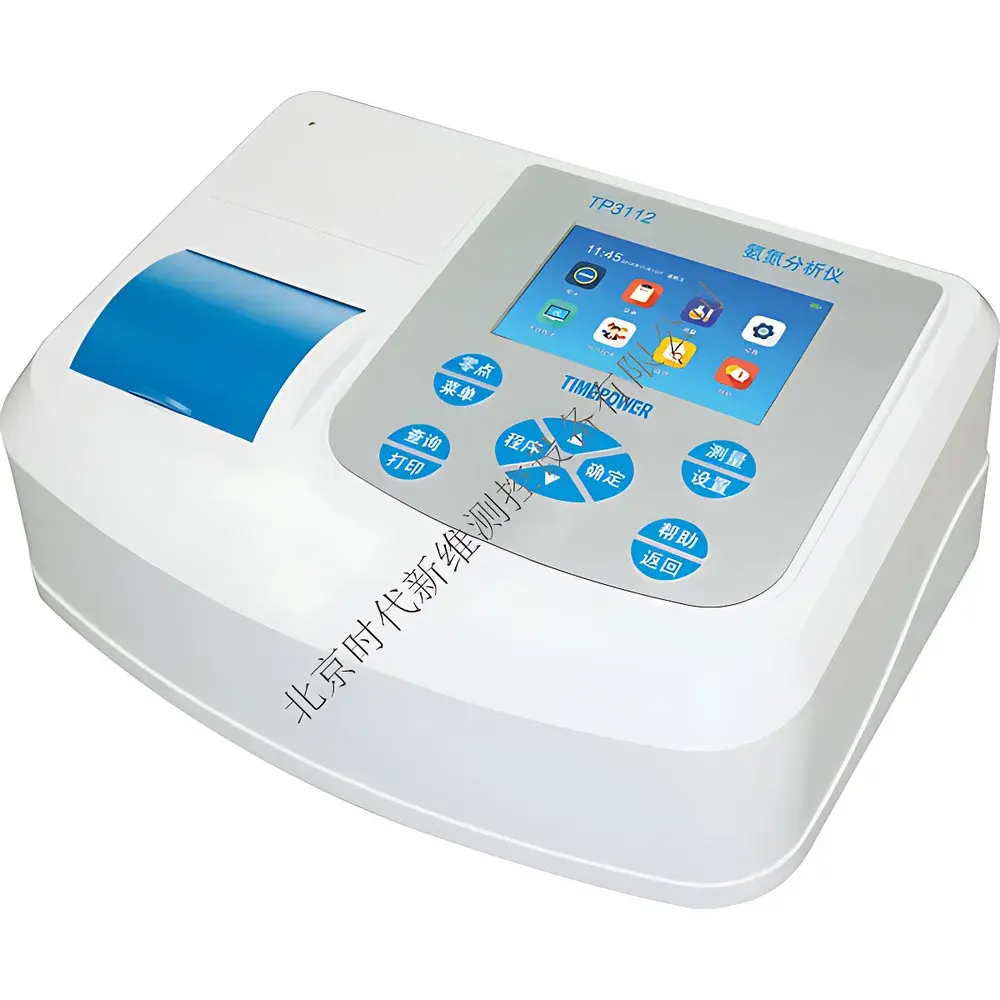
Timepower TP-3111 Permanganate Index (CODMn) Analyzer
| Brand | Timepower |
|---|---|
| Origin | Beijing, China |
| Manufacturer Type | Direct Manufacturer |
| Instrument Type | Benchtop Laboratory Analyzer |
| Measurement Principle | Potassium Permanganate Oxidation with ORP Endpoint Detection |
| Range | 0.1–10 mg/L (multi-segment calibration) |
| Repeatability | ≤5% RSD |
| Accuracy | ±5% of reading |
| LOD | 0.4 mg/L |
| Resolution | 0.01 mg/L |
| Single-Test Duration | 13 min (water bath heating) |
| Display | Backlit LCD with keypad interface |
| Data Storage | 30,000 measurement records with power-loss protection |
| Calibration Curves | 1 built-in standard curve + 96 user-defined curves |
| Connectivity | Ethernet port + USB 2.0 |
| Output | Integrated thermal printer |
| Light Source | Imported long-life cold LED (rated lifetime: 100,000 h) |
| Operating Modes | Standard mode / Continuous measurement mode |
| Reagent Compatibility | Dedicated pre-packaged CODMn test kits (ISO/GB-compliant) |
Overview
The Timepower TP-3111 Permanganate Index (CODMn) Analyzer is a benchtop laboratory instrument engineered for precise, standardized determination of the permanganate index—a key indicator of oxidizable organic and inorganic substances in water samples. It implements the classical potassium permanganate oxidation method under acidic conditions, followed by potentiometric endpoint detection via oxidation-reduction potential (ORP) monitoring—fully compliant with GB/T 11892–1989, the Chinese national standard equivalent to ISO 8467:1993 (Water quality — Determination of permanganate index). Unlike dichromate-based COD (CODCr) methods, the Mn-method selectively oxidizes low-molecular-weight organics and certain reductants (e.g., Fe2+, NO2−, S2−), making it especially suitable for monitoring relatively clean waters such as surface water, drinking water sources, and treated effluents. The TP-3111 automates the critical 13-minute water bath digestion step, eliminating manual timing errors and ensuring consistent thermal exposure across batches.
Key Features
- ORP-based endpoint detection ensures objective, operator-independent termination of oxidation—minimizing subjective color interpretation errors inherent in visual titration.
- Benchtop architecture with integrated water bath heater, precision temperature control (±0.5 °C), and real-time reaction monitoring.
- High-stability cold LED optical system (100,000 h lifetime) provides consistent photometric performance without warm-up drift or lamp replacement downtime.
- Dual-mode operation: Standard mode for regulatory compliance testing; continuous mode for high-throughput screening with automated sample queue handling.
- Onboard thermal printer supports immediate hardcopy output of current results, calibration logs, and full audit trails—including date/time stamps, operator ID, and method version.
- Robust data management: 30,000-result storage with non-volatile memory and automatic power-fail recovery; supports GLP-aligned record retention.
Sample Compatibility & Compliance
The TP-3111 accepts raw, filtered, or centrifuged aqueous samples within pH 4–9 and turbidity < 5 NTU. It is validated for use with natural surface waters, groundwater, municipal secondary effluents, and low-strength industrial discharges. Sample volume requirement is 100 mL per test. All reagents are supplied as sealed, lot-certified kits conforming to GB/T 11892 specifications—including standardized KMnO4 titrant, H2SO4 digestion medium, and Na2C2O4 standard solution. The analyzer meets essential requirements of ISO/IEC 17025:2017 for testing laboratories and supports traceable calibration through NIST-traceable reference materials. Its firmware includes configurable audit trail logging aligned with FDA 21 CFR Part 11 principles (user authentication, electronic signatures, immutable event logs).
Software & Data Management
Instrument control and data export are managed via embedded firmware with menu-driven navigation and multilingual UI support (English default). Raw ORP curves, temperature profiles, and endpoint timestamps are stored with each result. Data export is supported via USB mass-storage mode (CSV format) or Ethernet TCP/IP protocol for integration into LIMS or SCADA systems. PC software (optional) enables advanced reporting: trend analysis across sample batches, QC charting (X-bar/R charts), and automatic generation of compliance reports per GB/T 11892 Annex A. All stored data include metadata: sample ID, analyst ID, calibration status, reagent lot number, and environmental chamber temperature.
Applications
- Regulatory monitoring of source water and drinking water treatment plant intakes (e.g., reservoirs, rivers).
- Environmental impact assessment of agricultural runoff and urban stormwater.
- Process control in wastewater treatment facilities where low-COD influents require sensitive detection.
- Research applications in limnology, hydrochemistry, and biodegradability studies of emerging contaminants.
- Educational use in university environmental engineering labs for method validation and inter-laboratory comparison exercises.
FAQ
What is the difference between CODMn and CODCr?
CODMn uses potassium permanganate under mild acidic conditions and measures only readily oxidizable substances; CODCr employs potassium dichromate under strong acid reflux and oxidizes ~95% of organics. They are not numerically interchangeable.
Does the TP-3111 require daily recalibration?
No—calibration is performed per batch using certified oxalic acid standards. The instrument validates calibration integrity before each run via blank and standard checks.
Can it analyze seawater or high-salinity samples?
Not recommended. Chloride interference above 300 mg/L may suppress permanganate oxidation efficiency; desalination pretreatment is required.
Is method validation documentation provided?
Yes—each unit ships with a Factory Performance Verification Report, including linearity (R² ≥ 0.999), LOD/LOQ verification, and repeatability test data per ISO 5725-2.
How is reagent stability ensured during long-term storage?
All kit components are vacuum-sealed with desiccant and light-blocking packaging; shelf life is 18 months unopened at 4–25 °C.
Related Products







