
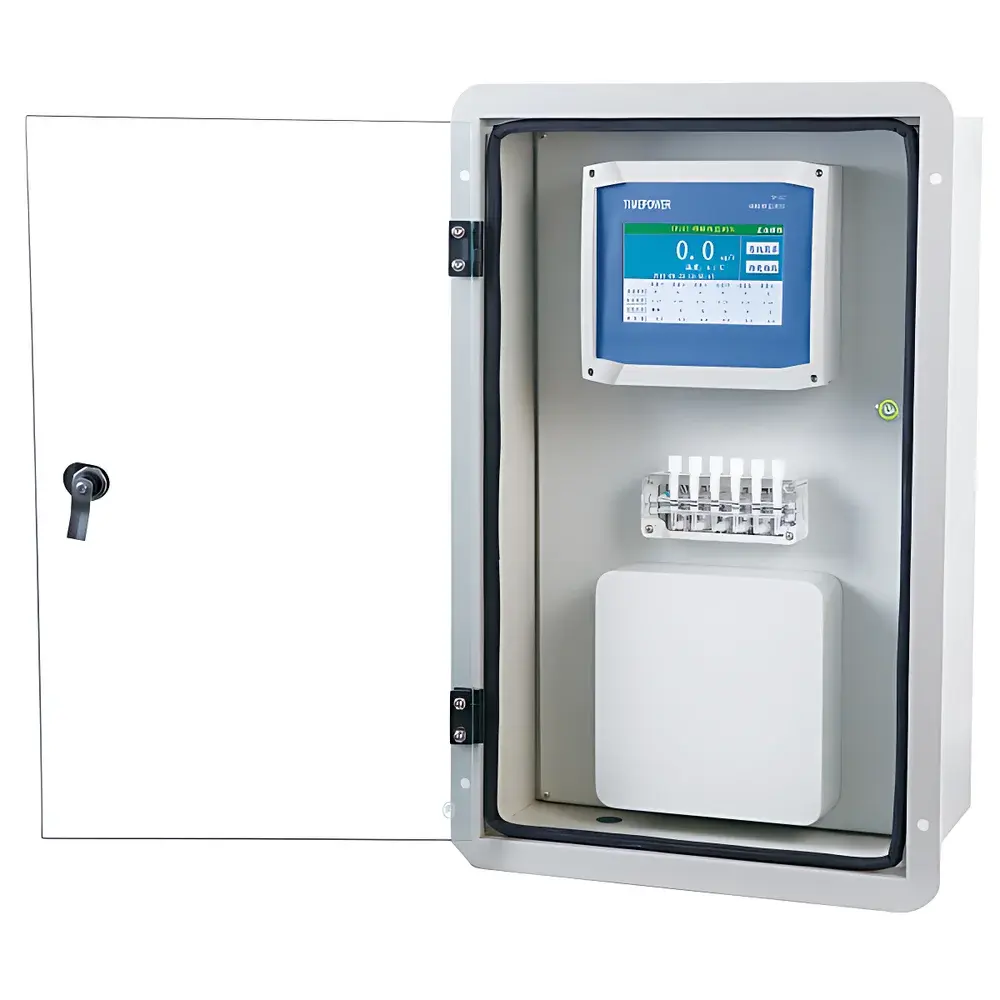
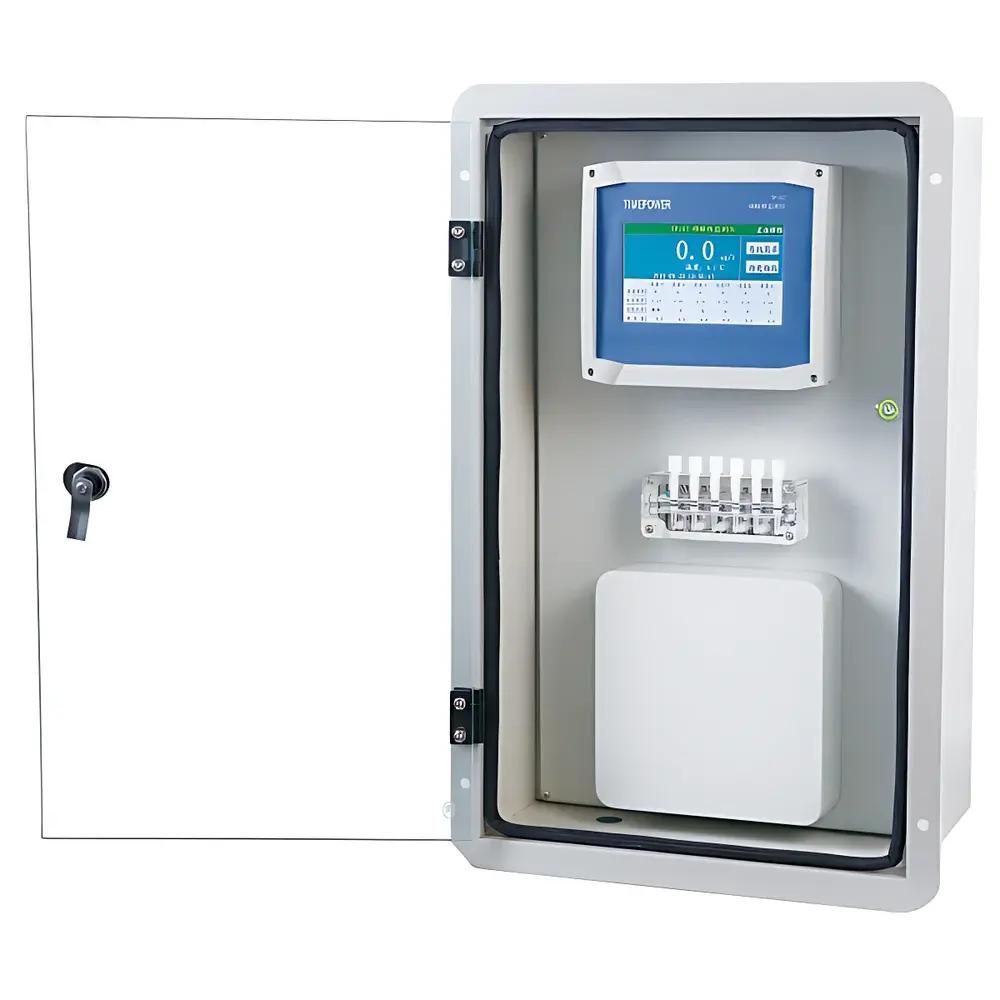
Timepower TP107 Online Phosphate Analyzer
| Brand | Timepower |
|---|---|
| Model | TP107 |
| Type | Online Analyzer |
| Origin | Beijing, China |
| Manufacturer | Timepower (Producer) |
| Measurement Principle | Vanadomolybdophosphoric Yellow Colorimetry (Acidic Medium) |
| Display | 7.0-inch Color TFT Touchscreen (Chinese UI) |
| Range Options | 0.00–20.00 mg/L or 0.00–50.00 mg/L |
| Accuracy | ±2% F.S. |
| Repeatability | ≤±1% F.S. |
| Drift | ≤±1% F.S./24 h |
| Response Time | < 4 min |
| Cycle Time | ~3 min per channel |
| Sample Flow Rate | 10–40 L/h |
| Sample Temp. | 5–50 °C |
| Suspended Solids | < 5 µm, non-colloidal |
| Ambient Temp. | 5–45 °C |
| Ambient Humidity | ≤90% RH (non-condensing) |
| Reagent Consumption | ~3 L/month |
| Output Signals | Isolated 0–20 mA / 4–20 mA / 0–10 mA (programmable) |
| Alarm Outputs | Independent per channel (flow loss, high/low limit) |
| Power Supply | AC 85–265 V, 45–65 Hz |
| Power Consumption | ≤100 W |
| Dimensions (W×H×D) | 460 × 720 × 280 mm |
| Panel Cutout | 670 × 410 mm |
| Weight | 22 kg |
| Compliance | GB/T 6913–2008 |
Overview
The Timepower TP107 Online Phosphate Analyzer is a dedicated photometric instrument engineered for continuous, real-time monitoring of orthophosphate (PO₄³⁻) concentration in aqueous process streams. It operates on the vanadomolybdophosphoric acid colorimetric method—where phosphate ions in acidic solution react with ammonium metavanadate and ammonium molybdate to form a stable yellow heteropolyacid complex (phosphovanadomolybdate). Absorbance of this complex is measured at a fixed wavelength using a monochromatic cold-light source, and quantified via the Lambert-Beer law. This principle ensures high selectivity for orthophosphate in the presence of common anions such as sulfate, chloride, and nitrate—provided sample pretreatment eliminates interfering species like silicates or suspended solids >5 µm. Designed for unattended operation in demanding industrial environments, the TP107 meets the analytical requirements of GB/T 6913–2008 for boiler feedwater and cooling water analysis, and serves as a robust solution for compliance-driven monitoring where trace-level phosphate control is critical to corrosion inhibition, scale prevention, and regulatory reporting.
Key Features
- Modular multi-channel architecture supporting 1–6 independent measurement channels—enabling cost-effective parallel monitoring of multiple sampling points without redundant hardware.
- High-reliability solenoid valves sourced from internationally certified suppliers, ensuring precise reagent dosing, consistent sample aspiration, and long-term valve cycle life (>500,000 operations).
- Automated dual-point calibration scheduled per user-defined intervals (e.g., every 6 or 24 hours), minimizing manual intervention while maintaining metrological traceability and reducing drift-related uncertainty.
- Embedded data logger retains up to 30 days of timestamped measurement records—including raw absorbance values, calibrated concentrations, calibration events, and system status flags—for root-cause analysis and audit readiness.
- Stable monochromatic LED light source with thermal compensation, delivering <0.5% intensity variation over 12 months—eliminating lamp replacement cycles typical of halogen-based systems.
- Flexible analog output configuration: three isolated current outputs (0–20 mA, 4–20 mA, or 0–10 mA) per channel, fully programmable for integration with PLCs, DCS, or automated chemical dosing controllers.
- Front-accessible panel-mount design with standardized cutout (670 × 410 mm), facilitating retrofit installation in existing control cabinets or analyzer shelters without structural modification.
- 7.0-inch capacitive touchscreen interface with multilayer visualization—simultaneously displaying real-time trends, historical curves (up to 72-hour overlay), alarm states, and maintenance prompts in intuitive Chinese-language UI.
Sample Compatibility & Compliance
The TP107 is validated for use with low-turbidity, non-colloidal water matrices meeting ISO 5667-3:2018 prefiltration guidelines. Sample particulate load must remain below 5 µm; optional inline filtration (e.g., 5-µm polypropylene cartridge) is recommended upstream of the analyzer inlet for applications involving cooling tower blowdown or wastewater-adjacent streams. The instrument complies with GB/T 6913–2008 for phosphate determination in power plant water chemistry, and its measurement uncertainty profile aligns with ASTM D859–22 (Standard Test Method for Silica in Water) when operated within specified environmental limits (5–45 °C ambient, ≤90% RH). While not inherently 21 CFR Part 11 compliant, audit trails, calibration logs, and user access controls can be extended via external SCADA historian systems conforming to GMP/GLP data integrity principles.
Software & Data Management
Data handling is managed by an embedded Linux-based firmware platform with deterministic real-time scheduling. All measurements are time-stamped using an internal RTC synchronized via optional NTP (when connected to plant Ethernet). Historical data is stored in binary-encoded CSV format on internal flash memory and exportable via USB 2.0 port. The system supports Modbus RTU (RS-485) for read-only register access—enabling third-party SCADA integration without proprietary drivers. Calibration parameters, alarm thresholds, and output scaling factors are protected by role-based password authentication (operator vs. engineer level). No cloud connectivity or remote firmware update capability is included, preserving network segmentation integrity in regulated facilities.
Applications
- Power generation: Continuous monitoring of phosphate residual in drum boiler feedwater and condensate polishing loops to prevent caustic embrittlement and maintain AVT-R (All Volatile Treatment – Reduced) chemistry targets.
- Chemical & petrochemical plants: Control of phosphate-based corrosion inhibitors in closed-loop cooling systems and steam condensate return lines.
- Municipal water treatment: Verification of orthophosphate dosing for lead/copper corrosion control in distribution networks (per US EPA Lead and Copper Rule requirements).
- Pharmaceutical manufacturing: Monitoring of purified water (PW) and water-for-injection (WFI) loop phosphate excursions during sanitization validation studies.
- Fertilizer production: Effluent compliance tracking against local discharge limits for total phosphorus (as PO₄³⁻ equivalent).
FAQ
What sample pretreatment is required prior to analysis?
A 5-µm particulate filter is mandatory; colloidal silica or iron hydroxide flocs must be removed via coagulation-filtration if present. Sample temperature must be stabilized between 5–50 °C before entering the analyzer manifold.
Can the TP107 measure total phosphorus, or only orthophosphate?
The TP107 measures only reactive orthophosphate (PO₄³⁻). Total phosphorus quantification requires acid digestion (e.g., persulfate oxidation) upstream of the analyzer—an external pretreatment module is not integrated.
Is the instrument suitable for seawater or brackish water applications?
No. High chloride concentrations (>10,000 mg/L) interfere with the vanadomolybdate reaction kinetics and cause spectral overlap. It is validated exclusively for freshwater and low-salinity industrial process waters.
How often must reagents be replaced?
At nominal flow and 3-minute cycle intervals, reagent consumption averages 3 liters per month. Reagent kits include acid buffer, vanadate-molybdate mix, and reducing agent—each supplied in sealed, light-protected bottles with 12-month shelf life when unopened.
Does the TP107 support remote diagnostics or predictive maintenance alerts?
It provides local event logging (e.g., “low reagent,” “flow fault,” “calibration overdue”) but lacks embedded IoT telemetry. Remote monitoring requires integration with plant-wide asset management software via Modbus or analog signal mapping.
Related Products







