
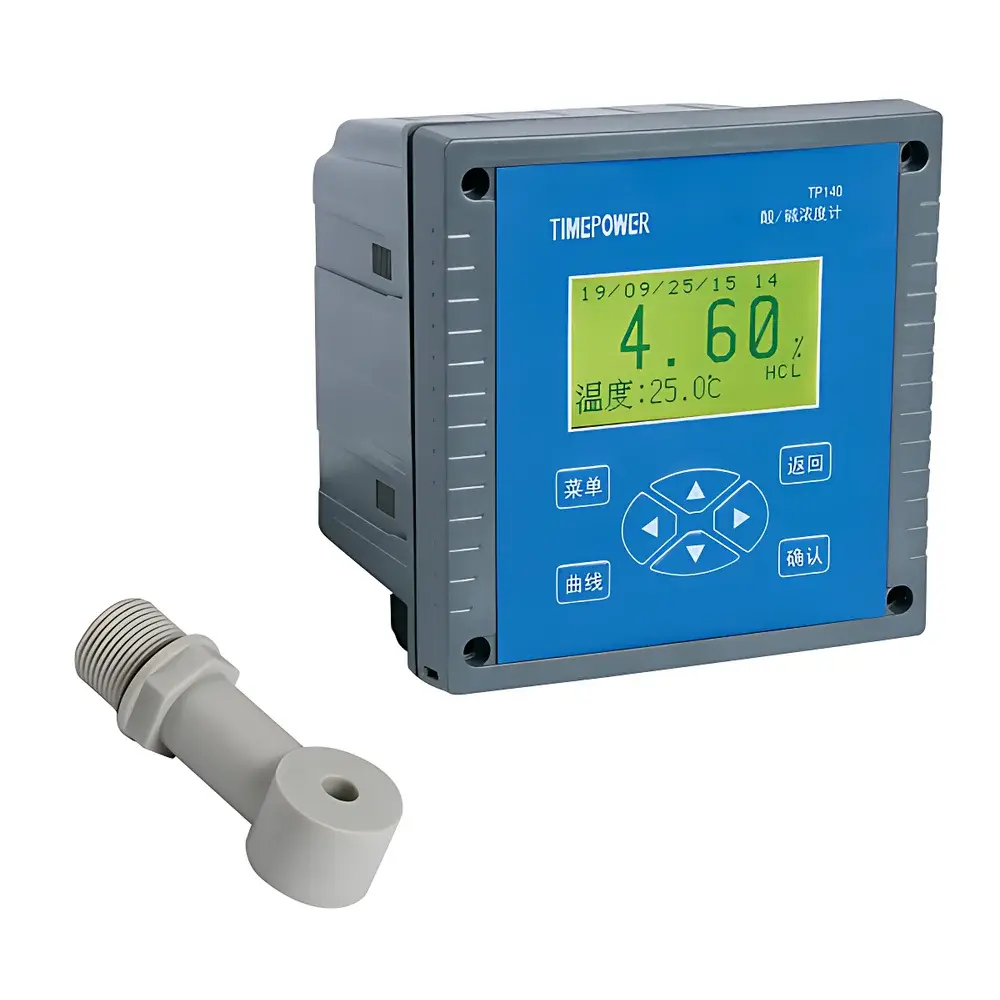
TimePower TP140 Online Acid-Base Concentration Meter
| Brand | TimePower |
|---|---|
| Origin | Beijing, China |
| Manufacturer | TimePower Measurement & Control Co., Ltd. |
| Model | TP140 |
| Output Signals | 0–10 mA / 0–20 mA / 4–20 mA (selectable) |
| Alarm Relays | 2 SPST (AC 220 V / DC 30 V, 3 A) |
| Display | 128 × 64 dot-matrix LCD with Chinese interface |
| Measurement Range | HCl (0–10.00%), NaOH (0–10.00%), H₂SO₄ (0–20.00%), NaCl (0–20.00%), HNO₃ (0–15.00%), Na₂CO₃ (0–10.00%) |
| Accuracy | ±2% FS |
| Resolution | 0.01% |
| Repeatability | <1% FS |
| Temperature Compensation | Pt1000 sensor, 0–60 °C |
| Sample Temp. Range | 5–50 °C |
| Ambient Temp. Range | 5–45 °C |
| Humidity | ≤90% RH (non-condensing) |
| Storage Temp. | −25–55 °C (electrode excluded |
| Power Supply | AC 85–265 V, 45–65 Hz |
| Power Consumption | ≤15 W |
| Enclosure Rating | IP65 |
| Dimensions (W×H×D) | 145 × 120 × 150 mm |
| Panel Cutout | 138 × 138 mm |
| Weight | 0.64 kg |
| Mounting | Panel-mount / wall-mount / rack-mount |
| Electrode Options | Flow-through / immersion / flanged (custom configurations available upon consultation) |
| Data Logging | Cyclic memory with auto-overflow overwrite |
Overview
The TimePower TP140 Online Acid-Base Concentration Meter is an industrial-grade electrochemical analyzer engineered for continuous, real-time monitoring of acid and base concentration in process streams. It operates on the principle of conductometric titration—measuring solution conductivity as a function of ion concentration—and applies temperature-compensated algorithms to deliver stable, linearized readings across multiple electrolyte systems. Designed specifically for high-purity water regeneration cycles (e.g., ion exchange resin regeneration with HCl or NaOH), boiler cleaning preparation, and chemical dosing control in power, pharmaceutical, and semiconductor facilities, the TP140 meets the operational demands of continuous-duty environments where measurement integrity, long-term stability, and corrosion resistance are critical. Its dual-channel capability supports simultaneous monitoring of two different analytes when paired with compatible electrode configurations, while its embedded Pt1000 temperature sensor ensures accurate thermal compensation per IEC 60746-3 guidelines.
Key Features
- Corrosion-resistant flow-through and immersion electrodes constructed from PEEK-bodied, platinum-coated stainless steel or custom ceramic elements—optimized for aggressive media including concentrated HCl, H₂SO₄, and NaOH solutions
- Wide multi-analyte calibration range: programmable for HCl (0–10.00%), NaOH (0–10.00%), H₂SO₄ (0–20.00%), NaCl (0–20.00%), HNO₃ (0–15.00%), and Na₂CO₃ (0–10.00%) with user-defined curve fitting
- High-fidelity signal acquisition via 24-bit analog-to-digital conversion, achieving resolution of 0.01% and repeatability better than 1% FS under controlled flow conditions
- Integrated microcontroller architecture based on low-power ARM Cortex-M4 core, enabling deterministic real-time response, firmware upgradability via USB, and extended service life
- IP65-rated NEMA 4X enclosure with front-panel membrane keypad and backlit 128×64 Chinese-language LCD—designed for visibility in low-light control rooms and humid utility corridors
- Dual independent relay outputs (SPST, AC/DC rated) configurable for high/low concentration alarms, pump interlocks, or system fault signaling with adjustable hysteresis
Sample Compatibility & Compliance
The TP140 is validated for use with aqueous solutions containing strong electrolytes at temperatures between 5 °C and 50 °C and pressures up to 0.6 MPa (when used with standard flow cells). It complies with CE marking requirements under the Electromagnetic Compatibility Directive 2014/30/EU and Low Voltage Directive 2014/35/EU. While not certified to ATEX or IECEx standards for hazardous areas, its design adheres to EN 61000-6-2 (immunity) and EN 61000-6-4 (emissions) for industrial environments. For regulated industries, the instrument supports audit-ready operation: all calibration events, alarm triggers, and configuration changes are timestamped and stored locally with >10-year non-volatile retention. Optional RS485 Modbus RTU interface enables integration into SCADA systems compliant with ISA-88 and ISA-95 frameworks.
Software & Data Management
No proprietary PC software is required for basic operation—the TP140 features a fully navigable Chinese menu system with intuitive parameter setup, calibration wizards, and real-time trend display. However, optional TimePower Configuration Utility (Windows-based) provides advanced diagnostics, batch export of logged data (CSV format), and firmware version management. All internal logs—including concentration values, temperature readings, relay status, and power-on cycles—are stored in circular buffer memory with automatic overwrite on overflow. Timestamps follow ISO 8601 format (YYYY-MM-DD HH:MM:SS), and data integrity is preserved during brownouts or unplanned shutdowns via supercapacitor-backed RAM. For GLP/GMP environments, the device supports manual calibration logging with operator ID entry (via alphanumeric keypad), though electronic signature functionality requires external LIMS integration.
Applications
- Monitoring HCl concentration during cation resin regeneration in high-purity water systems for power generation and microelectronics manufacturing
- Controlling NaOH dosage in anion resin regeneration loops to prevent over-treatment and minimize waste disposal costs
- Verifying acid concentration prior to boiler tube chemical cleaning (per ASTM D4582 and EPRI TR-102994 protocols)
- Continuous verification of neutralization tank effluent pH surrogate via conductivity-concentration correlation in wastewater pretreatment
- Supporting USP <797> environmental monitoring by ensuring correct concentration of sanitizing agents (e.g., diluted phosphoric acid) in cleanroom utilities
- Integration into automated chemical feed systems for cooling tower blowdown control where conductivity-based alkalinity estimation replaces discrete pH probes
FAQ
What electrolytes can the TP140 measure?
The TP140 is factory-calibrated for six common industrial electrolytes: hydrochloric acid (HCl), sodium hydroxide (NaOH), sulfuric acid (H₂SO₄), sodium chloride (NaCl), nitric acid (HNO₃), and sodium carbonate (Na₂CO₃). Custom calibration curves may be loaded for other strong electrolytes upon request.
Is temperature compensation automatic?
Yes—each measurement channel uses an integrated Pt1000 sensor to continuously monitor sample temperature within 0–60 °C and applies NIST-traceable polynomial compensation to conductivity readings per ISO 7888.
Can the TP140 operate in explosion-hazardous areas?
No—the TP140 is not intrinsically safe or explosion-proof certified. It must be installed outside classified zones or within purged enclosures meeting NEC Article 500 requirements.
How is calibration performed?
Calibration is conducted using certified standard solutions at two points (e.g., 0% and full-scale). The instrument guides users through zero and span adjustments via on-screen prompts; no external software is required.
What is the expected service life of the conductivity cell?
With proper maintenance—including periodic cleaning with 5% citric acid and avoidance of suspended solids—the flow-through electrode typically delivers 24–36 months of stable performance in continuous operation at ≤50 °C.






