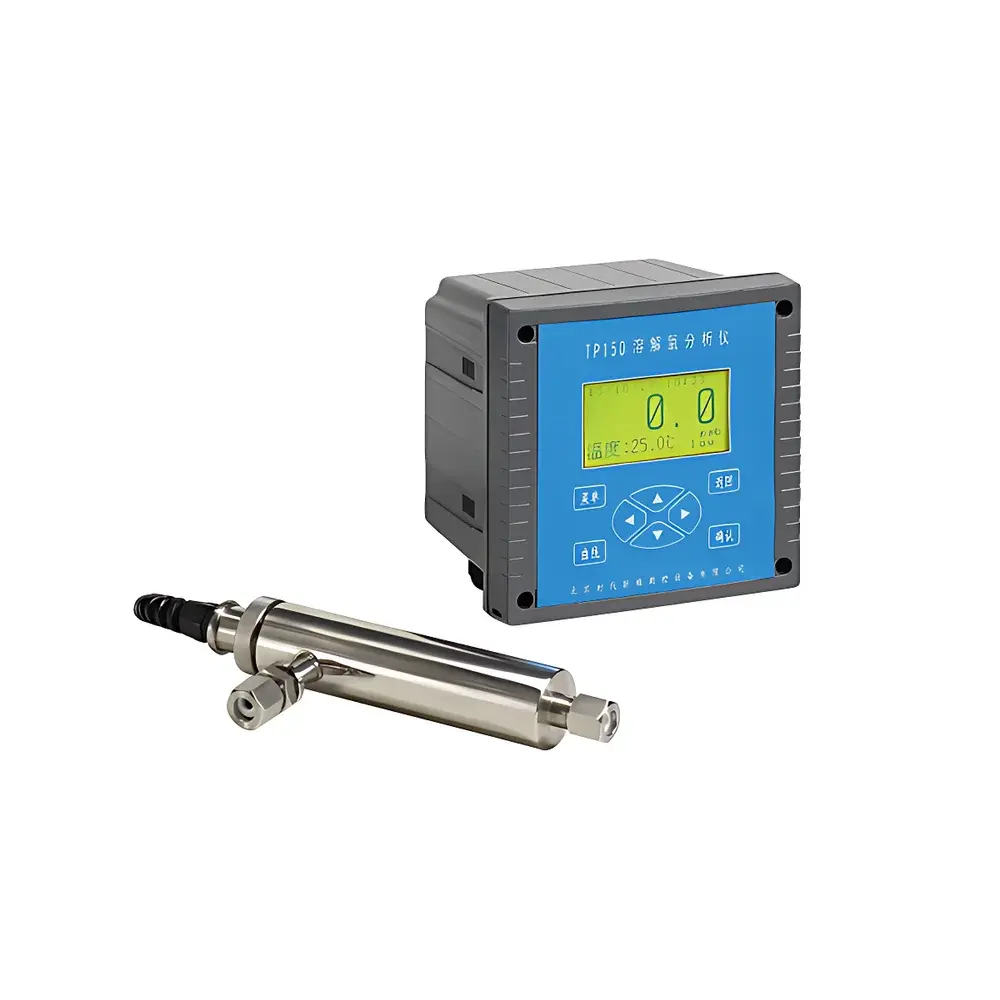
TimePower TP150 Online Dissolved Oxygen Analyzer
| Brand | TimePower |
|---|---|
| Model | TP150 |
| Origin | Beijing, China |
| Manufacturer | TimePower Co., Ltd. |
| Measurement Range | 0.00–20.00 mg/L |
| Resolution | 0.01 mg/L (in mg/L range) / 0.1 µg/L (in µg/L range) |
| Repeatability | ≤1% FS |
| Stability | ±1.5% FS |
| Temperature Compensation Range | 0.1–80.0 °C |
| Water Sample Temperature Range | 5–80 °C |
| Ambient Temperature Range | 5–45 °C |
| Humidity Limit | ≤90% RH (non-condensing) |
| Output Signals | 0–10 mA / 0–20 mA / 4–20 mA (selectable) |
| Relay Outputs | 2 SPST, AC220V/3A or DC30V/3A |
| Communication Interface | RS485 |
| Display | 128×64 dot-matrix LCD with Chinese interface |
| Power Supply | AC 220 V ±10%, 50 Hz ±1 Hz |
| Power Consumption | <5 W |
| Enclosure Rating | IP65 |
| Dimensions | 142 × 125 × 155 mm (H×W×D) |
| Panel Cutout | 138 × 138 mm |
| Weight | 1.6 kg |
| Data Retention | >10 years after power loss |
| Response Time (T90) | <5 min at 25 °C |
| Sensor Type | Polarographic (Clark-type) with BJC membrane cap rated to 130 °C |
| Temperature Sensor | Pt1000 |
Overview
The TimePower TP150 Online Dissolved Oxygen Analyzer is an industrial-grade electrochemical measurement system engineered for continuous, real-time monitoring of dissolved oxygen (DO) concentration in aqueous process streams. It operates on the polarographic (Clark-type) principle, utilizing a gas-permeable membrane and a noble metal cathode to generate a diffusion-limited current proportional to the partial pressure of molecular oxygen in the sample. The integrated BJC high-temperature membrane cap ensures stable performance under demanding thermal conditions—up to 130 °C—making the TP150 suitable for applications including boiler feedwater deaeration control, pharmaceutical water-for-injection (WFI) systems, bioreactor monitoring, and municipal wastewater treatment. Its dual-range auto-switching capability covers trace-level DO (0.0–100 µg/L), low-concentration (100–1000 µg/L), and standard-range (1.00–20.00 mg/L) measurements without manual intervention, supporting compliance with USP <643>, EP 2.2.43, and ISO 5814:2012 methodologies.
Key Features
- Polarographic sensor architecture with BJC high-temperature membrane cap (rated to 130 °C), enabling long-term stability in steam-heated or sterilizable loop applications
- Triple-range automatic scaling: 0.0–100 µg/L (0.1 µg/L resolution), 100–1000 µg/L (1 µg/L resolution), and 1.00–20.00 mg/L (0.01 mg/L resolution)
- High-fidelity signal acquisition using 24-bit A/D conversion and low-drift analog front-end circuitry, delivering ≤1% FS repeatability and ±1.5% FS long-term stability
- Embedded Pt1000 temperature sensor with full-range compensation (0.1–80.0 °C), supporting Henry’s law-based DO correction per ISO 5814
- Robust industrial enclosure rated IP65, designed for panel-mount installation in humid, chemically aggressive environments
- Configurable isolated analog outputs (0–10 mA, 0–20 mA, or 4–20 mA) and two programmable relay outputs (AC220V/3A or DC30V/3A) for process interlocks and alarm signaling
- Onboard non-volatile memory retains calibration data, historical readings, and configuration settings for >10 years following power loss
Sample Compatibility & Compliance
The TP150 is validated for use with low-conductivity purified water (e.g., PW, WFI, and pure steam condensate), municipal and industrial wastewater, cooling tower make-up water, and fermentation broths. It complies with mechanical and electrical safety standards IEC 61000-6-2 (EMC immunity) and IEC 61010-1 (safety requirements for measurement equipment). Its measurement methodology aligns with ISO 5814:2012 (electrochemical determination of dissolved oxygen) and supports audit-ready operation in regulated environments—calibration logs, event timestamps, and user-access records are retained locally and exportable via RS485 Modbus RTU protocol. While not intrinsically safe, the unit meets Class I, Division 2 requirements when installed per NEC Article 500 guidelines.
Software & Data Management
The TP150 features embedded firmware supporting Modbus RTU over RS485 for integration into DCS, SCADA, or PLC-based control architectures. All configuration parameters—including zero/span calibration points, alarm thresholds, output scaling, and temperature compensation coefficients—are accessible and modifiable via the intuitive Chinese-language LCD menu. No external software is required for routine operation; however, optional PC-based configuration tools enable batch parameter upload/download and trend log extraction. Data logging includes cyclic storage of up to 30 days of 1-minute interval readings, with automatic overwrite upon buffer saturation. Timestamped calibration events and relay activation logs are preserved independently and support GLP/GMP traceability requirements when paired with controlled documentation practices.
Applications
- Boiler feedwater and condensate monitoring for oxygen corrosion prevention per ASME PTC 19.11 and ASTM D867
- Pharmaceutical water systems (PW, WFI, pure steam) meeting USP <643> and EU GMP Annex 1 requirements
- Activated sludge process control in municipal wastewater treatment plants (WWTPs)
- In-line DO monitoring during aerobic bioreactor cultivation in biotechnology manufacturing
- Cooling water system optimization to mitigate microbiologically influenced corrosion (MIC)
- Food & beverage production lines requiring real-time oxygen ingress verification in carbonated or nitrogen-flushed packaging processes
FAQ
What sensor technology does the TP150 employ?
It uses a Clark-type polarographic sensor with a gas-permeable membrane and silver/silver chloride reference electrode, optimized for aqueous solutions with conductivity ≥5 µS/cm.
Is the TP150 suitable for high-purity water applications?
Yes—the low-noise analog design and µg/L-level resolution support accurate DO measurement in ultrapure water systems when paired with appropriate flow-through sensor housings and zero-oxygen calibration standards.
Can the TP150 be calibrated automatically?
No—it requires manual zero and span calibration using certified standards (e.g., sodium sulfite solution for zero, air-saturated water for span), but all calibration parameters are stored with date/time stamps.
Does the device support FDA 21 CFR Part 11 compliance?
The TP150 itself does not provide electronic signature or audit-trail encryption; however, its timestamped calibration and event logs can be incorporated into a broader Part 11–compliant data management system when interfaced via Modbus.
What maintenance intervals are recommended for the membrane and electrolyte?
BJC membrane caps should be replaced every 6–12 months depending on operating temperature and fouling potential; electrolyte replenishment is required every 3–6 months under continuous operation at ambient temperatures.