
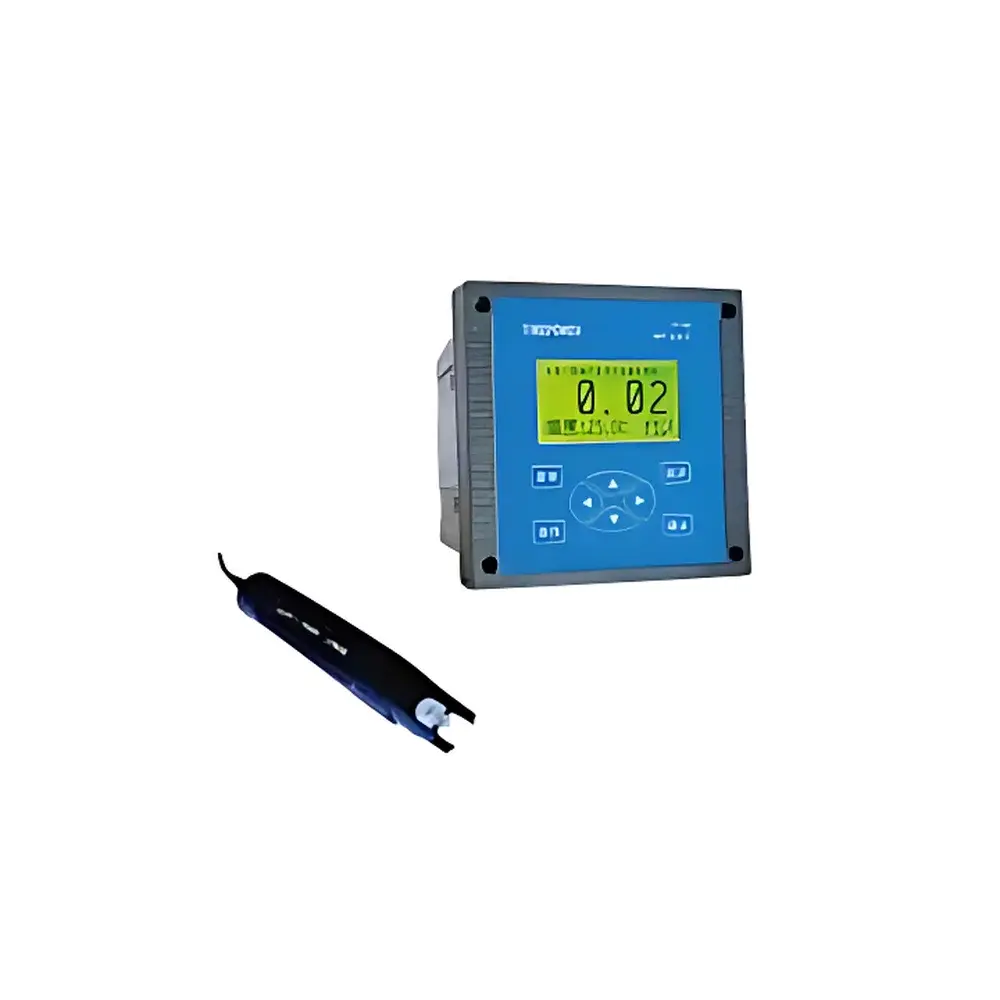
TimePower TP160 Industrial Online ORP Meter
| Brand | TimePower |
|---|---|
| Origin | Beijing, China |
| Manufacturer Type | Manufacturer |
| Product Category | Domestic |
| Model | TP160 |
| Instrument Type | Industrial Online ORP Meter |
| Display | 128×64 Dot-Matrix LCD (Chinese Interface) |
| Measurement Range | ±2000 mV |
| Electrical Accuracy | ±1 mV |
| Resolution | 0.1 mV |
| Temperature Compensation Range | 0–60 °C |
| Sample Temperature Range | 5–60 °C |
| Sample Pressure Limit | < 0.6 MPa |
| Environmental Operating Temperature | 5–45 °C |
| Relative Humidity | ≤90% RH (non-condensing) |
| Storage/Transport Temperature | −25–55 °C |
| Power Supply | AC 85–265 V, 45–65 Hz |
| Power Consumption | ≤15 W |
| Output Signals | Isolated Current Output (0–10 mA / 0–20 mA / 4–20 mA), Load < 300 Ω |
| Relay Outputs | 2 SPST (AC 220 V / 3 A or DC 30 V / 3 A), Configurable Alarm Thresholds |
| Enclosure Rating | IP65 |
| Data Logging | Cyclic Storage with Auto-Overflow Management |
| Memory Retention After Power Loss | >10 Years |
| Dimensions (H×W×D) | 145 mm × 120 mm × 150 mm |
| Panel Cutout | 138 mm × 138 mm |
| Weight | 0.64 kg |
| Electrode Type | Pt-based Redox Electrode (Direct Potentiometric Measurement) |
Overview
The TimePower TP160 Industrial Online ORP Meter is a robust, microprocessor-controlled potentiometric analyzer engineered for continuous oxidation-reduction potential (ORP) monitoring in process water and effluent streams. It operates on the fundamental principle of direct potentiometric measurement using a platinum sensing electrode immersed in the sample medium. The electrode develops an interfacial potential relative to a stable reference—typically Ag/AgCl—driven by electron exchange between the electrode surface and redox-active species (e.g., Cl₂/OCl⁻, Fe³⁺/Fe²⁺, MnO₄⁻/Mn²⁺) present in solution. At equilibrium, this measured potential reflects the thermodynamic tendency of the system to gain or lose electrons, expressed in millivolts (mV) versus the Standard Hydrogen Electrode (SHE). Unlike pH, ORP is a mixed-potential parameter; it does not quantify individual species concentrations but provides a real-time, integrative indicator of overall oxidative or reductive capacity—making it indispensable for disinfection control, corrosion mitigation, and redox-sensitive bioprocesses.
Key Features
- Precision potentiometric architecture with high-input-impedance (>10¹² Ω) analog front-end and 24-bit A/D conversion ensures stable mV-level resolution (0.1 mV) and low-drift performance under variable conductivity conditions.
- Integrated temperature compensation (0–60 °C) via Pt1000 sensor input enables accurate normalization of ORP readings across operational thermal ranges—critical for compliance with ASTM D1129 and ISO 5814 standards.
- IP65-rated NEMA-type enclosure with conformal-coated PCBs and opto-isolated relay outputs supports deployment in harsh industrial environments, including outdoor wet-process areas and chemical dosing skids.
- Configurable current output (4–20 mA standard) with galvanic isolation meets IEC 61000-4 immunity requirements and interfaces seamlessly with DCS, PLC, and SCADA systems without ground-loop interference.
- Onboard cyclic data storage retains up to 30 days of timestamped ORP and temperature records (user-configurable logging interval); memory integrity persists beyond 10 years without power.
- Two independently programmable relay outputs support fail-safe alarm strategies—for example, triggering chlorine feed pumps upon ORP drop below threshold or initiating backwash cycles in membrane filtration systems.
Sample Compatibility & Compliance
The TP160 is validated for aqueous matrices within 5–60 °C and <0.6 MPa pressure, including cooling tower water, wastewater effluent, pharmaceutical purified water (PW), and food-grade rinse solutions. It complies with electromagnetic compatibility (EMC) per IEC 61326-1 and safety requirements per IEC 61010-1. While not certified for SIL or ATEX, its design aligns with functional safety principles for non-safety-critical monitoring per IEC 61511. For regulated industries, audit trails are maintained via manual log export (no built-in FDA 21 CFR Part 11 electronic signature), and calibration records—including buffer verification using quinhydrone (258 mV at pH 4.01) and phosphate (86 mV at pH 6.86)—support GLP documentation workflows.
Software & Data Management
The TP160 operates as a standalone field instrument with no proprietary PC software dependency. All configuration—including relay setpoints, output scaling, temperature coefficient selection, and display contrast—is performed locally via membrane keypad and Chinese-language LCD interface. Data export requires manual transcription or integration via analog/digital I/O into third-party historian platforms (e.g., Siemens Desigo CC, Emerson DeltaV). For traceability, users are advised to maintain external calibration logs aligned with ISO/IEC 17025 metrological requirements. Firmware updates are not field-upgradable; hardware revision control is managed through TimePower’s manufacturing batch documentation.
Applications
- Power generation: Continuous ORP surveillance in condensate polishing units and demineralizer effluent to detect chloride breakthrough and prevent steam-cycle corrosion.
- Chemical manufacturing: Real-time redox control in electroplating baths, bleach synthesis reactors, and catalytic hydrogenation quench streams.
- Environmental engineering: Regulatory compliance monitoring of ORP in municipal wastewater disinfection contact tanks (per EPA Method 180.1) and landfill leachate treatment.
- Pharmaceutical water systems: Trend analysis of ORP in purified water (PW) and water-for-injection (WFI) distribution loops as a secondary indicator of microbial load and oxidant residual.
- Food & beverage processing: Verification of sanitizer efficacy (e.g., peracetic acid, chlorine dioxide) during CIP cycle validation and post-rinse verification.
FAQ
What reference electrode is required for TP160 operation?
The TP160 is designed for use with a combined Pt/Ag-AgCl reference electrode (not included). Separate reference and measuring electrodes may be used if impedance matching and junction potential stability are verified per ASTM D1129 Annex A3.
Can the TP160 measure ORP in high-conductivity seawater?
Yes—provided the electrode junction remains unblocked and the sample temperature stays within 5–60 °C. However, extended exposure to salinity >50,000 µS/cm may accelerate reference electrolyte depletion; regular maintenance and KCl refilling are recommended.
Is temperature compensation mandatory?
While optional, automatic temperature compensation is strongly advised. Uncorrected ORP drift exceeds ±2 mV/°C in many redox couples; omission compromises trending reliability and regulatory acceptance.
How often should calibration be performed?
Field calibration frequency depends on application criticality: daily for disinfection control, weekly for corrosion monitoring, and per batch for pharmaceutical water systems—always referencing traceable quinhydrone or certified redox buffers.
Does the TP160 support MODBUS RTU communication?
No—the TP160 offers only analog current output and relay contacts. For digital integration, external signal converters (e.g., 4–20 mA to MODBUS gateways) are required.




