
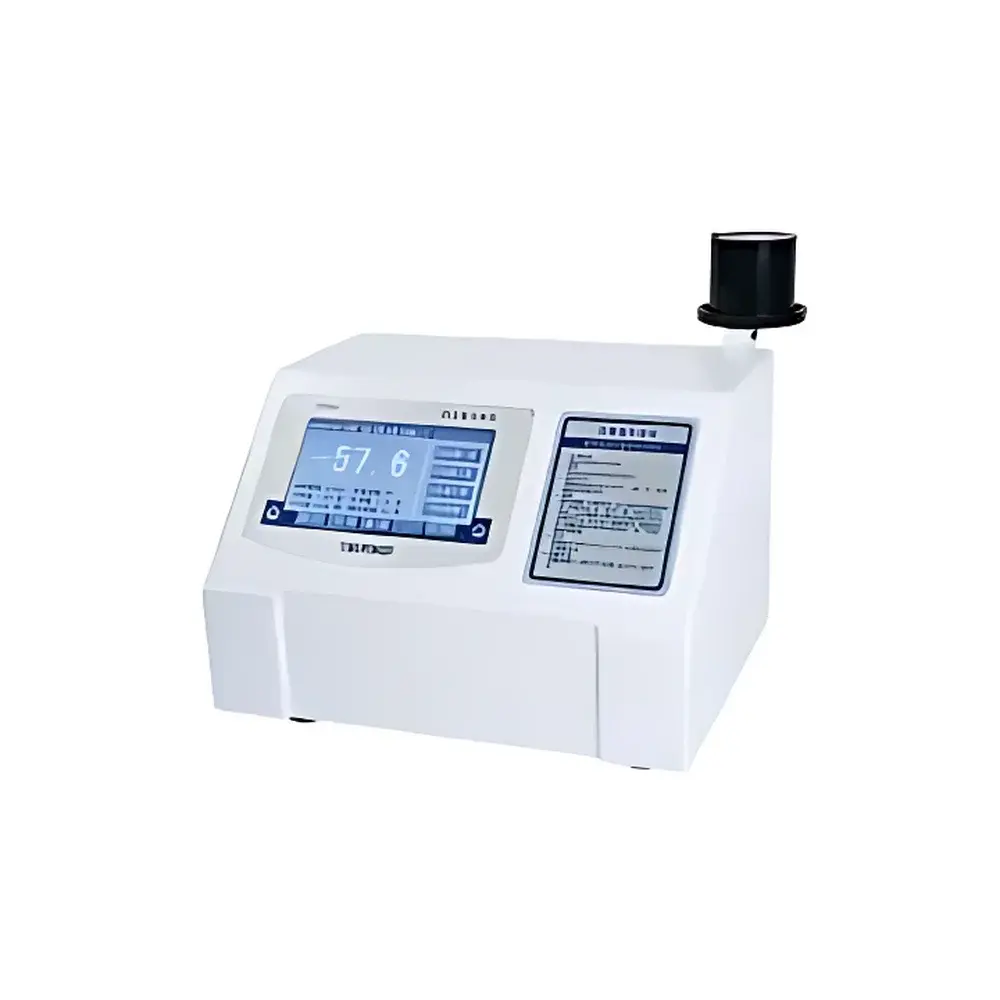
Timepower TP304 Iron Content Analyzer
| Brand | Timepower |
|---|---|
| Origin | Beijing, China |
| Manufacturer Type | Manufacturer |
| Product Category | Domestic |
| Model | TP304 |
| Pricing | Upon Request |
Overview
The Timepower TP304 Iron Content Analyzer is a benchtop photometric analyzer engineered for trace-level quantification of dissolved ferrous (Fe²⁺) and total iron (Fetotal) in ultra-pure water matrices commonly encountered in power generation and thermal cycle systems. It operates on the principle of visible-light photometry based on the 1,10-phenanthroline colorimetric method — a standardized spectrophotometric technique specified in ASTM D1068 and ISO 8586 for low-concentration iron determination. In this method, Fe²⁺ ions form a stable, highly absorbent orange-red complex with 1,10-phenanthroline under controlled pH and reducing conditions; absorbance at 510 nm is linearly proportional to iron concentration per the Beer–Lambert law. The instrument is calibrated and validated for continuous monitoring of boiler feedwater, condensate, steam-cycle condensate, generator internal cooling water, drum boiler water, and natural surface water sources where iron concentrations range from 0.0 to 200 µg/L — a critical range for early detection of corrosion-induced iron release in high-pressure steam systems.
Key Features
- Integrated optoelectronic architecture utilizing imported monochromatic cold-light LED source (510 ± 2 nm), ensuring long-term photometric stability, low thermal drift, and >50,000-hour operational lifetime.
- High-precision analog front-end with auto-zero compensation circuitry and real-time electrical drift correction via blank calibration routine.
- 5.0-inch capacitive touch color LCD interface with native Chinese language support and intuitive icon-driven navigation — optimized for plant-floor usability under variable lighting and glove-handling conditions.
- Embedded microcontroller platform (ARM Cortex-M4 core) delivering deterministic real-time control, ultra-low standby power consumption (<1.2 W), and robust electromagnetic compatibility (EMC) per IEC 61326-1.
- Onboard cyclic data logging supporting up to 256 measurement records with automatic overwrite policy; timestamps include date, time, and operator ID field (configurable).
- Programmable auto-timer function for scheduled calibration prompts, reagent addition alerts, and maintenance reminders — aligned with preventive maintenance protocols in ISO 55001-based asset management systems.
Sample Compatibility & Compliance
The TP304 is validated for aqueous samples with conductivity < 1 µS/cm and turbidity < 0.5 NTU. Sample introduction is manual via supplied sample cup; no integrated autosampler or fluidic manifold is included. All wetted components (cuvette holder, sample tray, reagent reservoirs) are constructed from chemically inert polypropylene and borosilicate glass to prevent leaching or adsorption artifacts. The analyzer complies with GB/T 27025–2019 (equivalent to ISO/IEC 17025) for testing laboratory competence, and its measurement methodology conforms to ASTM D1068–22 (Standard Test Methods for Iron in Water) and DL/T 938–2019 (Guidelines for Chemical Supervision of Thermal Power Plants). For regulated environments, raw data export (CSV format via USB port) supports retrospective audit trails required under GLP and GMP frameworks.
Software & Data Management
Data output is limited to local display and non-volatile memory storage; no proprietary PC software or cloud connectivity is provided. Measurement records include absorbance value, calculated concentration (µg/L), calibration status flag, and timestamp. USB 2.0 interface enables read-only export of logged data for external validation or integration into SCADA/Historian systems (e.g., OSIsoft PI, Ignition). Audit-ready documentation includes factory calibration certificate, optical path verification report, and linearity verification across full 0–200 µg/L span using NIST-traceable iron standard solutions (SRM 1643e).
Applications
- Corrosion monitoring in fossil-fueled and nuclear power plant secondary loops — detecting early-stage carbon steel or copper alloy degradation via soluble iron breakthrough.
- Quality assurance of ultrapure water (UPW) used in turbine lube oil conditioning and hydrogen-cooled generator circuits.
- Performance verification of mixed-bed ion exchange resins and reverse osmosis pretreatment stages.
- Environmental surveillance of intake water sources for iron-related scaling potential in heat exchangers and economizers.
- Periodic compliance testing per DL 5068–2014 (Technical Code for Water and Steam Chemistry Supervision in Thermal Power Plants).
FAQ
What reagents are required for daily operation?
The TP304 requires three reagents: (1) reducing agent (hydroxylamine hydrochloride solution), (2) buffer (acetate buffer, pH 3.5–4.5), and (3) chromogenic reagent (1,10-phenanthroline monohydrate solution). All must be analytical grade or higher and stored in labeled polyethylene containers.
How frequently must calibration be performed?
A blank calibration is mandatory before each measurement session. Full multi-point calibration (at least two points: 0 µg/L and 100 µg/L) is recommended every 14 days or after reagent batch change, per DL/T 938–2019 Clause 6.4.2.
Is the instrument suitable for field use?
No. The TP304 is designed for fixed-lab or control-room deployment only. It requires stable AC power, ambient temperature control (5–45 °C), and relative humidity ≤90% RH without condensation.
Does it support regulatory data integrity requirements?
While the device lacks electronic signature or 21 CFR Part 11 compliance features, its immutable timestamped logs, manual calibration records, and traceable standard usage satisfy paper-based GLP audit requirements when documented per SOP QM-ANL-07.
Can it measure Fe³⁺ directly?
No. The TP304 measures total reducible iron after chemical reduction of Fe³⁺ to Fe²⁺ in the sample digestion step. Total iron quantification assumes complete reduction efficiency under specified protocol conditions.




