
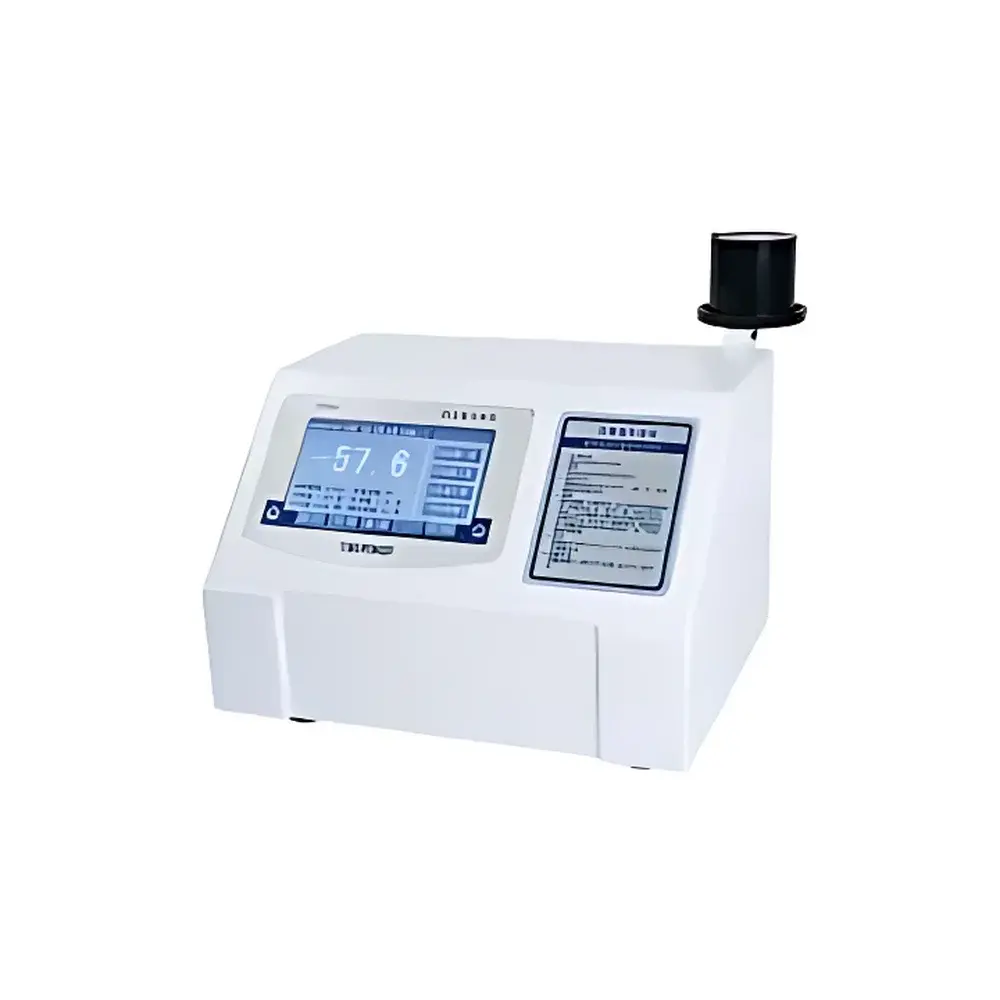
Timepower TP304 Iron Content Analyzer
| Brand | Timepower |
|---|---|
| Origin | Beijing, China |
| Manufacturer Type | Manufacturer |
| Product Category | Domestic |
| Model | TP304 |
| Pricing | Upon Request |
Overview
The Timepower TP304 Iron Content Analyzer is a benchtop photometric analyzer engineered for trace-level iron (Fe²⁺/Fe³⁺) quantification in ultra-pure water matrices critical to power generation and industrial steam cycles. It operates on the principle of visible-light spectrophotometry—specifically, the measurement of absorbance at a defined wavelength following colorimetric complexation of soluble iron species with 1,10-phenanthroline (or equivalent chromogenic reagent). Adhering strictly to the Lambert–Beer law, the instrument correlates optical density (OD) linearly with iron concentration within its calibrated range. Designed for continuous monitoring of boiler feedwater, condensate, turbine steam, generator internal cooling water, drum boiler water, and natural surface waters, the TP304 delivers reliable, low-range quantification essential for corrosion control, cycle chemistry optimization, and compliance with international utility water standards (e.g., IAPWS RP-19, ASTM D1066, and GB/T 12145–2016).
Key Features
- Integrated opto-electronic architecture employing imported cold-light monochromatic LED source—ensuring stable spectral output, minimal thermal drift, and extended operational lifetime (>10,000 hours).
- High-density surface-mount PCB design with embedded microcontroller unit (MCU), optimized for low-power consumption (<30 W) and long-term signal integrity under variable ambient conditions.
- 5.0-inch capacitive touchscreen LCD with native Chinese UI—supporting intuitive navigation, real-time trend visualization, and on-device parameter configuration.
- Automated timing protocol with audible/visual alerts for reagent addition, reaction incubation, and measurement initiation—reducing operator dependency and procedural variability.
- Dual-stage calibration routine: zero-point blank compensation (electrical and optical offset correction) plus periodic multi-point calibration curve verification—minimizing drift-induced bias over extended operation.
- Circular data buffer supporting up to 256 measurement records; automatic overwrite logic preserves recent history while maintaining system responsiveness and storage consistency.
Sample Compatibility & Compliance
The TP304 is validated for aqueous samples with total dissolved solids (TDS) < 10 ppm and conductivity < 0.2 µS/cm—typical of high-purity utility water streams. Sample introduction requires pre-filtration through 0.45 µm membrane filters to eliminate particulate interference. Reagent handling follows strict laboratory-grade protocols: all solutions must be prepared using Type I ultrapure water (resistivity ≥18.2 MΩ·cm), stored in certified polyethylene containers, and maintained at analytical reagent (AR) grade or higher purity. The analyzer supports routine quality assurance per GLP-aligned practices—including daily blank verification and biweekly full calibration—enabling traceable documentation for internal audits or regulatory review (e.g., ISO/IEC 17025, DL/T 912–2018).
Software & Data Management
Data acquisition, storage, and export are managed via onboard firmware without external PC dependency. Measurement logs include timestamp, sample ID (user-defined), raw absorbance value, calculated concentration (µg/L), and calibration status flag. Export options include USB flash drive transfer in CSV format compatible with LIMS integration. While the TP304 does not implement FDA 21 CFR Part 11-compliant electronic signatures or audit trails natively, its deterministic calibration sequence, immutable data buffering, and manual logbook synchronization support alignment with GMP-aligned documentation workflows when deployed in controlled environments.
Applications
- Real-time iron monitoring in fossil fuel and nuclear power plant secondary coolant loops to prevent flow-accelerated corrosion (FAC) in carbon steel piping.
- Verification of demineralizer and mixed-bed resin performance during makeup water treatment.
- Assessment of iron leaching from condensate polishing systems and feedwater heaters.
- Baseline iron profiling in hydroelectric reservoirs and intake sources prior to pretreatment.
- Supporting ASTM D859 and ISO 6332 methodologies for low-concentration iron determination in environmental and process waters.
FAQ
What is the recommended frequency for blank calibration?
Daily blank calibration is mandatory to correct for optical and electronic zero drift. Additional full calibration using certified iron standard solutions is required every 14 days.
Can the TP304 measure both ferrous and ferric iron separately?
No—the instrument reports total soluble iron after reduction to Fe²⁺ using ascorbic acid or similar reducing agent, per standard colorimetric method protocols.
Is the device suitable for field deployment?
It is designed for laboratory or control room use only; ambient operating limits are 5–45°C and ≤90% RH (non-condensing); no IP-rated enclosure is provided.
What reagents are required for routine operation?
Essential consumables include iron-free reagent water, 1,10-phenanthroline solution, reducing agent (e.g., ascorbic acid), and buffer (pH 3.5–4.5); all supplied separately per order specification.
Does the TP304 comply with USP or EP monographs?
While not explicitly validated against pharmacopeial methods, its photometric methodology aligns with general principles outlined in USP <643> and EP 2.2.45 for trace metal analysis in purified water.
Related Products





