
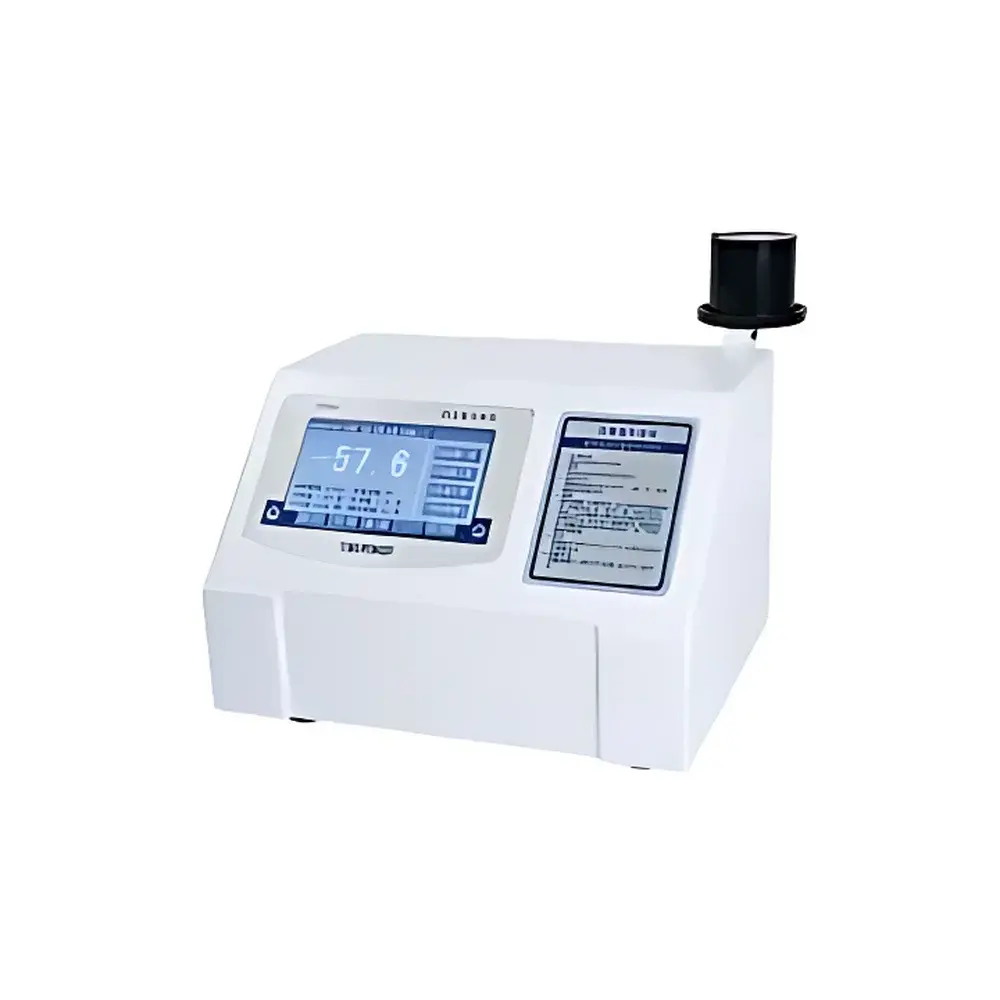
TimePower TP304 Laboratory Iron Ion Analyzer
| Brand | TimePower |
|---|---|
| Model | TP304 |
| Origin | Beijing, China |
| Manufacturer | TimePower (Domestic Producer) |
| Measurement Principle | Photometric Colorimetry (Based on Lambert-Beer Law) |
| Display | 5.0-inch TFT color touchscreen (Chinese UI) |
| Range | 0.0–200 μg/L |
| Accuracy | ±3% F.S. |
| Resolution | 0.1 μg/L |
| Repeatability | ≤1% |
| Stability | ±1.5% F.S. / 4 h |
| Operating Temp. | 5–45 °C |
| Humidity | ≤90% RH (non-condensing) |
| Power Supply | AC 85–265 V, 45–65 Hz |
| Power Consumption | ≤30 W |
| Dimensions | 260 × 200 × 180 mm |
| Weight | 3.2 kg |
| Data Storage | 256 entries (circular buffer) |
| Light Source | Imported monochromatic cold LED |
| Calibration | Automatic zero calibration (blank), periodic curve calibration recommended |
| Compliance Context | Designed for routine QC in power plant water chemistry per ASTM D1066, ISO 5667-3, and DL/T 938 (Chinese thermal power industry standard) |
Overview
The TimePower TP304 Laboratory Iron Ion Analyzer is a dedicated photometric instrument engineered for precise quantification of dissolved ferrous (Fe²⁺) and ferric (Fe³⁺) ions—reported as total elemental iron—in ultra-low-conductivity aqueous matrices. It operates on the fundamental principle of photometric colorimetry: following sample digestion and chromogenic reaction (typically with 1,10-phenanthroline or sulfosalicylic acid reagents), the resulting colored complex absorbs light at a specific wavelength. According to the Lambert-Beer law, absorbance measured at that wavelength is linearly proportional to iron concentration within the validated range of 0.0–200 μg/L. This method is widely adopted in thermal power generation, nuclear facility water chemistry, and high-purity industrial process water monitoring where sub-ppb to low-ppb iron detection is critical to prevent deposition, corrosion under insulation (CUI), and turbine blade fouling.
Key Features
- Integrated optoelectronic architecture utilizing an imported monochromatic cold LED light source—ensuring stable spectral output, minimal thermal drift, and extended service life (>10,000 hours).
- High-density surface-mount PCB design with embedded microcontroller unit (MCU), optimized for low-power operation and electromagnetic interference (EMI) resilience in laboratory and control room environments.
- 5.0-inch capacitive touch TFT display with native Chinese interface—supporting real-time absorbance readout, calibration prompts, and intuitive navigation without external PC dependency.
- Onboard automatic blank calibration function to compensate for optical path contamination, cuvette variability, and electronic zero drift—enhancing measurement reproducibility across shifts.
- Circular memory buffer storing up to 256 measurement records with timestamp; overflow data is automatically overwritten to maintain audit-ready traceability without manual file management.
- Programmable timing alerts for digestion incubation, reagent addition, and calibration intervals—reducing operator dependency and supporting standardized operating procedures (SOPs).
Sample Compatibility & Compliance
The TP304 is validated for use with boiler feedwater, condensate, steam-cycle samples, generator stator cooling water, drum boiler drum water, and natural surface/groundwater sources—provided samples meet conductivity requirements (<1 μS/cm) and are free from suspended solids or organic interferents. Sample preparation follows ASTM D1066 (Standard Practice for Sampling Steam) and ISO 5667-3 (Water quality — Sampling — Part 3: Guidance on preservation and handling of water samples). While the instrument itself is not certified to IEC 61508 or SIL standards, its operational protocol aligns with DL/T 938 (Guidelines for Water and Steam Chemistry Control in Thermal Power Plants) and supports GLP-compliant recordkeeping when paired with controlled reagent logs and calibration documentation. Reagent handling must comply with ISO 8655-5 (volumetric equipment) and CLSI EP21-A (evaluation of precision and stability).
Software & Data Management
Data acquisition and storage are fully embedded—no proprietary software installation required. All measurements, calibration events, and timestamps are retained locally in non-volatile memory. Export functionality is not provided via USB or Ethernet; however, users may manually transcribe values or integrate into LIMS via RS-232 serial output (optional configuration). The system supports 21 CFR Part 11–aligned workflows when used with documented SOPs: blank calibrations are performed daily, full calibration curves are verified biweekly using NIST-traceable iron standards (e.g., Sigma-Aldrich CRM 48017), and all interventions are logged in a bound hardcopy logbook. No remote access, cloud sync, or audit trail automation is implemented—consistent with Class II analytical instrumentation deployed in regulated utility environments.
Applications
- Monitoring iron carryover in high-pressure steam cycles to assess turbine deposit risk per EPRI TR-102532 guidelines.
- Verifying effectiveness of condensate polisher resin regeneration and identifying cation leakage in mixed-bed demineralizers.
- Supporting root cause analysis of flow-accelerated corrosion (FAC) in carbon steel piping networks through trended iron release profiles.
- Validating pretreatment performance in ultrapure water (UPW) systems serving semiconductor fabs or pharmaceutical water-for-injection (WFI) loops.
- Field-deployable verification of iron removal efficiency in membrane filtration and electrocoagulation pilot studies.
FAQ
What reagents are required for iron determination with the TP304?
The analyzer requires iron-specific chromogenic reagents—commonly 1,10-phenanthroline for Fe²⁺ or sulfosalicylic acid for total Fe—supplied separately. Reagents must be analytical grade or higher, stored in labeled polyethylene containers, and prepared using Type I ultrapure water (resistivity ≥18.2 MΩ·cm, TOC <5 ppb).
Is the TP304 compliant with USP or EP monographs?
No. The TP304 is not designed for pharmacopeial compliance (e.g., USP <232>/<233> or Ph. Eur. 2.4.20); it serves industrial water chemistry applications governed by ASTM, ISO, and DL/T standards.
Can the instrument measure other metals?
No. The TP304 is a single-parameter analyzer optimized exclusively for iron. Its optical filter set, reagent chemistry, and calibration algorithm are not interchangeable for copper, silica, or phosphate analysis.
What maintenance schedule is recommended?
Daily: blank calibration; biweekly: full calibration curve verification; quarterly: optical path cleaning with lint-free wipes and isopropanol; annual: LED intensity verification against factory baseline using reference cuvettes.
Does the TP304 support automatic dilution for out-of-range samples?
No. Samples exceeding 200 μg/L must be manually diluted with ultrapure water prior to analysis. Dilution factors must be recorded and applied during result interpretation.






