
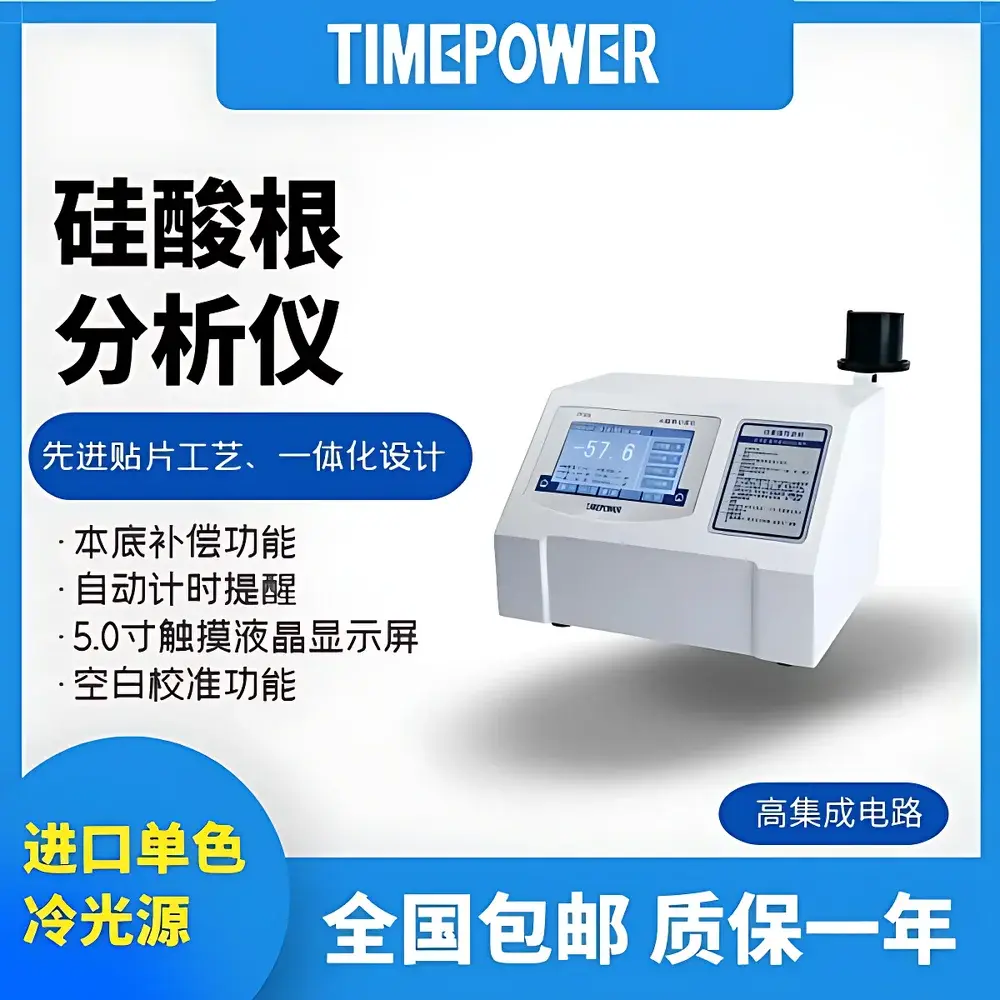
TimePower TP306 Laboratory Silica Analyzer
| Brand | TimePower |
|---|---|
| Origin | Beijing, China |
| Manufacturer Type | Original Equipment Manufacturer (OEM) |
| Product Type | Benchtop Laboratory Analyzer |
| Model | TP306 |
| Measurement Principle | Molybdenum Blue Colorimetric Method (Silicomolybdic Acid Reduction) |
| Display | 5.0-inch TFT color touchscreen with Chinese UI |
| Optical Source | Imported monochromatic cold-light LED (peak λ = 650 nm ± 5 nm) |
| Detection Range | 0–200 µg/L SiO₂ (extendable to 1000 µg/L via dilution) |
| Resolution | 0.1 µg/L |
| Accuracy | ±2% FS or ±1 µg/L (whichever is greater) |
| Repeatability | ≤1.5% RSD |
| Blank Calibration | Automatic zero-point and electronic drift compensation |
| Data Storage | Cyclic memory for up to 256 test records |
| Power Supply | AC 220 V ± 10%, 50/60 Hz |
| Dimensions | 320 × 240 × 180 mm |
| Weight | 4.2 kg |
| Compliance | Designed per GB/T 12149–2019 (Chinese Standard for Silica Determination in Boiler Water and Feedwater), ASTM D859–22 (Standard Test Method for Silica in Water), and ISO 10523:2022 (Water Quality — Determination of pH) |
Overview
The TimePower TP306 Laboratory Silica Analyzer is a benchtop photometric instrument engineered for precise quantification of dissolved silica (as SiO₂) and soluble silicates in ultrapure and process water streams. It operates on the internationally standardized molybdenum blue colorimetric method—where orthosilicic acid reacts with ammonium molybdate under acidic conditions to form silicomolybdic acid, which is subsequently reduced by a reducing agent (e.g., ascorbic acid or 1-amino-2-naphthol-4-sulfonic acid) to yield an intense blue chromophore. Absorbance is measured at 650 nm using a temperature-stabilized, long-life monochromatic cold-light LED source. The system is optimized for low-concentration analysis in critical applications where silica contamination directly impacts heat transfer efficiency, turbine blade deposition, and semiconductor wafer cleanliness.
Key Features
- 5.0-inch high-resolution TFT color touchscreen with intuitive Chinese-language interface—designed for rapid method navigation and real-time parameter visualization.
- Integrated circuit architecture employing advanced SMT (Surface Mount Technology) and embedded microcontroller platform ensures thermal stability, low power consumption (<8 W), and immunity to electrical noise in laboratory environments.
- Optical subsystem utilizes an imported cold-light LED with narrow spectral bandwidth (±5 nm), eliminating the need for mechanical filters or warm-up time—delivering signal stability <0.5% drift over 8 hours.
- Onboard baseline compensation algorithm corrects for reagent blank variability and optical path fouling—critical for sub-5 µg/L silica measurements in condensate and boiler feedwater.
- Automated timing sequence for digestion, reduction, and measurement phases reduces operator dependency and minimizes inter-analyst variability.
- Zero-point calibration routine compensates for both optical zero drift and analog-to-digital converter offset—ensuring trace-level accuracy without external recalibration between runs.
Sample Compatibility & Compliance
The TP306 accepts aqueous samples with turbidity <1 NTU and suspended solids <1 mg/L. It supports direct analysis of deionized water, condensate, steam drum blowdown, and pharmaceutical-grade purified water (PW). Sample volume requirement is 50 mL per test; optional filtration (0.45 µm membrane) is recommended for high-particulate matrices. The analyzer conforms to method validation requirements outlined in ASTM D859–22 and GB/T 12149–2019. While not FDA 21 CFR Part 11–compliant out-of-the-box, its data logging architecture supports audit-trail-ready configurations when integrated with validated LIMS platforms meeting GLP/GMP documentation standards.
Software & Data Management
Internal firmware enables cyclic storage of up to 256 complete analytical records—including date/time stamp, sample ID, calibration status, absorbance value, calculated SiO₂ concentration (µg/L), and operator ID. Data export is supported via USB 2.0 interface (CSV format); no proprietary software is required for retrieval. All stored entries are write-protected after acquisition and cannot be edited or deleted manually—ensuring data integrity for internal QA review. Firmware updates are delivered via encrypted firmware image files, maintaining version traceability per ISO/IEC 17025 clause 5.9.
Applications
- Power generation: Monitoring silica breakthrough in mixed-bed ion exchange effluents and detecting carryover in high-pressure turbine condensate systems.
- Semiconductor manufacturing: Verifying silica levels in UPW (ultrapure water) distribution loops prior to wafer rinsing—meeting SEMI F63 specifications for <10 ng/mL SiO₂.
- Pharmaceutical water systems: Supporting compliance with USP <1231> and EP 2.2.44 for silica in Water for Injection (WFI) and Purified Water (PW).
- Chemical processing: Quantifying silicate leaching from glass-lined reactors or catalyst support materials during batch synthesis.
- Research laboratories: Serving as a reference method for validating online silica sensors or developing new spectrophotometric silica assays.
FAQ
What is the detection limit of the TP306 under standard operating conditions?
The practical quantitation limit is 0.5 µg/L SiO₂ (signal-to-noise ratio ≥10) when using fresh reagents and calibrated cuvettes.
Can the TP306 measure total silica, including particulate forms?
No—it measures only dissolved (reactive) silica. Total silica requires acid digestion pretreatment, which is outside the instrument’s scope.
Is the molybdenum blue method susceptible to phosphate interference?
Yes; concentrations >1 mg/L PO₄³⁻ may suppress color development. The TP306 includes a built-in correction protocol based on simultaneous phosphate screening using a separate wavelength channel.
How often must the optical path be cleaned?
Under normal use with filtered samples, cleaning is recommended every 200 analyses or monthly—whichever occurs first—using lint-free wipes and isopropanol.
Does the TP306 support multi-point calibration curves?
Yes; users can define up to five calibration points spanning the 0–200 µg/L range, with linear or quadratic regression options enabled in firmware v2.3+.
Related Products







