
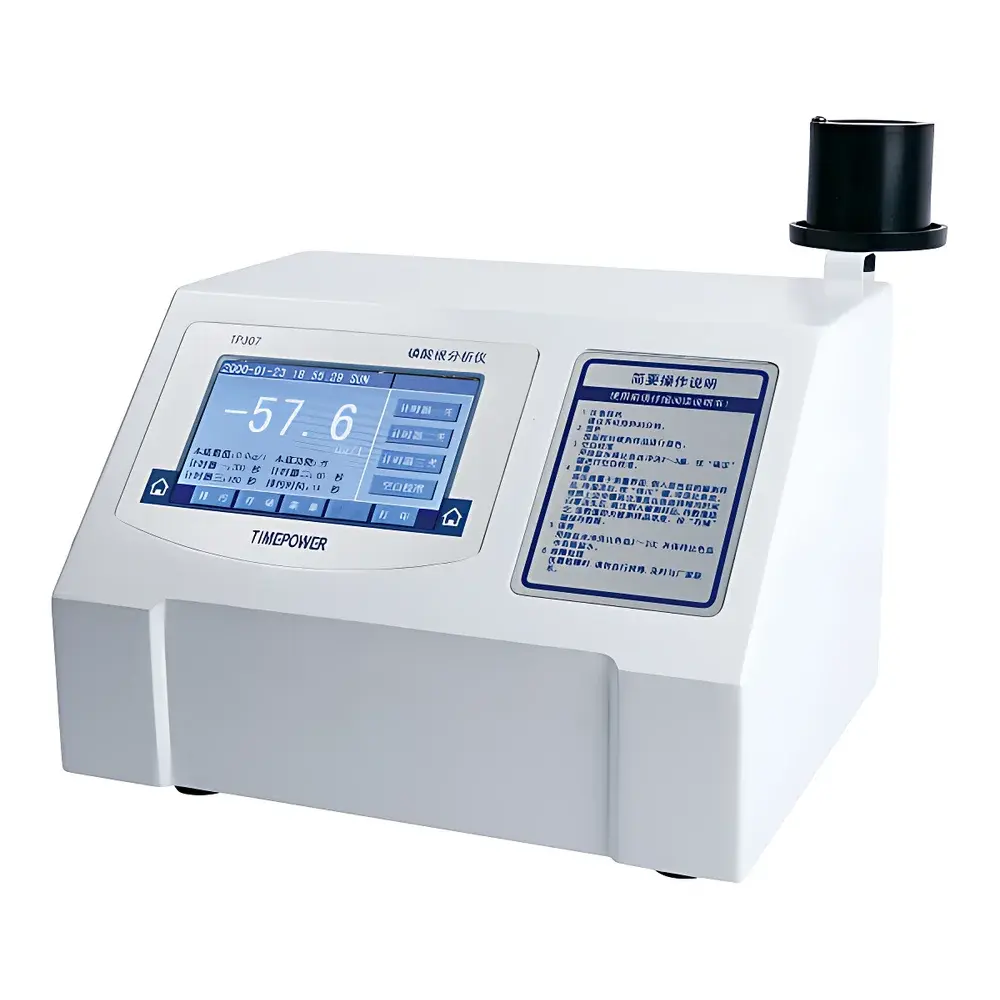
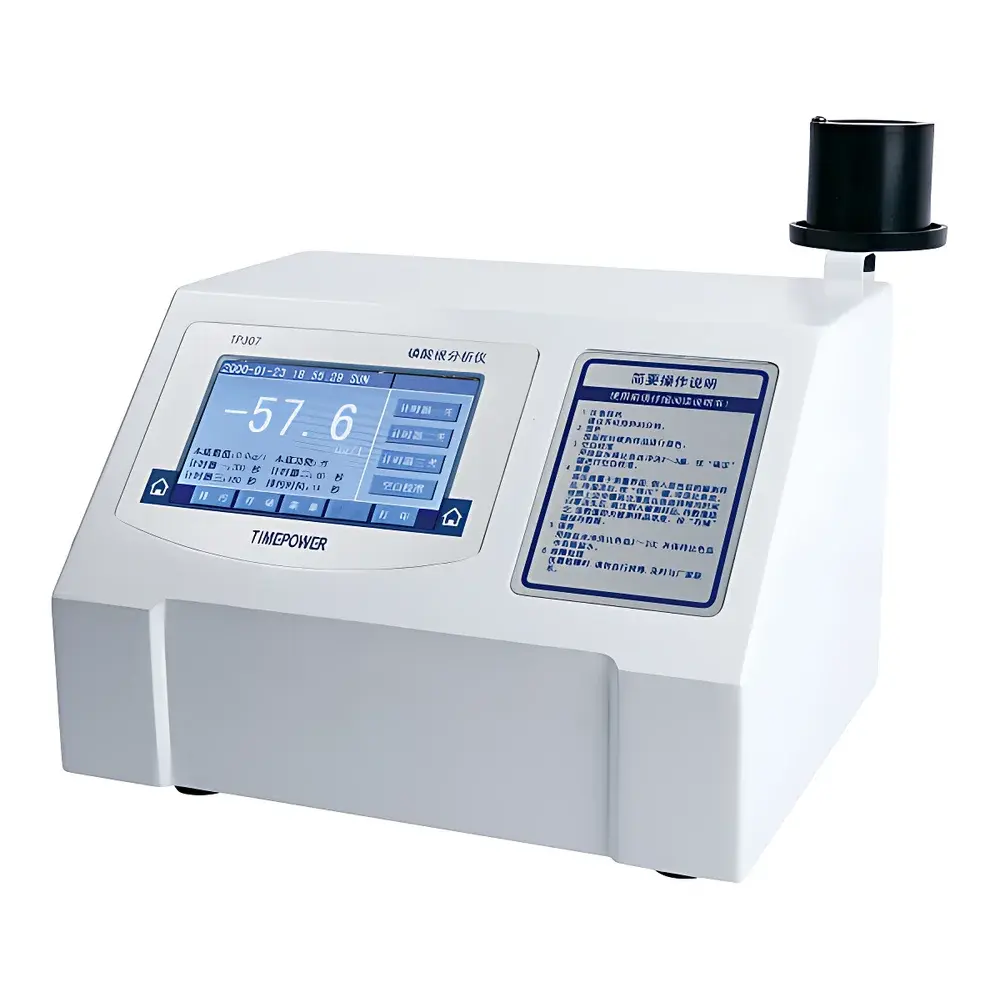
TimePower TP307 Phosphate Analyzer for Laboratory Water Quality Analysis
| Brand | TimePower |
|---|---|
| Origin | Beijing, China |
| Manufacturer Type | Direct Manufacturer |
| Country of Origin | China |
| Model | TP307 |
| Pricing | Upon Request |
Overview
The TimePower TP307 Phosphate Analyzer is a benchtop photometric analyzer engineered for precise, routine quantification of orthophosphate (PO₄³⁻) in ultra-pure and process water streams. It operates on the principle of vanadomolybdophosphoric acid colorimetry: in acidic medium, orthophosphate reacts with ammonium metavanadate and ammonium molybdate to form a stable yellow-colored heteropoly acid complex—phosphovanadomolybdic acid—whose absorbance at 420 nm is directly proportional to phosphate concentration. This reaction conforms to the Lambert–Beer law, enabling quantitative determination via calibrated photometric measurement. Designed specifically for power generation and high-purity industrial water monitoring, the TP307 delivers trace-level accuracy in critical applications including condensate, boiler feedwater, desalinated water, and steam-cycle chemistry control—where phosphate dosing must be tightly regulated to prevent scale formation and corrosion.
Key Features
- Integrated optical architecture featuring a high-stability imported monochromatic cold-light source (peak wavelength 420 nm), ensuring minimal thermal drift and long-term photometric repeatability.
- Advanced surface-mount technology (SMT) PCB design with single-chip microcontroller (MCU) core, optimized for low power consumption (<30 W) and electromagnetic compatibility in laboratory and plant environments.
- 5.0-inch full-color capacitive touchscreen interface with native Chinese UI, supporting intuitive navigation, real-time trend display, and parameter configuration without external software.
- Automated timing sequence control for color development and measurement cycles, reducing operator dependency and minimizing analytical variability.
- Dual-point calibration capability: zero-point blank calibration eliminates electronic and optical baseline drift; multi-point standard calibration supports linear range verification per ASTM D859 or ISO 6878 protocols.
- Circular data memory storing up to 256 measurement records with timestamp, auto-overflow overwrite, and on-device query—fully compliant with GLP documentation requirements.
Sample Compatibility & Compliance
The TP307 accepts aqueous samples with total suspended solids <1 mg/L and turbidity <1 NTU. It is validated for use with Type I ultrapure water (ASTM D1193), deionized water from mixed-bed ion exchange systems, and low-conductivity process streams (≤1 µS/cm). Sample introduction is manual via supplied sample cup; optional peristaltic pump integration is available for continuous flow mode. The analyzer meets CE marking requirements for electrical safety (IEC 61010-1) and electromagnetic immunity (IEC 61326-1). Its operational methodology aligns with ISO 6878:2004 (Water quality — Determination of phosphorus — Ammonium molybdate spectrophotometric method) and is routinely deployed in facilities operating under ASME PTC 19.11, EPRI guidelines, and pharmaceutical water system validation per USP .
Software & Data Management
No external PC software is required for basic operation; all calibration, measurement, and data review occur locally on the embedded HMI. Measurement records include date/time stamp, operator ID field (manually entered), calibration status flag, and raw absorbance value. Export functionality is limited to USB flash drive dump of CSV-formatted logs (timestamp, mg/L result, calibration ID). Audit trail features include immutable calibration history with user attribution and time stamp—supporting 21 CFR Part 11 readiness when paired with facility-level access controls and electronic signature policies. Firmware updates are performed via USB, with version logging and rollback capability.
Applications
- Phosphate residual monitoring in drum-type and once-through boiler water treatment programs (e.g., coordinated phosphate-pH control).
- Condensate polishing system verification in fossil and nuclear power plants.
- Final rinse water analysis in semiconductor wafer cleaning lines and biopharmaceutical equipment sanitization validation.
- Quality control of phosphate-containing excipients in parenteral formulation manufacturing.
- Educational laboratories conducting EPA Method 365.1–derived orthophosphate assays.
FAQ
What is the recommended frequency for blank and calibration verification?
Blank calibration should be performed daily prior to first use; full multi-point calibration using NIST-traceable phosphate standards is required every 14 days or after reagent lot change.
Can the TP307 measure total phosphorus?
No—the TP307 measures only orthophosphate (reactive phosphorus) without digestion. Total phosphorus determination requires separate persulfate or UV oxidation pretreatment per ISO 15681-1.
Is the instrument suitable for seawater or wastewater matrices?
Not recommended—high chloride, sulfate, or silicate concentrations cause interference and require matrix-specific correction or alternative methods (e.g., ICP-OES).
What grade of reagents and water must be used?
All reagents must be analytical grade or higher; water must meet ASTM Type I specifications (resistivity ≥18.2 MΩ·cm, TOC <10 ppb); storage in certified polyethylene containers is mandatory to avoid leaching.
Does the TP307 support remote data transmission?
No native Ethernet or 4–20 mA output is included; optional analog output module (0–5 V DC) and RS-485 Modbus RTU interface are available as factory-installed accessories.





