
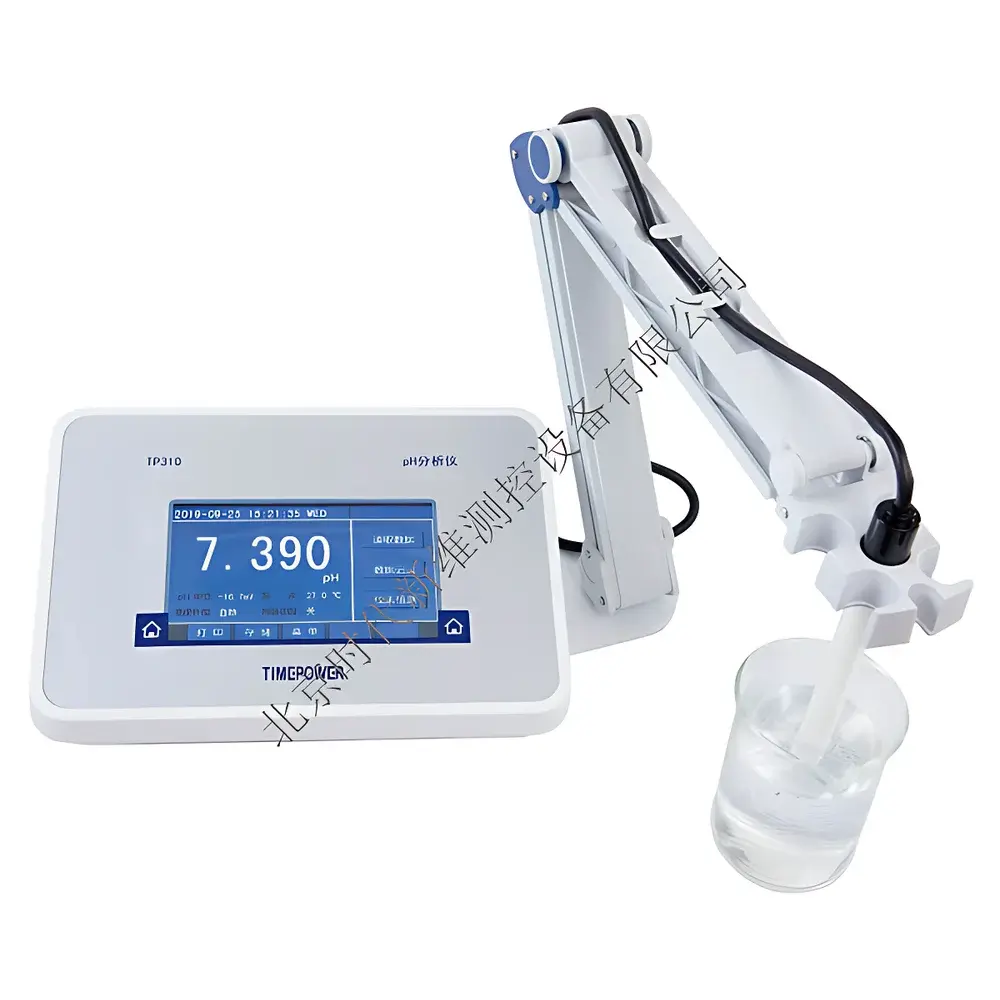
Timepower TP310 Benchtop pH Analyzer
| Brand | Timepower |
|---|---|
| Origin | Beijing, China |
| Manufacturer Type | Manufacturer |
| Origin Category | Domestic (China) |
| Model | TP310 |
| Instrument Type | Laboratory Water Quality Analyzer |
| Measured Parameter | pH |
| Measurement Range | 0.00–14.00 pH |
| Accuracy | ±0.02 pH |
| Resolution | 0.01 pH |
| Input Impedance | ≥1×10¹² Ω |
| Repeatability | ≤1% |
| Stability | ±1% F.S./4 h |
| Response Time (T90) | <1 min at 25 °C |
| Temperature Compensation Range | 0–60 °C |
| Temperature Sensor | Pt1000 |
| Sample Temperature Range | 5–60 °C |
| Ambient Temperature | 5–45 °C |
| Ambient Humidity | ≤90% RH (non-condensing) |
| Storage/Transport Temperature | −25–55 °C (electrode excluded |
| Power Supply | AC 85–265 V, 45–65 Hz |
| Power Consumption | ≤5 W |
| Dimensions | 200 × 200 × 85 mm |
| Weight | 2.1 kg |
| Display | 5.0-inch capacitive color touchscreen, Chinese UI |
Overview
The Timepower TP310 Benchtop pH Analyzer is a precision laboratory-grade instrument engineered for reliable, high-reproducibility pH measurement in aqueous samples across industrial, environmental, and research applications. It operates on the potentiometric principle—measuring the electromotive force (EMF) generated by an electrochemical cell composed of a pH-sensitive glass indicator electrode, a stable reference electrode (Ag/AgCl), and the test solution. This EMF correlates directly with hydrogen ion activity via the Nernst equation, enabling quantitative determination of pH under varying temperature conditions. The analyzer integrates a high-impedance (>1×10¹² Ω), low-drift input circuit to minimize loading effects on high-resistance pH electrodes—critical for accurate measurements in low-conductivity samples such as ultrapure water, boiler feedwater, and pharmaceutical process streams. Designed for compliance-driven environments, the TP310 supports traceable calibration workflows and maintains measurement integrity through automatic temperature compensation using a built-in Pt1000 sensor.
Key Features
- High-precision analog front-end with 24-bit ADC and microcontroller-based signal processing ensures ±0.02 pH accuracy and 0.01 pH resolution across the full 0.00–14.00 pH range.
- 5.0-inch capacitive color touchscreen with intuitive Chinese-language menu navigation—optimized for daily operation in QC labs, power plant chemistry departments, and municipal water treatment facilities.
- Integrated temperature measurement and automatic compensation (0–60 °C) using a calibrated Pt1000 sensor, eliminating manual correction errors and ensuring thermodynamic consistency per ISO 3696 and ASTM D1129.
- Dual-mode electrode support: compatible with both standard tri-combination pH electrodes (for general-purpose water analysis) and low-conductivity optimized variants (for pure water and condensate monitoring).
- Non-volatile memory retains up to 1,000 measurement records with timestamp, pH value, temperature, and calibration status; data overwrite policy prevents buffer overflow without user intervention.
- Robust mechanical architecture: compact footprint (200 × 200 × 85 mm), lightweight aluminum alloy housing, and surface-mount PCB design ensure long-term stability in 24/7 operational settings.
Sample Compatibility & Compliance
The TP310 is validated for use with aqueous matrices including drinking water, wastewater effluents, cooling tower water, boiler feedwater, pharmaceutical purified water (PW), and bioprocess buffers. It meets functional requirements outlined in ISO 7888 (water quality — determination of pH), EPA Method 150.1, and USP <791>. While not certified to IEC 61000-6-3 (EMC) or UL 61010-1 out-of-the-box, its electrical isolation, CE-marked power supply, and enclosure design align with general laboratory safety practices under GLP and GMP Annex 11 frameworks. Calibration traceability is supported through documented two- or three-point buffer protocols (e.g., pH 4.01, 7.00, 10.01 at 25 °C), with optional audit trail logging enabled via external PC connection.
Software & Data Management
Data export is performed via USB host interface to FAT32-formatted flash drives, generating CSV files compliant with LIMS ingestion standards. Each record includes date/time stamp, measured pH, sample temperature, electrode mV output, slope (%), and offset (mV)—enabling retrospective validation per FDA 21 CFR Part 11 principles when paired with controlled user access and electronic signature procedures. Internal firmware supports password-protected configuration changes and calibration lockout modes to prevent unauthorized parameter modification—a key requirement for regulated QA/QC laboratories. No proprietary software installation is required; raw data files are natively readable in Excel, MATLAB, or statistical process control (SPC) platforms.
Applications
- Power generation: continuous pH monitoring of turbine condensate, demineralized water, and steam-cycle chemistry control per EPRI guidelines.
- Pharmaceutical manufacturing: verification of purified water (PW) and water-for-injection (WFI) systems in accordance with USP <1231> and EU GMP Annex 1.
- Environmental testing labs: routine analysis of surface water, groundwater, and wastewater per ISO 5667-3 and APHA Standard Methods 4500-H+.
- Food & beverage R&D: pH profiling during fermentation, acidification, and shelf-life studies where batch consistency and regulatory documentation are mandatory.
- Academic research: teaching instrument for electrochemistry fundamentals, calibration theory, and sensor response kinetics in undergraduate and graduate laboratories.
FAQ
What calibration buffers are recommended for routine use?
Standard NIST-traceable buffers at pH 4.01, 7.00, and 10.01 (25 °C) are recommended. For low-ionic-strength samples (<50 µS/cm), use low-conductivity-certified buffers to avoid liquid junction potential errors.
Can the TP310 measure pH in non-aqueous or high-viscosity samples?
No—it is designed exclusively for aqueous solutions. Non-aqueous solvents, oils, or slurries may damage the glass membrane or cause unstable readings due to altered junction potentials.
Is the instrument suitable for field deployment?
The TP310 is a benchtop unit intended for stable laboratory or control room environments. It lacks IP-rated enclosure, battery power, or shock resistance required for portable use.
How often should the pH electrode be recalibrated?
Calibration frequency depends on application stringency: daily for regulated QC, before each analytical batch in research, or after electrode cleaning/storage—per ISO/IEC 17025 clause 7.7.
Does the device support GLP-compliant audit trails?
While internal memory logs measurement metadata, full GLP audit trails (user ID, change history, electronic signatures) require integration with validated third-party LIMS or ELN systems via exported CSV data.







