
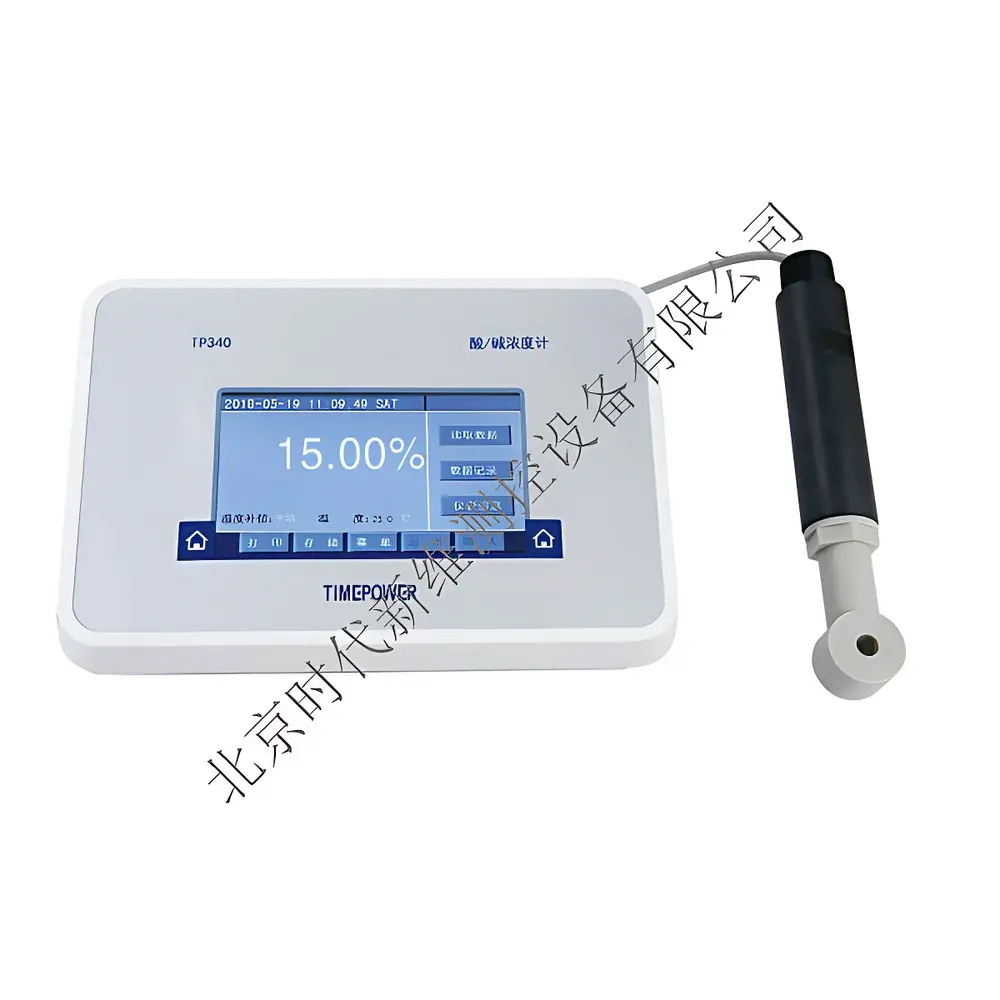
TimePower TP340 Laboratory Acid-Base Concentration Meter
| Brand | TimePower |
|---|---|
| Model | TP 340 |
| Origin | Beijing, China |
| Manufacturer | TimePower Instrument Co., Ltd. |
| Type | Non-contact Inductive Conductivity-Based Concentration Analyzer |
| Measurement Range | HCl (0–10.00%), NaOH (0–10.00%), H₂SO₄ (0–20.00%), NaCl (0–20.00%), HNO₃ (0–15.00%), Na₂CO₃ (0–10.00%) |
| Accuracy | ±2% F.S. |
| Resolution | 0.01% |
| Repeatability | ≤1% |
| Stability | ±1% F.S./4 h |
| Temperature Compensation | Pt1000 sensor, 0–60 °C |
| Sample Temp. | 5–50 °C |
| Ambient Temp. | 5–45 °C |
| Humidity | ≤90% RH (non-condensing) |
| Power Supply | AC 85–265 V, 45–65 Hz |
| Power Consumption | ≤5 W |
| Dimensions | 200 × 200 × 85 mm |
| Weight | 2.1 kg |
Overview
The TimePower TP340 Laboratory Acid-Base Concentration Meter is a precision electrochemical analyzer engineered for reliable, non-invasive quantification of acid and base concentrations in aqueous process solutions. Unlike conventional potentiometric or amperometric systems, the TP340 employs an inductive (toroidal) conductivity measurement principle—eliminating direct electrode contact with the sample. Its dual-coil sensor architecture consists of a primary (transmitter) coil and a secondary (receiver) coil, both wound from corrosion-resistant alloy and hermetically sealed within a chemically inert housing. When an alternating magnetic field is generated by the transmitter coil, eddy currents are induced in conductive electrolyte solutions; the magnitude of the resulting secondary current—detected by the receiver coil—is linearly proportional to solution conductivity. Using pre-calibrated, matrix-specific algorithms embedded in the firmware, the instrument converts conductivity data into concentration values for six common industrial reagents: hydrochloric acid (HCl), sodium hydroxide (NaOH), sulfuric acid (H₂SO₄), sodium chloride (NaCl), nitric acid (HNO₃), and sodium carbonate (Na₂CO₃). This method ensures long-term sensor stability, immunity to fouling, and minimal maintenance—critical for continuous lab-based quality control in regulated environments.
Key Features
- Non-contact toroidal conductivity sensing—no electrode polarization, no chemical leaching, no membrane replacement required
- High-resolution 5.0-inch color touchscreen interface with intuitive Chinese-language menu navigation (firmware supports multi-language localization upon request)
- 24-bit analog-to-digital conversion with advanced digital filtering, delivering high signal fidelity and low noise floor
- Integrated Pt1000 temperature sensor with automatic temperature compensation across 0–60 °C
- Microcontroller-based architecture featuring low-power consumption (≤5 W) and robust electromagnetic compatibility (EMC) per IEC 61326-1
- Circular data logging with auto-rollover—stores up to 1,000 measurement records with timestamp and temperature stamp
- Wide operating ambient range (5–45 °C, ≤90% RH non-condensing) suitable for QC labs, pilot plants, and controlled manufacturing suites
Sample Compatibility & Compliance
The TP340 is validated for use with low-to-moderate ionic strength aqueous solutions typical of industrial process streams—including regeneration brines, caustic wash solutions, pickling baths, and pharmaceutical buffer preparations. It complies with general-purpose laboratory instrumentation safety standards (IEC 61010-1) and meets EMC requirements for Class A equipment in industrial environments. While not certified for hazardous area installation (e.g., ATEX/IECEx), its non-intrusive sensor design inherently reduces risk of sparking or galvanic corrosion in aggressive media. For regulated applications, raw measurement data—including conductivity, temperature, concentration, and timestamps—can be exported via USB for traceable recordkeeping. The device supports manual audit trails and is compatible with GLP/GMP documentation workflows when integrated with validated laboratory information management systems (LIMS).
Software & Data Management
The TP340 operates on embedded firmware with no external PC dependency. All calibration, configuration, and data review functions are accessible through the onboard GUI. Calibration is performed using two-point standard solutions (e.g., 0% and known % w/w reference standards), with user-defined curve selection per analyte. Logged data are stored in non-volatile memory with time/date stamps and can be exported as CSV files via USB mass storage mode. No proprietary software is required; exported files are natively readable in Excel, MATLAB, or statistical process control (SPC) platforms. Firmware updates are delivered via USB and include version-controlled changelogs compliant with internal change control procedures.
Applications
- Monitoring ion exchange resin regeneration efficiency in power plant demineralization systems (ASTM D4582)
- Real-time verification of caustic soda or sulfuric acid concentration in chemical synthesis feedstock preparation
- Batch consistency checks for food-grade acidulant (e.g., citric, phosphoric) or alkali (e.g., sodium carbonate) dosing in beverage and dairy processing
- Pharmaceutical excipient solution preparation under USP <797> and <1251> guidance for non-sterile compounding
- Metallurgical leach circuit optimization where acid concentration directly impacts metal recovery kinetics
- Educational laboratories demonstrating fundamental relationships between conductivity, ionic strength, and concentration
FAQ
Does the TP340 require routine electrode cleaning or recalibration?
No—its toroidal sensor has no exposed electrodes or membranes; calibration is only needed when changing analytes or after extended storage. Recommended calibration frequency is once per shift in high-throughput QC labs.
Can the instrument measure mixed-acid solutions (e.g., HCl + HNO₃)?
No—the TP340 is calibrated for single-component solutions only. Mixed electrolytes introduce non-linear conductivity contributions and require alternative methods such as titration or ion chromatography.
Is the device compliant with FDA 21 CFR Part 11 for electronic records?
The TP340 does not provide electronic signatures or audit-trail encryption out-of-the-box; however, exported CSV logs may be incorporated into Part 11–compliant LIMS or ELN systems with appropriate procedural controls.
What is the maximum allowable suspended solids content in the sample?
For optimal performance, samples should contain ≤50 mg/L total suspended solids (TSS); higher particulate loads may attenuate the magnetic coupling and require inline filtration.
Can the TP340 operate continuously in a fume hood environment?
Yes—its sealed enclosure and wide ambient temperature/humidity tolerance make it suitable for fume hood mounting, provided condensation is prevented and ventilation does not exceed 3 m/s airflow at the sensor port.






