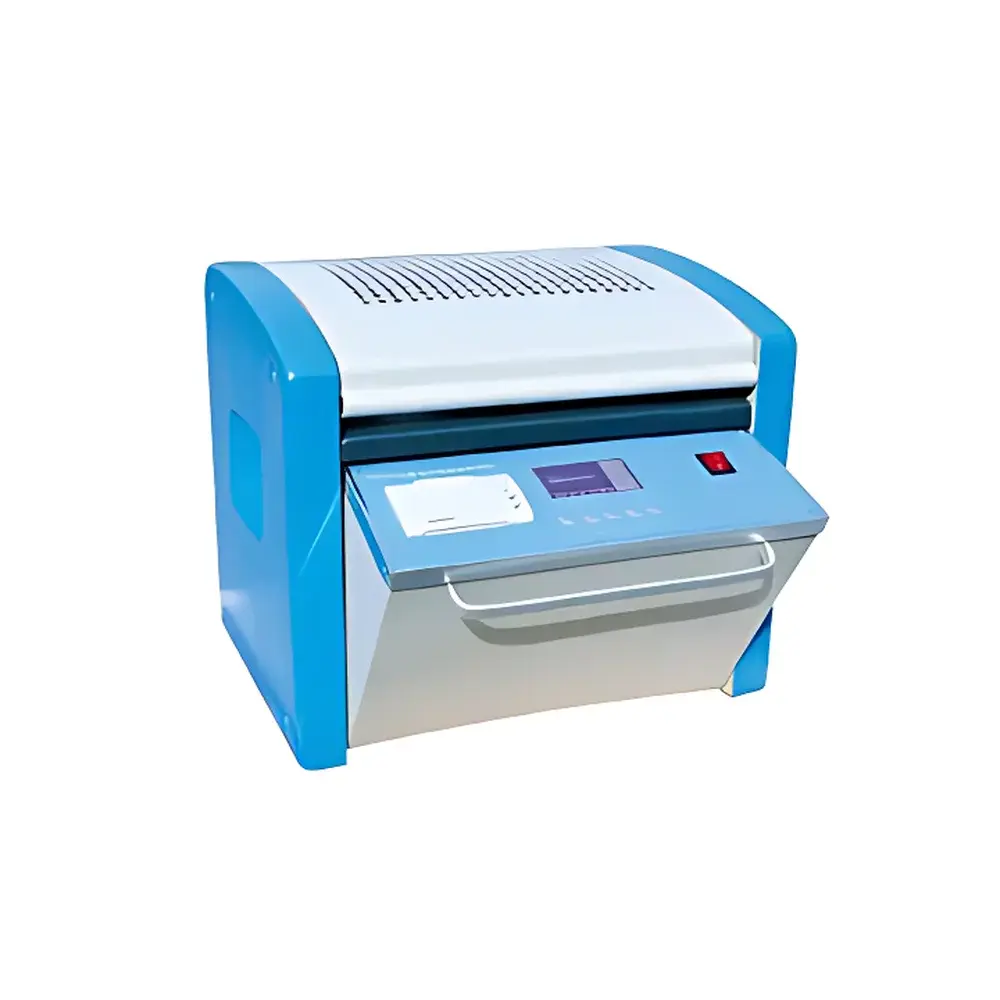
Timepower TP572 Oil Dielectric Strength Tester
| Brand | Timepower |
|---|---|
| Origin | Beijing, China |
| Manufacturer Type | OEM Manufacturer |
| Country of Origin | China |
| Model | TP572 |
| Voltage Ramp Rates | 2.0 kV/s and 3.0 kV/s (adjustable within 2.0–3.0 kV/s) |
| Measurement Range | 0–80 kV |
| Accuracy | ±2% of full scale |
| Resolution | 0.1 kV |
| Test Repetition | 1–9 cycles (default: 6) |
| Electrode Gap | Standardized per GB/T 507–1986 and DL 429.9–1991 |
| Stirring Mechanism | Magnetic stirrer with programmable agitation duration (0–59 min) |
| Standby Time | 15 min (adjustable 0–59 min) |
| Inter-test Interval | 3–5 min (adjustable 0–9 min) |
| Display | LCD panel with real-time voltage and status feedback |
| Protection | Overvoltage, overcurrent, and automatic zero-return safety interlocks |
| High-Voltage Source | Dry-type transformer assembly with sinusoidal waveform generation and stepless voltage regulation |
| Operating Environment | 5–40 °C, ≤85% RH |
| Power Supply | AC 220 V ±10%, 50 Hz ±10% |
| Dimensions (W×D×H) | 610 × 410 × 425 mm |
| Weight | 45 kg |
| Compliance | GB/T 507–1986, DL 429.9–1991 |
Overview
The Timepower TP572 Oil Dielectric Strength Tester is an automated, microprocessor-controlled instrument engineered for precise determination of the dielectric breakdown voltage of insulating oils used in high-voltage electrical equipment. It operates on the principle of controlled AC voltage ramping across standardized electrode geometry immersed in oil—per ASTM D877 and IEC 60156 equivalents—as defined by Chinese national standards GB/T 507–1986 and DL 429.9–1991. The device subjects a representative oil sample to a continuously increasing sinusoidal AC voltage at a fixed or user-selectable rate (2.0 or 3.0 kV/s), until electrical breakdown occurs across the inter-electrode gap. The corresponding peak voltage is recorded as the dielectric strength—expressed in kilovolts (kV)—and serves as a primary indicator of contamination level, moisture content, particulate presence, and overall insulation integrity.
Key Features
- Dual-CPU architecture ensures synchronized control of high-voltage generation, timing sequences, data acquisition, and safety monitoring.
- Integrated dry-type high-voltage transformer module delivers stable, low-distortion sinusoidal output without oil cooling or maintenance-intensive components—enabling compact footprint (610 × 410 × 425 mm) and field-deployable weight (45 kg).
- Programmable test parameters include ramp rate (2.0–3.0 kV/s), stirring duration (0–59 min), rest time pre-breakdown (15 min default, adjustable), and inter-test interval (3–5 min, configurable up to 9 min).
- Automatic sequence execution: electrode immersion detection → magnetic stirring → voltage ramp initiation → breakdown capture → voltage decay → zero-reset → data logging.
- Real-time LCD interface displays instantaneous test voltage, elapsed time, cycle count, and system status; supports on-device recall and thermal printing of up to 9 consecutive test records.
- Comprehensive hardware protection suite includes overvoltage cutoff, current-limiting circuitry, forced auto-zero return upon fault, and grounded chassis interlock—meeting functional safety requirements for Class I laboratory equipment.
Sample Compatibility & Compliance
The TP572 is validated for use with mineral-based and synthetic insulating oils conforming to IEC 60296, ASTM D3487, and GB 2536 specifications. It accommodates standard 25-mm-diameter spherical electrodes with 2.5-mm gap (per GB/T 507), housed in a single precision-machined oil cup (included). All operational logic and calibration traceability align with metrological requirements under JJF 1001–2011 (General Metrological Terminology) and ISO/IEC 17025–2017 (testing laboratory competence). While not FDA-regulated, its deterministic test protocol supports GLP-aligned documentation practices—including timestamped result storage, operator ID tagging (via optional external login integration), and audit-ready printouts suitable for internal quality review or regulatory submission packages.
Software & Data Management
Data handling is fully embedded: no external PC required for basic operation. Each test cycle stores voltage-at-breakdown, ramp rate applied, stirring duration, ambient temperature (monitored via internal sensor), and pass/fail flag relative to user-defined acceptance thresholds (e.g., ≥30 kV for new transformer oil per IEEE C57.106). Up to 9 test results are retained in non-volatile memory and retrievable via menu navigation. Thermal printer output includes date/time stamp, model number, serial ID, and compliance reference (GB/T 507–1986). For enterprise integration, RS-232 serial port enables ASCII-formatted data export to LIMS or Excel-compatible spreadsheets—supporting CSV parsing and trend analysis across multi-unit fleets. Firmware updates are performed via USB-to-serial adapter (not included).
Applications
- Routine condition monitoring of transformer oil in substation maintenance programs.
- Acceptance testing of new insulating oil prior to commissioning of power transformers, reactors, and bushings.
- Quality assurance in oil reclamation facilities verifying post-treatment dielectric recovery.
- Research laboratories evaluating aging kinetics of ester-based biodegradable insulating fluids.
- Third-party certification labs performing accredited tests per CNAS-CL01 (equivalent to ISO/IEC 17025).
- Manufacturing QA for oil-filled circuit breakers, capacitors, and cable terminations.
FAQ
What standards does the TP572 comply with?
It is designed and verified against GB/T 507–1986 (“Method of Determining Dielectric Strength of Insulating Oil”) and DL 429.9–1991 (“Test Methods for Electrical Properties of Insulating Oil in Power Plants and Substations”). Its electrode geometry, ramp linearity, and timing resolution meet technical equivalency to IEC 60156 and ASTM D877.
Can the instrument test oils above 80 kV?
The standard configuration has a maximum rated output of 80 kV. Units capable of 100 kV require factory modification—including reinforced insulation, recalibrated HV divider, and updated firmware—and must be ordered as custom configurations.
Is calibration traceable to national standards?
Yes. Timepower provides a Certificate of Conformance with initial delivery, including verification against a NIM-traceable high-voltage divider (±0.5% uncertainty). Annual recalibration is recommended and supported through authorized service centers in Beijing and Shanghai.
How is operator safety ensured during testing?
The unit incorporates double-pole grounding detection, interlocked HV enclosure door switch, automatic discharge circuit (<5 s residual voltage <1 kV), and mandatory earth connection verification prior to voltage application—all documented in the IEC 61010-1 safety manual supplied with each unit.
Related Products