
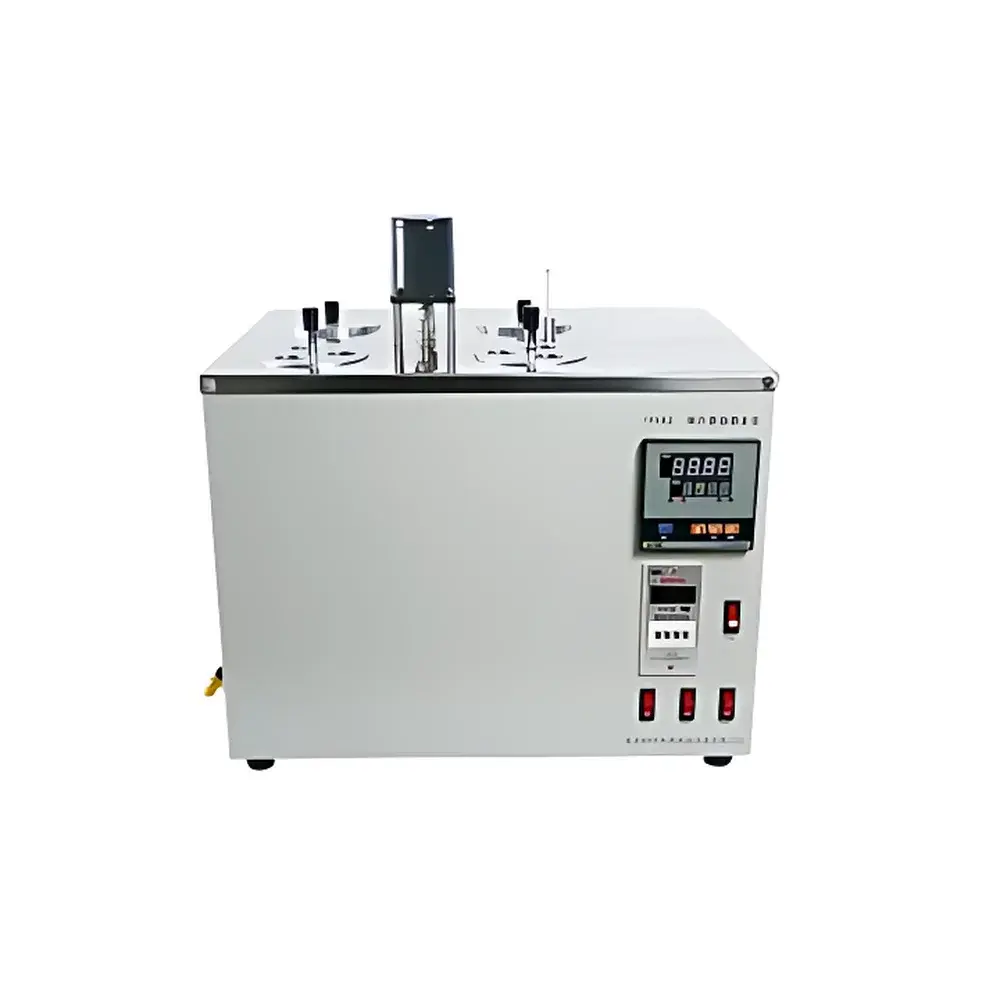
Timepower TP582 Copper Strip Corrosion Tester
| Brand | Timepower |
|---|---|
| Origin | Beijing, China |
| Manufacturer Type | Manufacturer |
| Country of Origin | Domestic (China) |
| Model | TP582 |
| Pricing | Upon Request |
| Temperature Control Range | Ambient to 150 °C |
| Temperature Accuracy | ±1 °C |
| Heating Power | 600 W (main) + 1000 W (auxiliary) |
| Temperature Sensor | Industrial Pt100 Platinum Resistance Thermometer |
| Timing Range | 1 min to 24 h |
| Time Display | LED digital |
| Temperature Display | 7-segment LED |
| Sample Capacity | Up to 12 copper strips (4 test wells per bath, configurable multi-bath operation) |
| Ambient Operating Conditions | 5–40 °C, ≤85% RH |
| Power Supply | AC 220 V ±10%, 50 Hz ±10% |
| Power Consumption | ≤1800 W |
| Dimensions (W×D×H) | 480 × 360 × 520 mm |
| Weight | 18 kg |
| Compliance Standards | GB/T 5096, GB/T 7326, ASTM D130, ASTM D4048, SH/T 0232, SH/T 0023, ISO 6251 |
Overview
The Timepower TP582 Copper Strip Corrosion Tester is a precision-engineered laboratory instrument designed for quantitative assessment of corrosive sulfur compounds and reactive species in petroleum products. It operates on the standardized copper strip corrosion test principle—where a polished, dimensionally specified copper strip is immersed in a heated sample under controlled time and temperature conditions, then visually compared against ASTM/ISO reference color standards after cleaning and drying. This method provides a rapid, reproducible, and widely accepted pass/fail or semi-quantitative evaluation of a product’s potential to corrode copper-based components in fuel systems, storage tanks, and refining infrastructure.
Key Features
- Four independent heating wells with uniform thermal distribution, enabled by PID-controlled metal bath heating and magnetic stirring for consistent temperature homogeneity across all test positions.
- Dual-stage heating architecture: primary 600 W heater for precise setpoint regulation and auxiliary 1000 W heater for rapid thermal ramp-up—reducing pre-heat time without compromising stability.
- Industrial-grade Pt100 platinum resistance thermometer integrated into each bath for real-time feedback and high-fidelity temperature monitoring (±1 °C accuracy over 0–150 °C range).
- Programmable digital timer with audible end-of-test alarm; timing resolution down to 1 minute, adjustable from 1 min to 24 hours—fully compliant with exposure durations mandated by ASTM D130 (3 h at 50 °C), ASTM D4048 (4 h at 100 °C), and GB/T 5096 (3 h at 50 °C or 16 h at 100 °C).
- Self-diagnostic microcontroller system that monitors heater status, sensor integrity, and power continuity—flagging anomalies prior to test initiation to prevent invalid runs.
- Ergonomic front-panel interface with dual LED displays: one for temperature (7-segment), one for elapsed/remaining time—enabling unambiguous visual verification without software dependency.
Sample Compatibility & Compliance
The TP582 accommodates a broad spectrum of hydrocarbon-based fluids, including aviation gasoline, jet fuel (Jet A/A-1), automotive gasoline, naphthas, solvent oils, diesel fuels (EN 590, ASTM D975), distillate fuel oils, lubricating oils (including turbine and hydraulic grades), greases, and specialty hydrocarbon solvents with Reid Vapor Pressure (RVP) ≤124 kPa (930 mmHg). Its design conforms rigorously to multiple international test standards: ASTM D130 (Standard Test Method for Corrosivity to Copper by Petroleum Products), ASTM D4048 (for gaseous fuels), ISO 6251 (Petroleum products — Determination of copper strip corrosion), GB/T 5096 (Chinese national standard equivalent to ASTM D130), GB/T 7326 (for lubricating greases), SH/T 0232 (for liquefied petroleum gas), and SH/T 0023 (for residual fuel oils). All mechanical dimensions, strip specifications (ASTM B152-compliant Cu-ETP, 12.7 × 19.1 × 1.5 mm), and bath geometry adhere strictly to these normative requirements to ensure inter-laboratory comparability.
Software & Data Management
The TP582 operates as a standalone hardware platform with no embedded operating system or network connectivity. Data integrity is maintained through deterministic analog-to-digital conversion, non-volatile parameter storage, and hardware-level watchdog timers. While it does not include PC-based software, its operational parameters—including set temperature, exposure duration, and actual bath temperature history (via optional external data logger integration)—are fully traceable for GLP/GMP environments. The instrument supports audit-ready documentation when used in conjunction with laboratory information management systems (LIMS) via manual entry or barcode-assisted logging. All calibration and maintenance records—including Pt100 verification logs and timer drift checks—align with ISO/IEC 17025 requirements for accredited testing laboratories.
Applications
- Quality control in refineries for finished gasoline, diesel, and jet fuel batches prior to release.
- Monitoring sulfur scavenger efficiency in hydrotreating units and post-treatment blending operations.
- Stability assessment of biofuel blends (e.g., FAME, HVO) where oxidation-induced acid formation may accelerate copper corrosion.
- Compatibility screening of additives, detergents, and antioxidants in lubricant formulations.
- Regulatory compliance testing for EN 228, ASTM D4814, DEF STAN 91-91, and MIL-DTL-83133 specifications.
- Research into corrosion mechanisms of novel synthetic hydrocarbons and low-sulfur alternative fuels.
FAQ
What safety precautions must be observed before powering on the TP582?
The bath must be filled with an appropriate heat-transfer medium (water, silicone oil, or specified oil mixture) prior to energizing the unit. Dry operation will irreversibly damage the heating elements and pose fire risk. Never operate with empty wells.
Is user recalibration of the temperature controller required?
No—the PID auto-tuning parameters are factory pre-configured and optimized for thermal inertia of the metal bath. Re-tuning is only recommended if long-term drift (>±2 °C) is observed during routine verification using NIST-traceable reference thermometers.
Can the TP582 perform simultaneous tests at different temperatures?
No—the four wells share a common thermal mass and are regulated to a single setpoint. For multi-temperature studies, sequential runs or use of multiple units is required.
Which copper strip specifications are supported?
The instrument accepts ASTM D130-compliant copper strips (ASTM B152 Grade ETP, 99.9% minimum Cu, 12.7 × 19.1 × 1.5 mm, surface finish Ra ≤0.2 µm), supplied with certified cleaning and polishing protocols per ASTM D130 Annex A1.






