
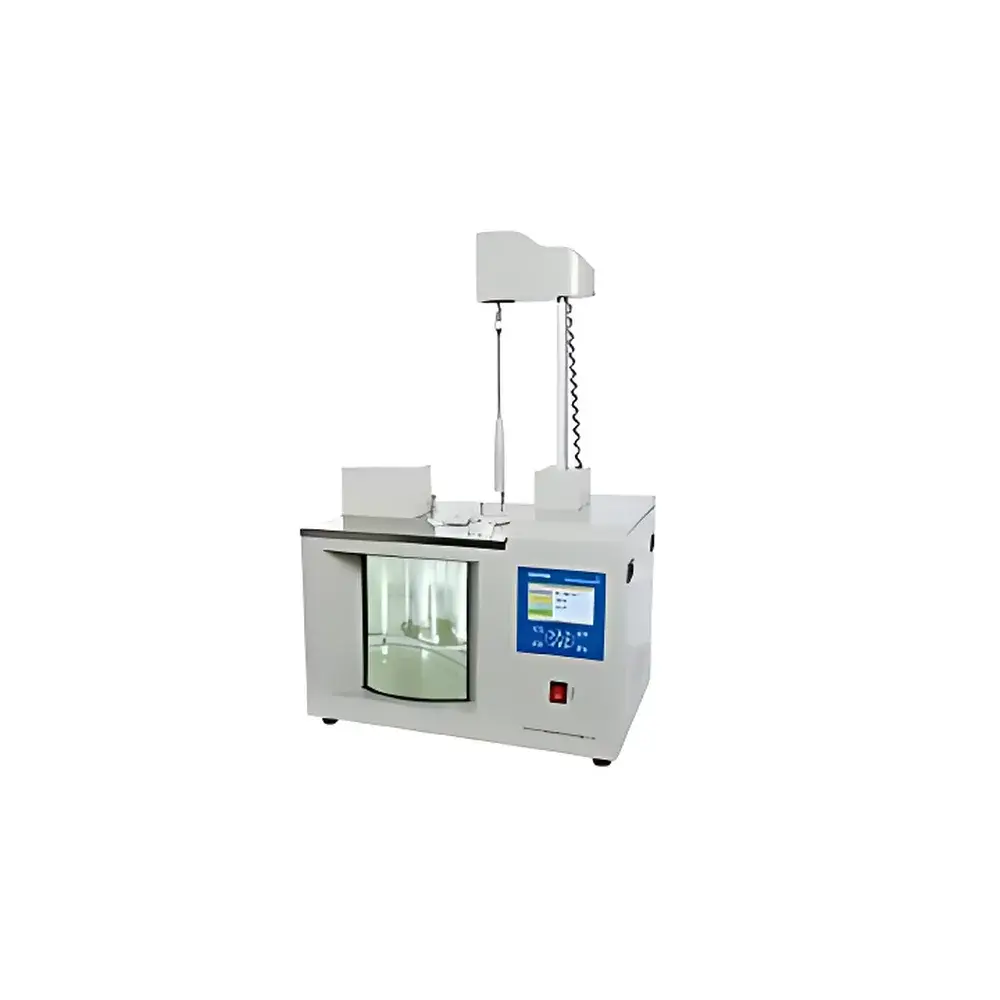
TimePower TP651 Emulsion Resistance Tester for Petroleum and Synthetic Fluids
| Brand | TimePower |
|---|---|
| Origin | Beijing, China |
| Manufacturer Type | Direct Manufacturer |
| Country of Origin | China |
| Model | TP651 |
| Pricing | Upon Request |
| Temperature Range | Ambient to 100 °C |
| Temperature Accuracy | ±2 °C |
| Temperature Repeatability | ≤4 °C |
| Temperature Resolution | 0.1 °C |
| Bath Temperature Setpoints | 54 °C ±1 °C (standard), 82 °C ±1 °C (for viscous oils) |
| Stirring Duration | 5 min (automated) |
| Stirrer Positioning | Descends to 6 mm above cylinder bottom |
| Cylinder | 100 mL calibrated glass cylinder |
| Control System | Microcontroller-based with 480×272 color LCD, full Chinese GUI |
| Power Supply | AC 220 V ±10%, 50 Hz ±10% |
| Max Power Consumption | ≤1600 W |
| Dimensions (W×D×H) | 510 mm × 360 mm × 580 mm |
| Net Weight | 23.5 kg |
| Operating Environment | 5–40 °C, ≤85% RH |
Overview
The TimePower TP651 Emulsion Resistance Tester is an automated benchtop instrument engineered for precise evaluation of emulsion separation behavior in petroleum-based lubricants, turbine oils, hydraulic fluids, and synthetic industrial fluids—per ASTM D1401 and ISO 6614 methodologies, and fully compliant with the procedural requirements of GB/T 7305 (China National Standard). It quantifies the time required for a defined oil–water mixture to separate into distinct, visually discernible layers under controlled thermal and mechanical agitation conditions. The test principle relies on standardized interfacial destabilization: a 40 mL oil sample and 40 mL distilled water are introduced into a calibrated 100 mL graduated cylinder, heated to either 54 °C ±1 °C (standard) or 82 °C ±1 °C (for high-viscosity formulations), then subjected to 5 minutes of uniform mechanical stirring at fixed rotational speed and depth. Following agitation, the system automatically initiates a high-accuracy digital timer to record the elapsed time until complete phase separation—defined as the formation of three clear, stable layers (oil, emulsion, and water)—or until the maximum observation period (typically 60 minutes) expires.
Key Features
- Fully automated electromechanical actuation: Precision electric linear actuator controls stirrer arm descent and retraction; stirrer tip positions reproducibly at 6 mm above cylinder base—ensuring consistent shear input and eliminating operator-induced variability.
- Microprocessor-controlled thermal regulation: Dual-sensor PID-controlled water bath maintains setpoint stability within ±1 °C over extended durations; heating range spans ambient to 100 °C with resolution of 0.1 °C and repeatability ≤4 °C.
- Integrated human-machine interface: 480×272 pixel color LCD display with intuitive Chinese-language menu navigation; real-time status feedback includes temperature, stirring phase, countdown timer, and system diagnostics.
- Compliance-driven workflow logic: Automatic transition from stirring phase to separation timing eliminates manual intervention; “Confirm Separation” button triggers timestamp capture and final result storage—supporting audit-ready documentation.
- Robust mechanical architecture: Stainless steel frame, corrosion-resistant bath tank, and vibration-damped mounting minimize measurement drift; designed for continuous operation in QC laboratories and third-party testing facilities.
Sample Compatibility & Compliance
The TP651 accommodates standard 100 mL borosilicate glass cylinders conforming to ASTM D1401 specifications. It supports routine analysis of mineral oils, polyalphaolefins (PAOs), phosphate esters, polyglycols, and other synthetics used in power generation turbines, hydraulic systems, and compressor applications. Instrument design and operational protocols align with regulatory expectations for method validation under GLP (Good Laboratory Practice) and ISO/IEC 17025-accredited environments. While not FDA 21 CFR Part 11–certified out-of-the-box, its deterministic control logic, non-volatile event logging, and timestamped result export facilitate integration into validated electronic lab notebook (ELN) or LIMS workflows where traceability and data integrity are mandated.
Software & Data Management
The TP651 operates via embedded firmware without external PC dependency. All test parameters—including set temperature, actual bath temperature, start/stop timestamps, and final separation time—are stored in internal memory with date/time stamping. Results can be manually transcribed or exported via RS-232 serial interface (optional cable) for CSV-formatted archival. Firmware supports user-defined test profiles and retains up to 100 test records with automatic overwrite protection. No proprietary software installation is required; raw data output is plain-text compatible with common spreadsheet and statistical analysis tools. Audit trails include system boot events, temperature excursions (>±2 °C deviation), and operator confirmation actions—enabling root-cause analysis during internal quality reviews.
Applications
- Turbine oil condition monitoring in fossil-fueled and nuclear power plants per ASTM D2711 and IEC 60296 guidelines.
- Acceptance testing of new lubricants prior to commissioning in critical rotating equipment.
- Quality control screening for batch-to-batch consistency in additive-manufactured synthetic fluids.
- Research into emulsifier degradation kinetics and hydrolytic stability of ester-based lubricants.
- Third-party certification testing for commercial lubricant suppliers seeking API, OEM, or industry consortium approvals.
FAQ
What standards does the TP651 comply with?
The instrument implements the physical test protocol specified in GB/T 7305, and its operational parameters (temperature control, stirring geometry, timing accuracy) are functionally equivalent to ASTM D1401 and ISO 6614.
Can the TP651 be used for non-petroleum-based fluids such as bio-lubricants?
Yes—provided the fluid exhibits measurable phase separation under the defined thermal and mechanical conditions; users should validate method applicability per ISO 17025 clause 5.4.2 when extending beyond petroleum derivatives.
Is calibration traceable to national standards?
Temperature sensors are factory-calibrated against NIST-traceable references; users may perform periodic verification using certified RTD probes and reference thermometers per ISO/IEC 17025 Section 6.6.
Does the instrument support multi-language interfaces?
The current firmware offers only Chinese-language UI; English-language firmware is available upon special order with minimum volume commitment.
How is maintenance performed on the stirring mechanism?
The stirrer shaft and coupling require no scheduled lubrication; cleaning must be performed with lint-free cloth and isopropyl alcohol—never abrasive solvents or excessive force—to preserve dimensional tolerances and axial alignment.




