
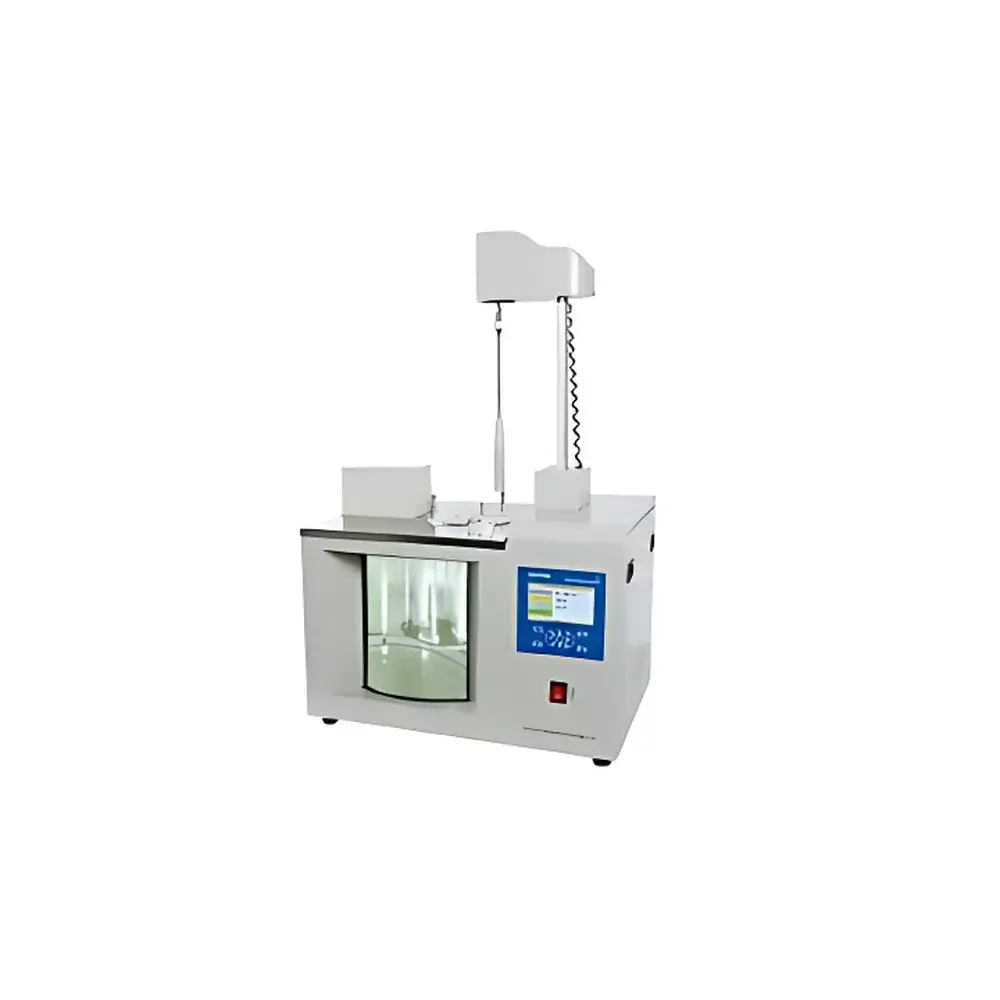
Timepower TP651 Petroleum and Synthetic Fluid Demulsibility Tester
| Brand | Timepower |
|---|---|
| Origin | Beijing, China |
| Manufacturer Type | Direct Manufacturer |
| Product Origin | Domestic (China) |
| Model | TP651 |
| Pricing | Available Upon Request |
| Temperature Range | Ambient to 100 °C |
| Temperature Accuracy | ±2 °C |
| Temperature Repeatability | ≤4 °C |
| Temperature Resolution | 0.1 °C |
| Bath Temperature Setpoints | 54 °C ±1 °C (standard), 82 °C ±1 °C (for viscous oils) |
| Stirring Duration | 5 min (automated) |
| Stirrer Positioning | Descends to 6 mm above cylinder bottom |
| Cylinder | 100 mL calibrated glass cylinder |
| Power Supply | AC 220 V ±10%, 50 Hz ±10% |
| Power Consumption | ≤1600 W |
| Dimensions (W×D×H) | 510 mm × 360 mm × 580 mm |
| Net Weight | 23.5 kg |
| Operating Environment | 5–40 °C, ≤85% RH |
Overview
The Timepower TP651 Petroleum and Synthetic Fluid Demulsibility Tester is an automated benchtop instrument engineered for precise evaluation of the demulsification behavior of lubricating oils, turbine oils, hydraulic fluids, and synthetic base stocks under standardized thermal and mechanical agitation conditions. It operates on the principle of controlled water-oil separation kinetics—measuring the time required for a defined oil-water emulsion to separate into distinct, visually discernible layers following a standardized stirring protocol. This test directly quantifies a fluid’s inherent resistance to stable emulsion formation—a critical performance indicator for industrial lubricants exposed to moisture ingress in power generation, petrochemical processing, and marine propulsion systems. The TP651 implements the core methodology specified in GB/T 7605 (equivalent to ASTM D1401 for general petroleum products) and aligns with the procedural framework of GB/T 7305 (for turbine oils), ensuring technical compatibility with internationally recognized demulsibility assessment practices.
Key Features
- Fully automated test sequence: integrated microcontroller orchestrates bath temperature stabilization, stirrer descent to precisely 6 mm above cylinder base, 5-minute standardized agitation, automatic stirrer retraction, and commencement of separation timing—all without manual intervention.
- High-precision thermostatic water bath: digitally regulated to maintain 54 °C ±1 °C (or 82 °C ±1 °C for high-viscosity samples), with resolution of 0.1 °C and repeatability ≤4 °C—ensuring strict adherence to test condition tolerances.
- Electromechanical lift system: brushless DC linear actuator provides smooth, repeatable vertical movement of the stirrer assembly, eliminating mechanical backlash and enabling consistent immersion depth across hundreds of cycles.
- Human-centric HMI: 480×272-pixel color LCD interface with full Chinese menu navigation, context-sensitive prompts, and guided parameter entry—designed for rapid operator training and error-resistant operation in QC laboratories.
- Robust mechanical architecture: rigid steel frame, corrosion-resistant bath tank, and precision-machined cylinder holder ensure long-term dimensional stability and alignment integrity—critical for reproducible meniscus observation and phase boundary detection.
Sample Compatibility & Compliance
The TP651 is validated for use with mineral-based turbine oils, rust-inhibited lubricants, phosphate ester synthetics, polyalkylene glycol (PAG) fluids, and other hydrocarbon- or ester-based industrial lubricants meeting ISO 8573-1 air purity class requirements for test environments. It supports the 100 mL calibrated glass cylinder per GB/T 7605 and ASTM D1401 specifications. While not certified to IEC 61000-6-3 or UL 61010-1 out-of-the-box, its electrical design conforms to basic safety principles for laboratory equipment operating within 5–40 °C ambient and ≤85% relative humidity. Data acquisition and user actions are timestamped and logged internally, supporting GLP-aligned recordkeeping; optional RS232/USB export enables integration with LIMS platforms compliant with FDA 21 CFR Part 11 when paired with validated software clients.
Software & Data Management
The embedded firmware executes deterministic real-time control of all hardware subsystems—temperature regulation, motor sequencing, timer initiation, and UI state management—without reliance on external OS dependencies. All test parameters (setpoint, duration, operator ID, date/time stamp) and results (separation time in minutes:seconds, observed layer clarity per visual rating scale) are stored in non-volatile memory with retention exceeding 10,000 cycles. Export functionality via USB flash drive permits CSV-formatted output compatible with Excel, Minitab, or statistical process control (SPC) dashboards. Audit trail capabilities include sequential event logging (e.g., “Stirrer lowered at 14:22:03”, “Separation confirmed at 14:37:41”)—facilitating internal quality audits and third-party verification against ISO/IEC 17025 clause 7.7 requirements.
Applications
This instrument serves as a primary quality control tool in turbine oil monitoring programs for thermal and nuclear power plants, where demulsibility failure correlates strongly with bearing wear, servo valve sticking, and accelerated oxidation. It is routinely deployed in refinery QC labs for batch release testing of rust-and-oxidation (R&O) inhibited oils, in lubricant additive manufacturing for evaluating demulsifier package efficacy, and in independent testing laboratories performing contract analysis for ASTM D1401-compliant reports. Research applications include comparative studies of base stock polarity effects on interfacial tension, screening of novel surfactant inhibitors, and accelerated aging protocols assessing demulsibility degradation over simulated service life.
FAQ
What standards does the TP651 comply with?
It implements the test methodology of GB/T 7605 and GB/T 7305, which are technically aligned with ASTM D1401 and DIN 51589-1, respectively.
Can the instrument accommodate alternative cylinder sizes?
No—the mechanical design, stirrer geometry, and thermal uniformity profile are optimized exclusively for the standard 100 mL graduated cylinder specified in GB/T 7605.
Is calibration traceable to national standards?
Temperature sensors are factory-calibrated against NIM-traceable references; users may perform field verification using certified RTD probes per JJG 229-2010.
How is data integrity ensured during power interruption?
Non-volatile memory retains all active test logs and configuration settings; the system resumes from last known safe state upon power restoration.
What maintenance intervals are recommended?
Daily visual inspection of cylinder holder alignment and stirrer blade integrity; quarterly cleaning of bath tank and thermal sensor housing; annual verification of temperature accuracy and stirrer positioning repeatability.
Related Products






