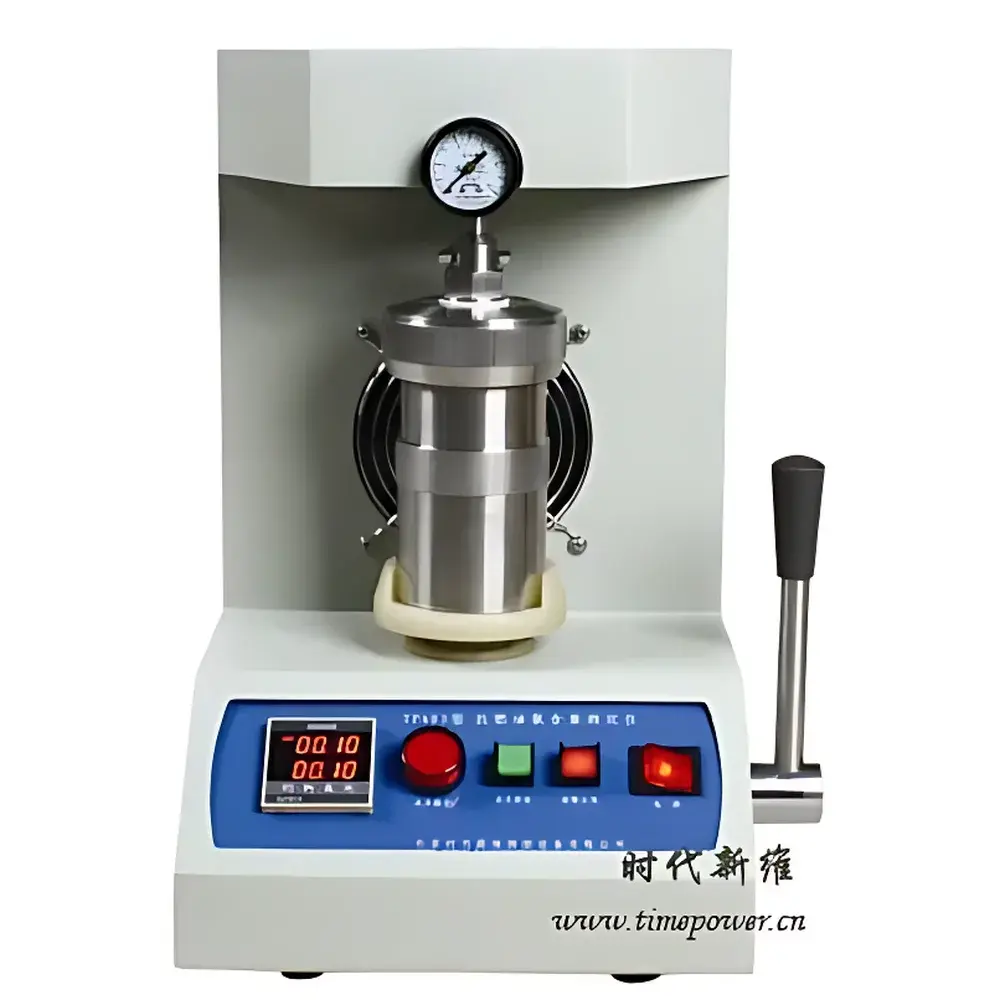
TimePower TP683 Sulfur and Chlorine Analyzer for Turbine Control Fluids
| Brand | TimePower |
|---|---|
| Model | TP683 |
| Measurement Principle | Oxygen Bomb Combustion with Mercury Nitrate or Barium Chloride Titration |
| Compliance | DL/T 433, GB/T 388 |
| Max Operating Pressure | ≥20 MPa |
| Ignition Voltage | 12–24 V DC |
| Repeatability (RSD) | ≤0.0006% (w/w) |
| Ambient Temperature Range | 10–40 °C |
| Relative Humidity | 30–80% RH |
| Power Supply | AC 220 V ±10%, 50 Hz ±10% |
| Power Consumption | <500 W |
| Dimensions (W×D×H) | 300 × 300 × 390 mm |
| Cooling Method | Integrated High-Flow Air Cooling |
| Net Weight | 8.7 kg |
Overview
The TimePower TP683 Sulfur and Chlorine Analyzer is a dedicated combustion-based analytical instrument engineered for the precise quantification of total sulfur and chlorine content in turbine control fluids—particularly phosphate ester-based anti-wear hydraulic oils—and other high-boiling petroleum products including lubricating oils, residual fuels, and heavy distillates. It operates on the classical oxygen bomb combustion principle defined in ASTM D1552 (for sulfur) and adapted to meet the stringent requirements of Chinese national standard GB/T 388 and power industry specification DL/T 433. In this method, a precisely weighed sample is combusted quantitatively in a high-pressure oxygen environment within a sealed, corrosion-resistant bomb rated to ≥20 MPa. The resulting sulfur oxides are absorbed in an alkaline peroxide solution and subsequently titrated with standardized mercury(II) nitrate; chlorine is similarly converted to chloride ions and determined via barium chloride precipitation or potentiometric titration. This gravimetric/titrimetric approach delivers trace-level accuracy without reliance on optical detection systems, making it especially suitable for matrix-rich, low-volatility samples where XRF or UV fluorescence methods may suffer from interferences or poor recovery.
Key Features
- High-integrity oxygen bomb assembly constructed from austenitic stainless steel with dual-seal design, certified for sustained operation at ≥20 MPa working pressure
- Automated combustion sequence control: integrated solenoid oxygen charging, timed ignition (12–24 V DC pulse), post-combustion cooling, and venting—all programmable via front-panel interface
- Integrated high-flow air-cooling system enables rapid thermal equilibration between runs, reducing cycle time to under 15 minutes per analysis
- Robust mechanical architecture with vibration-dampened base and ergonomic sample loading chamber, optimized for daily use in QC laboratories with limited bench space
- No external gas cylinders required—compatible with standard laboratory-grade oxygen supply (≥99.5% purity, regulated to 3.0 MPa inlet)
- Compliance-ready design: supports manual logbook entries aligned with GLP documentation practices; audit trail maintained via timestamped operational records
Sample Compatibility & Compliance
The TP683 is validated for use with phosphate ester anti-wear fluids (e.g., Fyrquel, Skydrol, and comparable formulations), as well as mineral oil-based turbine oils, marine cylinder oils, and ASTM D4294-incompatible residues. Its combustion-titration methodology avoids spectral overlap issues common in EDXRF and eliminates calibration drift associated with UV fluorescence detectors in high-salt or additive-laden matrices. The instrument conforms to the procedural rigor mandated by DL/T 433 for power plant maintenance labs and satisfies the elemental reporting requirements of GB/T 388 for referee testing of lubricant sulfur content. While not inherently 21 CFR Part 11 compliant (as it lacks electronic signature capability), its manual data recording workflow is fully compatible with paper-based or hybrid QA systems operating under ISO/IEC 17025 or IEC 61000-4-30 environments.
Software & Data Management
The TP683 operates via an embedded microcontroller with non-volatile memory storage for up to 200 test records, each containing sample ID, date/time stamp, gross/net weight, oxygen pressure, ignition status, titrant volume, and calculated S/Cl concentration (reported in % w/w). Data export is supported through RS-232 serial interface to external PCs running Excel-compatible terminal software or LIMS middleware. No proprietary software installation is required. All calculation algorithms implement the stoichiometric conversions specified in GB/T 388 Annex B and include built-in blank correction and repeatability validation per test batch. Raw titration volumes and final results are retained for full traceability—essential for internal audits and third-party accreditation reviews.
Applications
- Monitoring sulfur accumulation in phosphate ester turbine control fluids to prevent servo valve corrosion and electrochemical degradation
- Verifying chlorine contamination in reclaimed hydraulic oils prior to reinstallation in critical rotating equipment
- Referee analysis for sulfur content in heavy fuel oils per ISO 8217 specifications
- QC release testing of new lubricant batches in OEM-certified manufacturing facilities
- Research investigations into oxidative stability mechanisms involving halogen-catalyzed hydrocarbon cleavage pathways
- Supporting root-cause analysis during turbine trip events linked to fluid chemistry excursions
FAQ
What sample mass range is recommended for optimal precision?
Typical sample weights range from 0.5 g to 2.0 g, depending on expected sulfur/chlorine concentration. For anti-wear fluids with typical S levels of 0.001–0.01%, 1.0 g is standard.
Can the TP683 analyze solid samples such as greases or asphalt?
No—this instrument is designed exclusively for liquid or low-melting-point semi-liquids that can be accurately weighed and uniformly distributed in the combustion cup. Solid matrices require prior solvent dissolution or alternate digestion protocols not supported by the TP683 platform.
Is operator training required before first use?
Yes. Safe operation requires familiarity with high-pressure oxygen handling, bomb assembly torque procedures, and titration endpoint recognition. TimePower provides a comprehensive SOP manual and optional on-site commissioning support.
How often must the oxygen bomb be hydrostatically tested?
Per manufacturer recommendation and general lab safety policy, the bomb should undergo certified hydrostatic pressure verification every 24 months or after any suspected over-pressurization event.
Does the instrument support automatic titrant delivery?
No—the TP683 relies on manual burette titration to ensure analyst-controlled endpoint detection, preserving method equivalence with classical reference procedures cited in DL/T 433 and GB/T 388.