
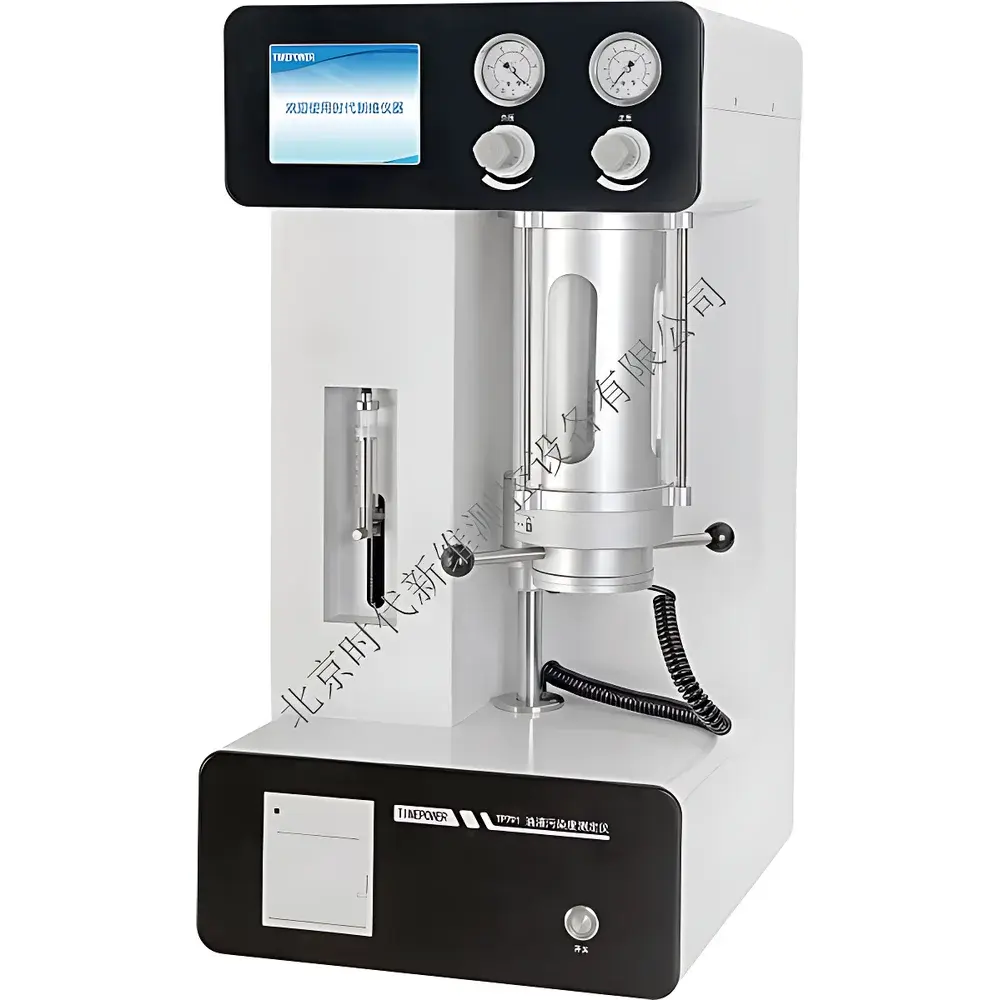
TimePower TP791 Oil Contamination Analyzer (Light Obscuration Particle Counter)
| Brand | TimePower |
|---|---|
| Origin | Beijing, China |
| Manufacturer Type | Manufacturer |
| Product Category | Domestic |
| Model | TP791 |
| Instrument Type | Light Obscuration (Photometric Blocking) Particle Counter |
| Measurement Principle | ISO 11171–Compliant Light Obscuration |
| Optical Source | Semiconductor Laser |
| Particle Size Range | 0.8 µm to 600 µm (sensor-dependent) |
| Number of Detection Channels | 16 (user-definable thresholds within calibration range) |
| Sample Volume | 0.2–1000 mL |
| Sampling Accuracy | ±0.5% |
| Flow Rate | 5–80 mL/min |
| Resolution | <10% (per ISO 21501-4) |
| Coincidence Limit | 12,000–24,000 particles/mL (sensor-dependent) |
| Repeatability | RSD < 2% |
| Positive Pressure Capacity | 0.8 MPa |
| Negative Pressure Capacity | 0.08 MPa |
| Max. Fluid Viscosity | ≤650 cSt |
| Data Output | Built-in thermal printer + RS232 interface |
| Operating Temperature | 0–60 °C |
| Power Supply | AC 220 V ±10%, 50 Hz ±10% |
| Power Consumption | ≤200 W |
| Dimensions (main unit) | 360 × 370 × 700 mm |
| Weight (main unit) | 30 kg |
| Compliance Standards | GB/T 18854, ISO 11171, ISO 4406, NAS 1638, GJB 420B, DL/T 432, SAE AS4059F, GB/T 14039, ГОСТ 17216 |
Overview
The TimePower TP791 Oil Contamination Analyzer is a precision light obscuration (LO) particle counter engineered for quantitative assessment of solid particulate contamination in liquid media—primarily hydraulic fluids, lubricants, insulating oils, turbine oils, and other industrial oils. It operates in strict accordance with the internationally recognized photometric blocking principle defined in ISO 11171, which establishes metrological traceability for particle sizing and counting via calibrated optical detection. As a core instrument in fluid condition monitoring programs, the TP791 delivers standardized contamination grade classification per ISO 4406, NAS 1638, GJB 420B, and other regulatory frameworks governing aerospace, power generation, and heavy machinery maintenance. Its design integrates a high-stability semiconductor laser source, a 16-channel digital signal processor, and a dual-pressure (positive/negative) sample handling system—enabling robust performance across viscosity ranges up to 650 cSt without manual dilution or pre-filtration.
Key Features
- ISO 11171–compliant light obscuration detection with NIST-traceable calibration support via built-in multi-curve reference libraries.
- 16 independent user-configurable size thresholds (0.8–600 µm), allowing granular analysis aligned with application-specific reporting requirements (e.g., ≥4 µm(c), ≥6 µm, ≥14 µm, ≥21 µm).
- Precision syringe pump sampling with programmable volume (0.2–1000 mL) and flow control (5–80 mL/min), ensuring volumetric accuracy better than ±0.5%.
- Dual-mode pressure chamber (0.8 MPa max positive / 0.08 MPa max negative) for automatic degassing and bubble suppression—critical for viscous or volatile samples.
- Thermal printer and RS232 serial interface for local hardcopy output and integration into LIMS or centralized lab data management platforms.
- Touchscreen HMI with Chinese/English language toggle, on-board data storage (≥10,000 test records), and automated grade assignment per selected standard (e.g., ISO 4406 code “18/16/13”).
- Support for multiple container formats—including standard 100-mL glass vials, disposable cups, and pressurized sample bottles—ensuring compatibility with field, workshop, and central lab workflows.
Sample Compatibility & Compliance
The TP791 is validated for use with mineral-based, synthetic, and bio-based oils—including aviation turbine fuel (Jet A-1), phosphate ester fire-resistant fluids, polyalphaolefin (PAO) lubricants, and silicone dielectric coolants. It also supports non-aqueous organic solvents and polymer solutions where insoluble particulate characterization is required (e.g., catalyst residue screening in petrochemical synthesis). All measurement protocols align with ASTM D6786 (for jet fuel), ISO 4406:2021 (fluid cleanliness coding), ISO 11171:2018 (calibration procedures), and GJB 420B–2015 (military hydraulic fluid specifications). The instrument architecture supports GLP-compliant operation through audit-trail-capable data logging and user-access controls—facilitating FDA 21 CFR Part 11 readiness when deployed in regulated manufacturing environments.
Software & Data Management
While the TP791 operates autonomously via its embedded firmware, raw count data and grade assignments are exportable via RS232 to third-party software (e.g., Excel, LabVIEW, or custom SQL-based asset health dashboards). Each test record includes timestamp, operator ID, sample ID, volume aspirated, environmental temperature, pressure status, and full channel-by-channel pulse height distribution. Calibration curves are stored in non-volatile memory and may be updated using certified PSL reference standards traceable to NIST SRM 1960. Firmware supports user-defined pass/fail limits and statistical trending over time—enabling predictive maintenance logic based on ISO cleanliness code drift.
Applications
- Condition-based monitoring of hydraulic systems in aircraft landing gear, wind turbine pitch controls, and industrial presses.
- Acceptance testing of new oil batches prior to commissioning transformers, turbines, and gearboxes.
- Root-cause analysis of wear debris in engine oil drain samples—correlating particle counts with ferrographic or elemental analysis results.
- Verification of filter efficiency in offline kidney-loop filtration systems used in marine propulsion lubrication circuits.
- Quality control of base oils and additive packages during formulation, ensuring absence of agglomerates or catalyst fines.
- Compliance verification for military logistics depots under MIL-STD-1246C cleanliness requirements.
FAQ
What particle size standards does the TP791 support out-of-the-box?
The instrument includes preloaded calibration curves for ISO 11171, NAS 1638, GJB 420B, SAE AS4059F, DL/T 432, GB/T 14039, and ГОСТ 17216—enabling immediate compliance reporting without external recalibration.
Can the TP791 analyze water-contaminated oil samples?
No. Water droplets cause optical interference and false counts in light obscuration mode. Emulsified or free water must be removed via centrifugation or coalescing filtration prior to analysis.
Is the instrument suitable for cleanroom-certified environments?
Yes—the TP791 meets ISO Class 5 (Class 100) cleanroom compatibility requirements when operated with HEPA-filtered compressed air and validated sampling protocols.
Does the system require annual recalibration by an accredited metrology lab?
Per ISO 21501-4, users should verify sensor linearity and threshold accuracy annually using traceable PSL standards; full recalibration is recommended every two years or after major component replacement.
How is sample carryover mitigated between tests?
The syringe pump and fluidic path are automatically flushed with clean solvent (e.g., filtered petroleum ether) between runs, with dwell-time and rinse volume programmable in the method editor.



