
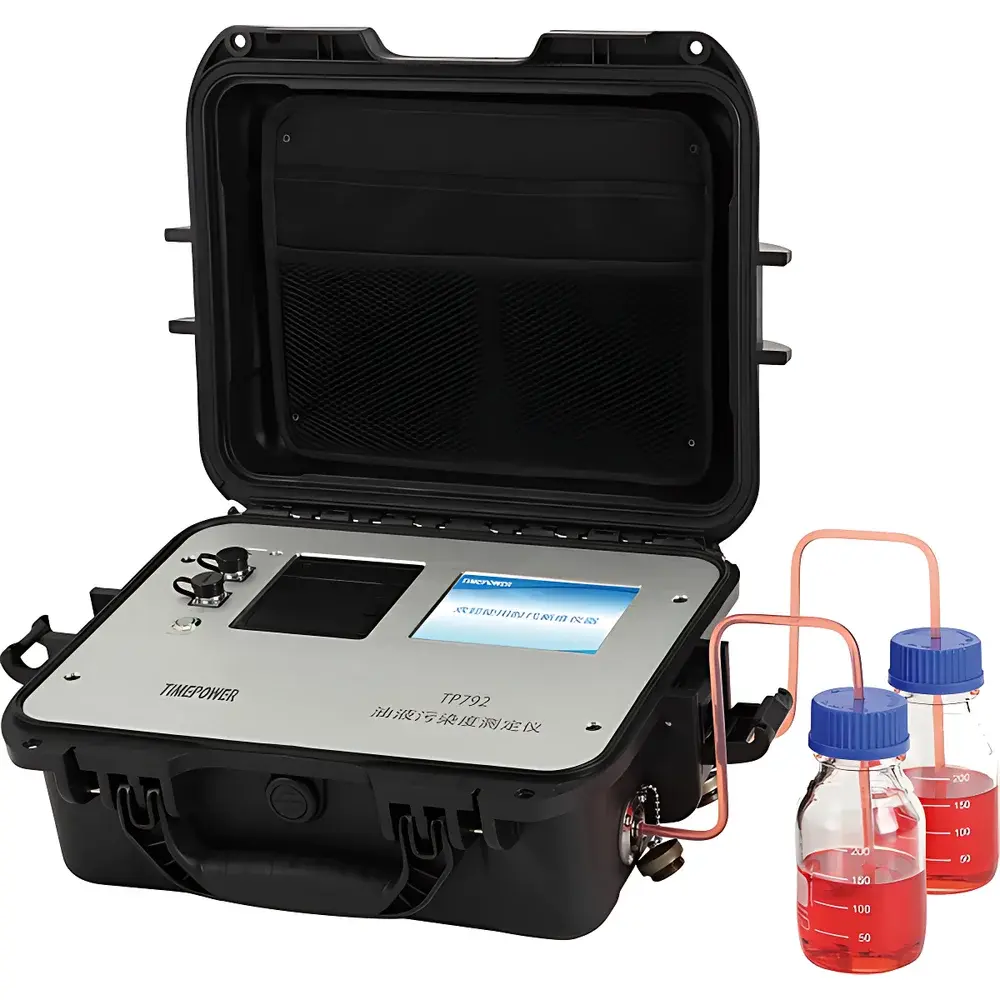
Timepower TP792 Portable Oil Contamination Analyzer
| Brand | Timepower |
|---|---|
| Origin | Beijing, China |
| Manufacturer Type | OEM/ODM Manufacturer |
| Country of Origin | China |
| Model | TP792 |
| Instrument Type | Light-Blocking (Optical Obstruction) Particle Counter |
| Light Source | Semiconductor Laser |
| Particle Size Range | 1–400 µm |
| Sensitivity | 1 µm (per ISO 4402) or 4 µm(c) (per GB/T 18854 & ISO 11171) |
| Detection Channels | 32 user-configurable size thresholds |
| Sample Volume per Test | 10 mL ±3% |
| Analysis Time | 30 s per run |
| Flow Rate | 5–35 mL/min (adjustable |
| Rinse Volume Range | 0–90 mL (1 mL increments) |
| Coincidence Limit | 24,000 particles/mL (5% coincidence error) |
| Counting Repeatability | RSD < 2% (at ≥1000 particles/mL) |
| Counting Accuracy | ±10% |
| Offline Viscosity Range | ≤100 cSt (≤400 cSt with optional pneumatic bottle sampler) |
| Online Pressure Range | 0.1–0.6 MPa (up to 40 MPa with optional pressure-reduction module) |
| Online Interval Setting | 1 s to 10 h 59 min 59 s |
| Operating Temperature | −20 °C to +60 °C |
| Storage Temperature | −30 °C to +80 °C |
| Sample Temperature Range | 0 °C to +80 °C |
| Power Supply | 100–265 VAC / 24 VDC / Optional External Li-ion Battery |
| Power Consumption | ≤100 W |
| Dimensions | 415 × 310 × 170 mm |
| Weight | 7 kg |
Overview
The Timepower TP792 Portable Oil Contamination Analyzer is a field-deployable, ISO-compliant particle counter engineered for quantitative assessment of solid particulate contamination in liquid lubricants and hydraulic fluids. It operates on the internationally standardized light-blocking (optical obstruction) principle defined in ISO 11171, GB/T 18854, and ASTM F312-22 — where suspended particles passing through a precisely collimated laser beam induce transient reductions in transmitted light intensity. These signal attenuations are converted into pulse amplitudes proportional to particle cross-sectional area, enabling simultaneous sizing and counting across 32 user-defined thresholds from 1 µm to 400 µm. Designed for both offline laboratory verification and continuous online monitoring, the TP792 supports real-time condition-based maintenance (CBM) strategies in mission-critical systems where fluid cleanliness directly correlates with component reliability, wear rate, and system uptime.
Key Features
- High-fidelity optical detection architecture incorporating a stable semiconductor laser source and low-noise photodetector array optimized for dynamic range and signal-to-noise ratio.
- 5.6-inch capacitive touchscreen interface with intuitive navigation, multilingual support (English, Chinese), and context-sensitive on-screen prompts for calibration, sampling, and reporting.
- Precision volumetric metering system ensuring ±3% accuracy in 10 mL sample delivery — critical for compliance with ISO 4406:2017 and NAS 1638 reporting requirements.
- Triple embedded calibration curve support (ACFTD, ISO MTD, ROST) with automatic conversion logic to minimize inter-standard uncertainty during reporting.
- Integrated thermal printer supporting alphanumeric and Unicode character input (including Chinese characters) for immediate hardcopy generation of test reports compliant with internal QA documentation protocols.
- Dual data storage architecture: onboard non-volatile memory (≥10,000 records) plus USB 2.0 host port for direct export to FAT32-formatted USB drives.
- Industrial-grade communication interfaces: isolated RS-232 and RS-485 ports enabling integration into SCADA, MES, or CMMS platforms with configurable Modbus RTU protocol support.
- Modular sampling flexibility — compatible with offline syringe-based aspiration, pressurized pneumatic bottle samplers (for high-viscosity oils up to 400 cSt), and online flow cells with pressure-rated fittings (0.1–40 MPa with optional regulator).
Sample Compatibility & Compliance
The TP792 is validated for use with mineral- and synthetic-based hydraulic oils, turbine oils, transformer (insulating) oils, gear oils, engine oils, aviation kerosene, water-glycol hydraulic fluids, and polymer solutions. Its optical design accommodates samples with turbidity up to 30 NTU and non-volatile residue content ≤5 mg/100 mL. The instrument meets electromagnetic compatibility (EMC) requirements per IEC 61326-1:2020 and safety standards per IEC 61010-1:2010. All firmware and data handling routines comply with GLP principles, including full audit trail logging for user actions, calibration events, and report generation. While not FDA 21 CFR Part 11-certified out-of-the-box, its timestamped, immutable data export structure supports validation under regulated environments when deployed with documented SOPs and electronic signature workflows.
Software & Data Management
The TP792 embeds a deterministic real-time operating system (RTOS) with deterministic scheduling for time-critical particle detection cycles. Raw pulse data, channel histograms, and metadata (date/time, operator ID, sample ID, calibration ID) are stored in structured binary format with CRC-32 integrity checking. Exported CSV files include ISO 4406 code pairs (e.g., 18/16/13), NAS 1638 class, GJB 420B code, and full distribution tables. Optional PC software (TP-DataLink v3.x) provides statistical trending, multi-instrument fleet comparison, SPC charting (X̄-R, CUSUM), and automated report templating aligned with ISO 55001 asset management frameworks. All data exports are timestamped, uneditable, and retain traceability to original acquisition parameters.
Applications
- Aerospace: Hydraulic fluid cleanliness verification pre-flight and post-maintenance per SAE AS4059F and GJB 420B Class 5–12.
- Power Generation: Transformer oil particulate monitoring per DL/T 432 and IEC 60296, supporting predictive insulation failure mitigation.
- Marine & Offshore: Real-time lube oil surveillance in main propulsion gearboxes and servo-valve circuits to prevent catastrophic wear.
- Heavy Machinery: In-situ contamination tracking in excavator hydraulic systems to validate filter performance and schedule replacements.
- Railway Traction: Gear oil particle load assessment in electric locomotive drive axles per EN 14985 and UIC 541-3.
- Manufacturing: Closed-loop verification of flushing efficacy during commissioning of new hydraulic systems prior to startup.
FAQ
What particle size standards does the TP792 support for calibration and reporting?
The instrument natively supports ACFTD, ISO MTD, and ROST calibration curves, with built-in conversion algorithms for ISO 4406, NAS 1638, GJB 420A/B, AS4059E/F, GB/T 14039, SAE 749D, ROCT 17216, and JTS-005.
Can the TP792 operate continuously in an online configuration?
Yes — it supports autonomous online operation with programmable sampling intervals from 1 second to 10 hours 59 minutes 59 seconds, and includes hardware-level flow stabilization to maintain consistent velocity across varying line pressures.
Is external power required for field deployment?
No — the instrument accepts 100–265 VAC, 24 VDC, or optional external lithium-ion battery packs (sold separately), enabling >8 hours of uninterrupted operation in remote or mobile applications.
How is data integrity ensured during transfer to external systems?
All exported data files contain embedded checksums, acquisition timestamps, instrument serial number, and operator-assigned sample identifiers — satisfying baseline traceability requirements for ISO/IEC 17025-accredited laboratories.
Does the TP792 require annual recalibration?
Per ISO 21501-4 and manufacturer recommendations, optical alignment and volumetric accuracy should be verified annually using NIST-traceable reference particles and certified pipettes; full recalibration is advised after any physical impact or exposure to extreme thermal cycling.



