
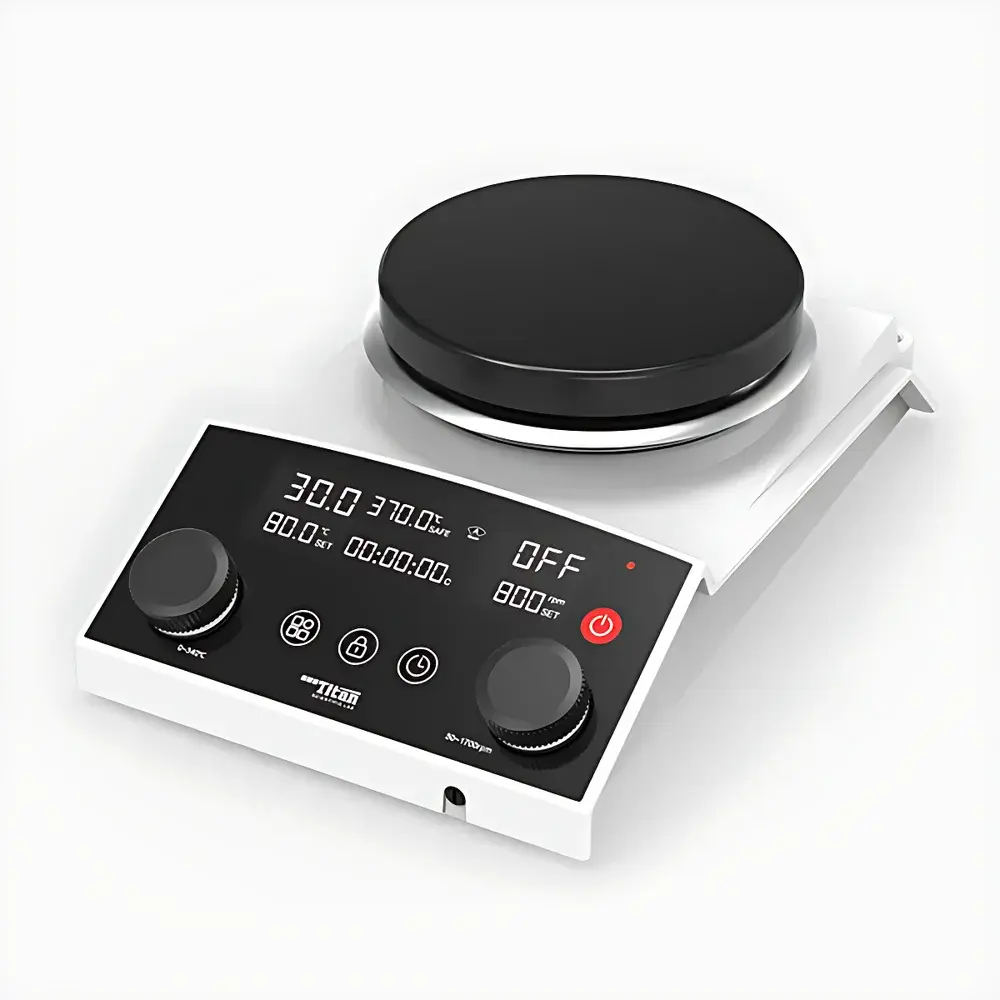
Titan BMS-14C Controlled-Heating Magnetic Stirrer
| Brand | Titan |
|---|---|
| Origin | Shanghai, China |
| Manufacturer Type | Direct Manufacturer |
| Product Category | Domestic |
| Model | BMS-14C |
| Instrument Type | Magnetic Stirrer |
| Maximum Stirring Volume | 20 L |
| Speed Range | 50–1700 rpm |
| Temperature Control Range | Ambient to 340 °C |
Overview
The Titan BMS-14C Controlled-Heating Magnetic Stirrer is an engineered benchtop solution for precise, reproducible mixing and temperature-controlled reaction management in analytical, synthetic, and quality control laboratories. Designed around a robust permanent-magnet coupling system and integrated PID-controlled heating plate, it delivers stable rotational torque and uniform thermal distribution across standard laboratory vessels—from beakers and flasks to jacketed reactors. Unlike basic stirrers, the BMS-14C employs closed-loop thermal feedback with real-time sensor monitoring (PT100-grade accuracy) to maintain setpoint stability within ±2 °C across its full 340 °C operating range. Its operation adheres to fundamental principles of viscous drag transfer and conductive heat exchange, making it suitable for applications requiring both kinetic homogeneity and thermally defined reaction pathways—such as polymerization initiation, catalyst activation, dissolution testing, and buffer equilibration.
Key Features
- High-torque dual-core stirring motor delivering consistent rotation up to 1700 rpm, optimized for viscosities up to 10,000 mPa·s (with appropriate stir bar geometry)
- Digitally adjustable heating plate with ceramic-coated aluminum surface, engineered for rapid thermal response and long-term thermal cycling endurance
- Intuitive rotary encoder interface with dual LED display showing simultaneous real-time values for speed (rpm) and plate temperature (°C)
- Overheat protection circuitry compliant with IEC 61000-4-2 ESD immunity standards; automatic shutdown triggered at 360 °C or upon sensor fault detection
- Chemically resistant housing (IP21-rated) with reinforced base structure to minimize vibration transmission during high-speed operation
- Stir bar detection algorithm (optional firmware upgrade) that alerts users to misalignment or insufficient magnetic coupling before operational drift occurs
Sample Compatibility & Compliance
The BMS-14C accommodates standard glassware including borosilicate beakers (50 mL–5000 mL), round-bottom flasks (up to 3 L), and flat-bottom reaction vessels compatible with magnetic stir bars ≤80 mm in length. It supports use with PTFE- or PTFE/glass-coated stir bars rated for temperatures up to 340 °C. The unit conforms to CE marking requirements under the Low Voltage Directive (2014/35/EU) and Electromagnetic Compatibility Directive (2014/30/EU). While not certified for hazardous area use (ATEX/IECEx), its design meets general laboratory safety expectations outlined in ISO/IEC 17025:2017 Annex A.3 for equipment used in accredited testing environments. Routine calibration verification can be performed using NIST-traceable digital thermometers and tachometers per internal SOPs aligned with GLP practices.
Software & Data Management
The BMS-14C operates as a standalone instrument without mandatory software dependency. However, optional RS-485 serial output (Modbus RTU protocol) enables integration into centralized lab automation systems for remote parameter setting, runtime logging, and audit-trail generation. When connected to validated LIMS or ELN platforms, temperature and speed profiles may be archived with timestamped metadata, supporting compliance with FDA 21 CFR Part 11 requirements where electronic records are subject to review. Firmware updates are delivered via secure USB interface with cryptographic signature validation to ensure integrity and traceability.
Applications
- Controlled-temperature synthesis of metal-organic frameworks (MOFs) and coordination polymers requiring extended reflux conditions
- Dissolution testing of pharmaceutical dosage forms per USP , particularly for sustained-release formulations demanding precise thermal ramping
- Preparation of homogeneous catalyst slurries for heterogeneous hydrogenation studies
- Standardization of calibration standards in environmental chemistry labs (e.g., heavy metal stock solutions requiring complete solute dispersion)
- Cell culture media pre-warming and pH buffer equilibration prior to sterile filtration
- Viscosity benchmarking of industrial lubricants and adhesives under isothermal shear conditions
FAQ
What is the maximum recommended vessel diameter for optimal stirring efficiency?
For consistent vortex formation and minimal dead zones, vessels with diameters between 60 mm and 180 mm are recommended. Larger diameters may require custom-length stir bars or auxiliary positioning aids.
Can the BMS-14C be used under inert atmosphere conditions?
Yes—provided the vessel is sealed with appropriate gas-tight fittings and the stir bar remains magnetically coupled through the vessel wall. Thermal expansion of glass must be accounted for during prolonged heating cycles.
Is calibration documentation available for regulatory submissions?
Titan provides a factory-issued Certificate of Conformance with each unit. Optional IQ/OQ documentation packages—including test protocols and raw data logs—are available upon request for GMP or ISO 17025-aligned installations.
Does the unit support programmable ramp-hold temperature profiles?
No—the BMS-14C implements single-setpoint PID control only. For multi-step thermal protocols, external programmable controllers or integrated reactor systems are recommended.



