
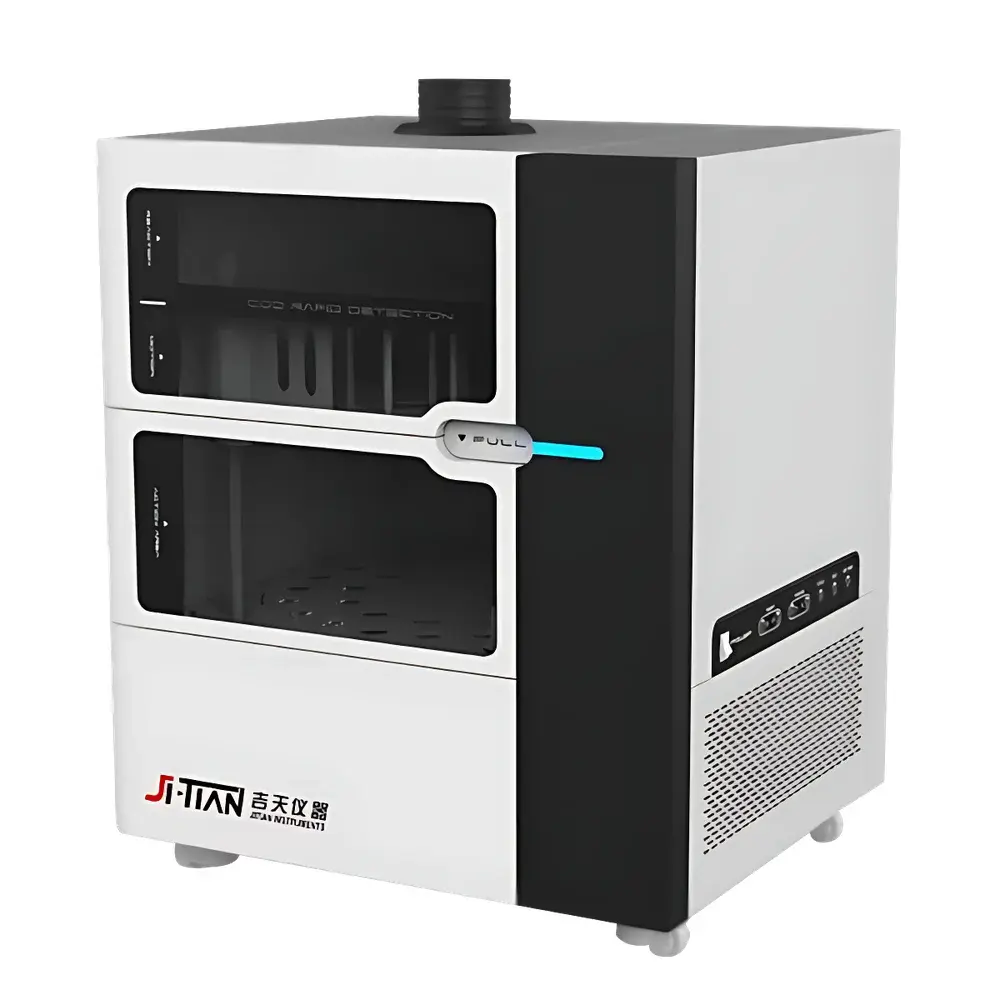
Titan Instruments ACOD-30 Fully Automated Chemical Oxygen Demand (COD) Analyzer
| Brand | Titan Instruments |
|---|---|
| Origin | Beijing, China |
| Manufacturer Type | Authorized Distributor |
| Country of Origin | China |
| Model | ACOD-30 |
| Pricing | Available Upon Request |
Overview
The Titan Instruments ACOD-30 Fully Automated Chemical Oxygen Demand (COD) Analyzer is an integrated laboratory system engineered for precise, reproducible, and operator-safe determination of chemical oxygen demand in aqueous environmental samples. Based on the standardized open-reflux digestion–potentiometric titration principle per HJ 828–2017 (“Determination of Chemical Oxygen Demand in Water—Dichromate Method”), the ACOD-30 automates the entire analytical workflow—including sample aspiration, reagent dispensing (including concentrated sulfuric acid and potassium dichromate), controlled thermal digestion (reflux at 150 °C for 2 h), condensate management via auto-aligned reflux condenser modules, post-digestion cooling, redox titration with standardized ferrous ammonium sulfate (FAS), endpoint detection, and waste disposal. By eliminating manual handling of corrosive reagents and high-temperature digestion vessels, the system significantly reduces occupational exposure risk while enhancing inter-run precision (RSD < 3.5% for certified reference materials) and method compliance integrity.
Key Features
- Integrated modular architecture comprising robotic autosampler, 9-channel independent reagent delivery system (preventing cross-contamination between oxidants, catalysts, and titrants), and dual-range titration module with separate high- and low-concentration pathways.
- Patented circumferential spray-rinse mechanism ensures complete removal of residual sulfuric acid and volatile organic residues from digestion vials prior to titration—critical for minimizing blank drift and carryover.
- Pre-screening algorithm analyzes initial sample absorbance or conductivity to estimate COD concentration range; automatically selects optimal digestion volume (2.5 mL or 10 mL), dilution factor, and FAS titrant concentration (0.025 mol/L or 0.1 mol/L).
- Real-time chloride interference assessment: quantifies Cl⁻ content spectrophotometrically pre-digestion and triggers HgSO₄ masking agent addition if [Cl⁻] > 1000 mg/L, fully aligned with HJ 828–2017 protocol requirements.
- Self-diagnostic “Run Integrity Check” verifies vial positioning, reagent bottle levels, pump priming status, and condenser alignment before initiating each sequence—preventing acid leakage or thermal runaway events.
- Biomimetic full-spectrum colorimetric endpoint detection replaces subjective visual titration: a calibrated CMOS sensor continuously monitors the Cr³⁺/Cr⁶⁺ redox transition (420–650 nm), detecting inflection points with ±0.02 mL volumetric resolution.
- End-to-end audit trail: every reagent dispense volume, digestion temperature/time profile, titration curve (mL vs. potential/mV), and endpoint decision timestamp is logged with user ID and instrument serial number—supporting GLP/GMP traceability and FDA 21 CFR Part 11-compliant electronic records when paired with validated LIMS integration.
Sample Compatibility & Compliance
The ACOD-30 accepts liquid samples within pH 2–12 and total suspended solids ≤ 50 mg/L (pre-filtered). Validated for raw influent and effluent wastewater, surface water, leachate, and industrial process streams containing organics such as alcohols, carboxylic acids, aldehydes, and aromatic compounds. All operational parameters—including reflux temperature stability (±1 °C), digestion time accuracy (±30 s), and titrant delivery precision (CV < 0.8% at 1 mL) —are verified against NIST-traceable COD standards (e.g., potassium hydrogen phthalate, KHP). System performance meets ISO 6060:1989 and ASTM D1252–12 (Method B) equivalency requirements. Routine calibration verification follows HJ 828–2017 Section 7.3 (recovery testing with 100 mg/L KHP standard).
Software & Data Management
Controlled via Titan Analytical Suite v4.2 (Windows 10/11 compatible), the software provides method editor, sequence scheduler, real-time process monitoring dashboard, and automated report generation (PDF/CSV/XLSX). Raw titration curves and derivative plots are exportable for secondary review. Audit logs include digital signatures, role-based access control (admin/operator/auditor profiles), and immutable storage with optional encrypted network backup. Data export complies with EPA STORET and EU WISE data schema conventions. Optional API enables bidirectional integration with ELN platforms (e.g., LabArchives, Benchling) and enterprise LIMS (e.g., Thermo Fisher SampleManager, LabVantage).
Applications
- Regulatory compliance monitoring for municipal wastewater treatment plants (WWTPs) under China’s GB 18918–2002 and EU Urban Wastewater Treatment Directive (91/271/EEC).
- Industrial pretreatment verification for textile, pharmaceutical, food & beverage, and petrochemical facilities discharging to public sewers.
- Environmental impact assessment (EIA) field laboratories performing rapid screening of riverine and lake sediment porewater.
- Research applications requiring high-throughput COD kinetics studies (e.g., biodegradability assays, inhibitor toxicity testing).
- Accredited testing laboratories seeking CNAS ISO/IEC 17025:2017 method validation documentation packages for automated COD analysis.
FAQ
Does the ACOD-30 comply with international COD standards beyond HJ 828–2017?
Yes—the system’s digestion efficiency, reagent stoichiometry, and titration accuracy have been independently verified against ISO 6060 and ASTM D1252–12 (Method B) performance criteria.
How is chloride interference managed during automated analysis?
The system performs in-line chloride quantification prior to digestion and automatically adds mercury sulfate masking reagent when chloride exceeds 1000 mg/L, in strict accordance with HJ 828–2017 Section 6.3.
Can the ACOD-30 be integrated into an existing LIMS environment?
Yes—via RESTful API or ODBC driver; validated interfaces exist for major LIMS vendors including LabVantage, Thermo Fisher SampleManager, and STARLIMS.
What maintenance protocols are required for long-term operational reliability?
Daily: rinse probe and vial station; weekly: inspect pump tubing wear and calibrate photometric sensor; quarterly: verify digestion temperature uniformity and titrant concentration via gravimetric standardization.
Is method validation support provided for laboratory accreditation?
Titan Instruments supplies a comprehensive IQ/OQ/PQ protocol package, including blank recovery data, spike recovery studies (85–115%), repeatability assessments (n=6), and linearity verification (5–1000 mg/L COD), aligned with ISO/IEC 17025:2017 Clause 7.2.2.




