
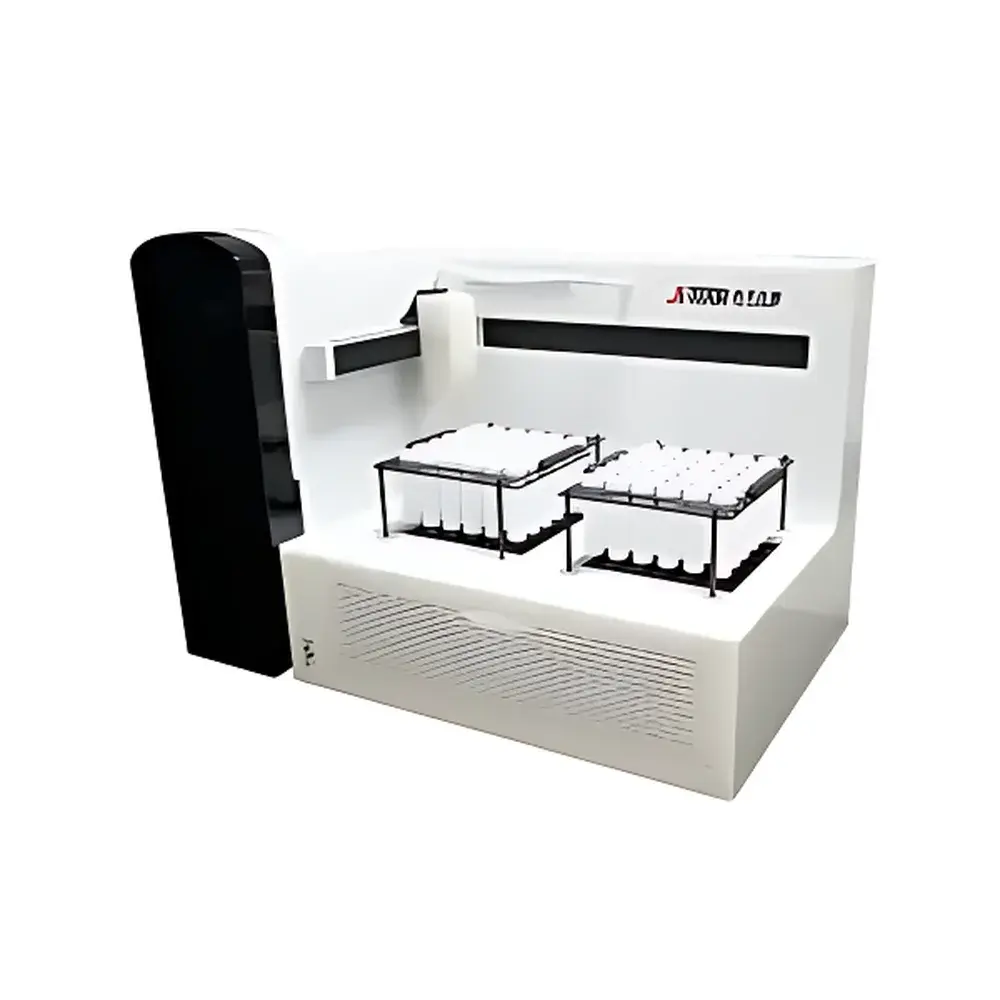
Titan Instruments ADP-5 Fully Automated Graphite Block Digestion System
| Brand | Titan Instruments |
|---|---|
| Origin | Beijing, China |
| Model | ADP-5 |
| Instrument Type | Graphite Block Digestion System |
| Automation Level | Fully Automated |
| Sample Capacity | 72 positions |
| Temperature Range | Ambient to 240 °C |
| Temperature Control | Dual independent PID-controlled graphite blocks |
| Temperature Accuracy | ±0.1 °C |
| Heating Principle | Uniform conductive heating via high-density pyrolytic graphite blocks |
| Reagent Channels | 11 independent chemically resistant fluid paths (HF-compatible) |
| Integrated Functions | Automated reagent addition, sample tube lifting/oscillation mixing, programmable digestion ramping, acid evaporation (dry-down), post-digestion tubing rinse, and final volumetric dilution |
Overview
The Titan Instruments ADP-5 Fully Automated Graphite Block Digestion System is an engineered solution for standardized, high-throughput inorganic sample preparation in compliance with internationally recognized wet digestion protocols. Based on the principle of controlled conductive heating through high-purity, low-thermal-mass pyrolytic graphite blocks, the ADP-5 delivers uniform thermal distribution across all 72 sample positions—minimizing inter-sample temperature deviation and ensuring method reproducibility essential for trace metal analysis. Unlike open-vessel hot plates or microwave-assisted systems, the ADP-5 operates under atmospheric pressure with full programmability of multi-step thermal profiles (including hold, ramp, and dry-down phases), making it particularly suitable for laboratories performing routine elemental analysis by ICP-MS, ICP-OES, AAS, and HG-AFS. Its design prioritizes operator safety by eliminating manual handling of aggressive reagents—including hydrofluoric acid—and minimizing exposure to acidic fumes during digestion and evaporation steps.
Key Features
- Fully automated 72-position digestion platform with synchronized or independent operation of dual graphite blocks—enabling parallel processing of heterogeneous sample matrices using distinct digestion methods.
- 11-channel reagent delivery system with chemically inert PTFE/PEEK fluid paths, calibrated for precise volumetric dispensing (0.1–20 mL range) and validated for HF compatibility without degradation.
- High-stability PID temperature control architecture delivering ±0.1 °C accuracy across the full 25–240 °C operating range; each graphite block features embedded Pt100 sensors and real-time thermal feedback loops.
- Integrated mechanical actuation system for programmable tube lifting, orbital oscillation (0–300 rpm), and vertical shaking—enhancing reagent-sample contact efficiency and preventing bumping or localized overheating.
- Automated post-digestion sequence including acid removal (controlled evaporation at user-defined temperatures), decontamination rinse cycles using ultrapure water or dilute nitric acid, and final sample dilution to fixed volumes (e.g., 25 mL or 50 mL).
- Modular software interface supporting method library management, audit-trail-enabled execution logging, and remote monitoring via Ethernet-connected PC or tablet device—compatible with Windows-based laboratory networks.
Sample Compatibility & Compliance
The ADP-5 supports a broad spectrum of solid and semi-solid matrices requiring total digestion prior to elemental quantification, including soils, sediments, sludges, plant tissues, food composites, geological samples, polymers, and battery cathode materials. Its robust construction meets CE marking requirements and aligns with key regulatory frameworks governing analytical quality assurance: ASTM D3682 (trace metals in water), EPA Method 3010A (acid digestion of solids), ISO 11466 (soil extractable metals), and Chinese national standards GB/T 22105-2008, HJ 491-2019, HJ 694-2014, HJ 700-2014, and HJ 781-2016. The system’s hardware and firmware support GLP-compliant data integrity through time-stamped method execution records, user authentication logs, and non-editable run reports—facilitating internal audits and readiness for FDA 21 CFR Part 11 validation when deployed in regulated environments.
Software & Data Management
Control is executed via Titan Instruments’ proprietary Digestion Control Suite v3.x—a Windows-native application designed for method development, scheduling, and real-time status visualization. Each digestion protocol includes configurable parameters for reagent type/volume/timing, temperature ramp rates, dwell durations, agitation frequency, and endpoint criteria (e.g., volume reduction threshold). All operational events—including valve actuations, temperature deviations >±0.5 °C, and reagent low-level alerts—are recorded with UTC timestamps and linked to user IDs. Export options include CSV-formatted raw logs and PDF summary reports compliant with ISO/IEC 17025 documentation requirements. Optional integration with LIMS platforms is supported via OPC UA or RESTful API endpoints for automated result ingestion into enterprise QA/QC workflows.
Applications
- Environmental laboratories performing routine monitoring of As, Cd, Cr, Cu, Hg, Ni, Pb, and Zn in soil, sediment, airborne particulates (TSP/PM2.5 filters), and wastewater sludge per EPA and EU WFD directives.
- Geochemical labs analyzing ore grades, exploration core samples, and metallurgical concentrates where matrix-dependent digestion optimization is critical for accurate REE and base metal recovery.
- Food safety testing facilities conducting multi-element screening per GB 5009.11-2014 and GB 5009.268-2016, especially for As speciation precursors and Cd/Pb accumulation in cereals, leafy vegetables, and seafood.
- Materials science R&D groups dissolving LiCoO₂, NMC, and LFP cathode powders for battery recycling studies and impurity profiling prior to electrochemical performance evaluation.
- Pharmaceutical QC labs validating elemental impurities in APIs and excipients per ICH Q3D guidelines, where consistent digestion efficiency directly impacts detection capability at sub-ppb levels.
FAQ
Does the ADP-5 support hydrofluoric acid (HF) handling?
Yes—the entire reagent delivery path, including valves, tubing, and tips, is constructed from HF-resistant materials (perfluoroalkoxy alkane and fused silica), and the digestion blocks are coated with fluoropolymer to prevent etching.
Can two different digestion methods run simultaneously?
Yes—dual independent graphite blocks allow separate temperature programming, reagent sequences, and timing schedules, enabling concurrent processing of soil (HNO₃–HCl–HF) and water filter (HNO₃–H₂O₂) samples.
Is method validation documentation available?
Titan Instruments provides IQ/OQ documentation templates, temperature uniformity mapping reports, and reagent delivery accuracy verification protocols upon request to support laboratory qualification processes.
What maintenance is required for long-term reliability?
Scheduled maintenance includes quarterly calibration of Pt100 sensors, biannual replacement of peristaltic pump tubing, and annual inspection of graphite block emissivity and thermal coupling integrity—procedures outlined in the included service manual.
Can the ADP-5 integrate with existing ICP-MS or AAS autosamplers?
While not directly coupled, the system outputs standardized 15–50 mL polypropylene vials compatible with most commercial autosampler trays; optional barcode labeling and LIMS handshaking enable seamless sample tracking across instrumentation platforms.



