
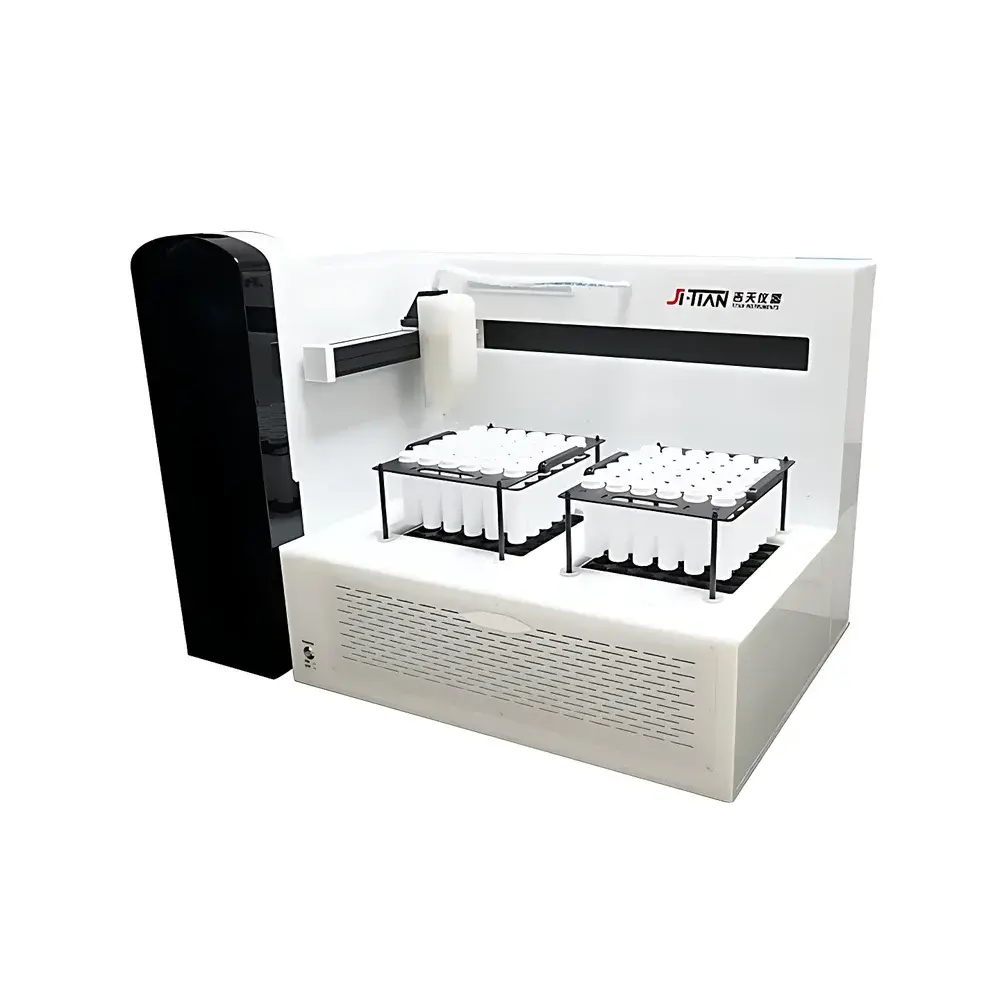
Titan Instruments ADP5 Fully Automated Graphite Block Digestion System
| Brand | Titan Instruments |
|---|---|
| Origin | Beijing, China |
| Manufacturer Type | Direct Manufacturer |
| Product Category | Domestic |
| Model | ADP5 |
| Instrument Type | Graphite Digestion System |
| Automation Level | Fully Automatic |
| Sample Capacity | 72 positions |
| Temperature Range | Ambient to 240 °C |
| Temperature Control Accuracy | ±0.1 °C (PID-controlled) |
| Heating Principle | Uniform graphite block heating |
| Reagent Channels | 11 independent reagent lines |
Overview
The Titan Instruments ADP5 Fully Automated Graphite Block Digestion System is an integrated, walk-away solution for high-throughput inorganic sample preparation via wet-acid digestion. Engineered for precision and reproducibility, the ADP5 implements a closed-loop, programmable digestion workflow grounded in classical open-vessel acid digestion chemistry—utilizing HNO₃, HCl, HF, H₂O₂, and other EPA- and ISO-compliant reagents under precisely controlled thermal conditions. At its core lies a dual-zone, high-density graphite heating block architecture, delivering uniform thermal distribution across all 72 sample positions while minimizing inter-sample temperature deviation. Unlike conventional hot plates or single-zone digesters, the ADP5 eliminates manual intervention throughout the entire sequence: reagent dispensing, tube elevation and orbital mixing, ramp-and-hold temperature programming, post-digestion acid evaporation (“acid fuming”), automated line rinsing, and final volumetric dilution. This end-to-end automation significantly reduces operator exposure to corrosive fumes and hazardous acids—aligning with OSHA laboratory safety guidelines and supporting institutional compliance with ANSI Z9.5 and ISO/IEC 17025 pre-analytical requirements.
Key Features
- 72-position high-capacity digestion platform enabling parallel processing of environmental, food, geological, and industrial samples without batch segmentation.
- 11-channel independent reagent delivery system with chemically resistant fluidic pathways—validated for safe, accurate metering of hydrofluoric acid (HF), aqua regia, and peroxide-based oxidants.
- Dual independent graphite heating zones, each with dedicated PID temperature control, allowing simultaneous execution of two distinct digestion methods (e.g., EPA Method 3050B for soils and USP <232> for pharmaceuticals) within a single run.
- Programmable multi-step thermal profiles—including pre-digestion hold, ramped heating, digestion soak, and controlled fuming—with real-time temperature logging at 1-second intervals.
- Integrated mechanical arm for precise vertical positioning and orbital shaking (0–300 rpm), ensuring homogeneous reagent–sample interaction and preventing localized charring or bumping.
- Full-system self-cleaning protocol: automatic purging of reagent lines, wash cycles using deionized water or dilute nitric acid, and drying sequences to prevent cross-contamination and crystallization buildup.
Sample Compatibility & Compliance
The ADP5 supports standard 50 mL PTFE, quartz, or borosilicate digestion tubes and accommodates diverse solid and semi-solid matrices—including soil, sediment, plant tissue, food composites, polymer ash, battery cathode materials, and catalyst residues. Its operational parameters meet the thermal and temporal requirements of globally recognized regulatory methods: U.S. EPA Methods 3010A, 3050B, and 3051A; China’s GB/T 22105–2008, HJ 491–2019, HJ 694–2014, HJ 700–2014, GB 5009.11–2014, GB 5009.268–2016, and HJ 781–2016; as well as ISO 11466 (soil trace elements) and ASTM D5173 (waste digests for ICP analysis). All hardware and software functions are designed to support GLP/GMP documentation needs, including user-access-level permissions, electronic signatures, and audit-trail-enabled method versioning.
Software & Data Management
Control is executed via Titan’s proprietary Digilab™ software, compatible with Windows-based PCs and Android/iOS tablets. The interface features drag-and-drop method building, graphical temperature/reagent timeline visualization, and real-time status dashboards showing zone temperatures, reagent remaining volume, and step completion timestamps. Data export is compliant with LIMS integration standards (CSV, XML, PDF reports), and raw logs include full metadata: operator ID, method name, start/stop times, temperature deviations, and error codes. Optional 21 CFR Part 11 compliance packages provide electronic signature validation, role-based access control, and immutable audit trails—fully configurable for regulated laboratories undergoing FDA or CNAS inspections.
Applications
The ADP5 serves as a critical front-end module in elemental analysis workflows requiring trace-metal quantification by ICP-OES, ICP-MS, GF-AAS, or HG-AFS. Primary application domains include environmental monitoring (heavy metals in wastewater sludge, airborne particulates on Teflon filters, and contaminated soils); geochemical exploration (digestion of silicate-rich ores and rare-earth concentrates); food safety testing (As, Pb, Cd, Hg in cereals, seafood, and infant formula); battery R&D (LiCoO₂, NMC, and LFP cathode dissolution prior to transition metal profiling); and pharmaceutical quality control (catalyst residue screening per ICH Q2(R2) and USP <232>/<233>). Its robust design also supports method development for emerging applications such as microplastic digestion and nuclear fuel cycle material characterization.
FAQ
What types of acids can be safely dispensed through the 11-channel system?
Hydrochloric acid (HCl), nitric acid (HNO₃), hydrofluoric acid (HF), hydrogen peroxide (H₂O₂), sulfuric acid (H₂SO₄), and perchloric acid (HClO₄) — subject to validated tubing compatibility and concentration limits specified in the Safety Manual.
Is remote monitoring supported during unattended overnight runs?
Yes — live status updates, email/SMS alerts for critical events (e.g., reagent depletion, temperature excursion >±0.5 °C), and secure web-based dashboard access are available via optional Titan CloudLink module.
How does the system ensure traceability for ISO/IEC 17025 accreditation?
Every digestion run generates a timestamped, digitally signed report containing method parameters, calibration records, environmental sensor readings (ambient temp/humidity), and full audit trail of user actions — exportable in PDF/A-1b format.
Can the ADP5 integrate with existing ICP-MS autosamplers?
Direct hardware integration is not provided; however, standardized 50 mL tube output format and barcode-compatible tube racks enable seamless handoff to CETAC ASX-560, Elemental Scientific XYZ, or similar autosampler platforms.
What maintenance is required to sustain long-term temperature accuracy?
Annual verification of thermocouple calibration against NIST-traceable reference standards and graphite block emissivity checks are recommended — both supported by Titan’s certified service network in APAC and EMEA regions.



