
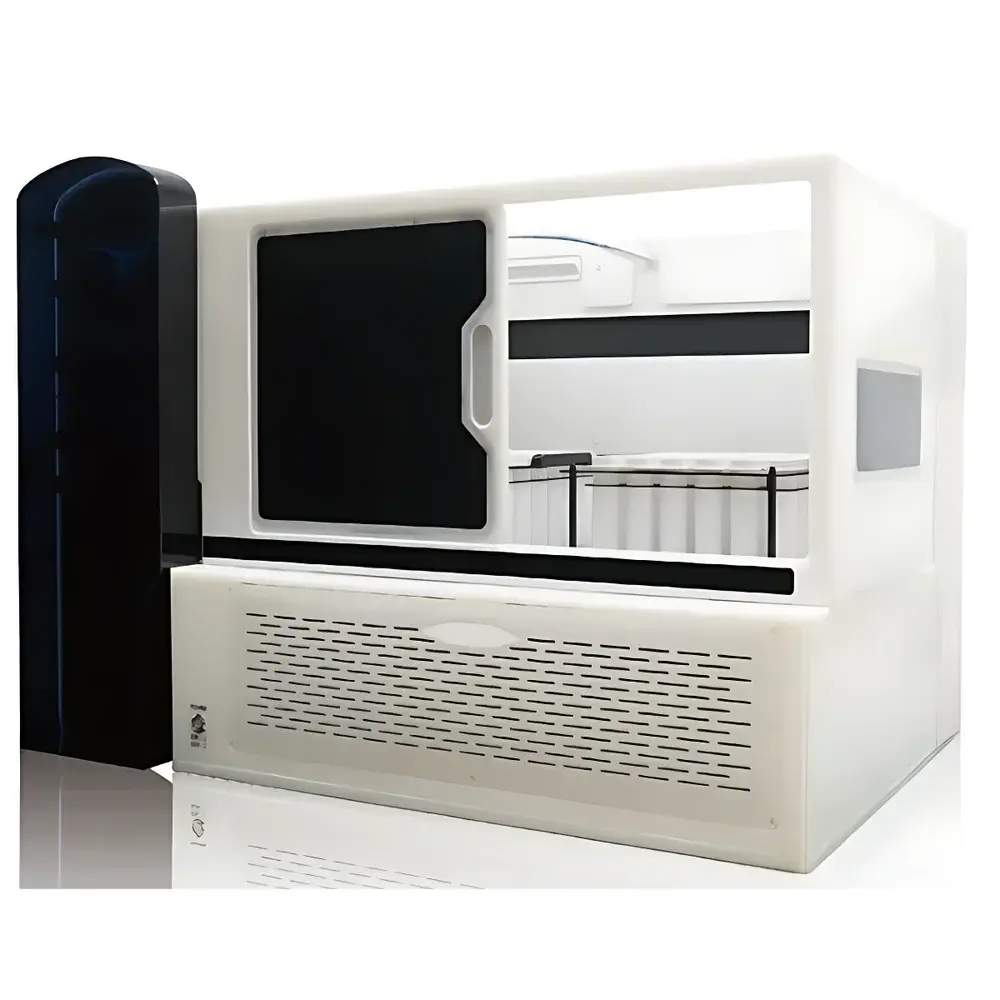
Titan Instruments ADP5 Fully Automated Graphite Block Digestion System
| Brand | Titan Instruments |
|---|---|
| Origin | Beijing, China |
| Manufacturer Type | Authorized Distributor |
| Product Origin | Domestic (China) |
| Model | ADP5 |
| Pricing | Available Upon Request |
Overview
The Titan Instruments ADP5 Fully Automated Graphite Block Digestion System is an integrated, walk-away solution engineered for high-throughput, reproducible wet-chemical digestion of inorganic samples. Based on the principle of controlled open-vessel acid digestion—utilizing precisely regulated conductive heating via dual independent graphite blocks—the ADP5 automates the entire sequence from reagent addition and sample homogenization to temperature-programmed digestion, acid removal (‘ashing’), manifold line rinsing, and final volumetric dilution. Designed to replace manual hotplate or block heater workflows, the system minimizes operator exposure to corrosive fumes (e.g., HF, HNO₃, HCl, H₂SO₄), reduces inter-operator variability, and ensures method consistency across batches. Its architecture complies with core requirements of ISO/IEC 17025:2017 for method validation in accredited laboratories and supports traceability protocols aligned with GLP and GMP environments.
Key Features
- High-Capacity Parallel Processing: Accommodates up to 72 samples (standard 50 mL PTFE or quartz digestion tubes) per run, significantly increasing throughput for environmental monitoring, regulatory compliance testing, and routine QC labs.
- Multi-Reagent Dispensing System: Programmable per-tube reagent delivery with up to four independent syringe pumps; compatible with aggressive acids including hydrofluoric acid (HF), enabling complete silicate matrix dissolution without manual handling.
- Dual Independent Temperature Control: Two separate graphite heating blocks, each with PID-controlled thermal regulation (range: ambient to 220 °C, resolution: ±0.1 °C), allowing concurrent execution of dissimilar digestion methods (e.g., EPA Method 3050B for soils and USP <232> for pharmaceuticals) within a single instrument cycle.
- Integrated Sample Homogenization: Motor-driven vertical lift-and-shake mechanism ensures uniform mixing during reagent addition and early-stage digestion—critical for heterogeneous matrices such as sediments, plant tissues, or battery cathode powders.
- Automated Post-Digestion Workflow: Includes timed evaporation (‘赶酸’) under inert gas assist, automated rinse cycles for all fluidic pathways using deionized water or dilute nitric acid, and precision volumetric final dilution (±0.5% accuracy at 50 mL) via gravimetric or fixed-volume dispensing.
- Flexible Control Architecture: Operable via dedicated Windows-based software (local PC) or remote tablet interface (iOS/Android); supports method library management, real-time parameter logging, and digital signature-enabled method locking for audit readiness.
Sample Compatibility & Compliance
The ADP5 processes solid and semi-solid matrices requiring mineralization prior to elemental analysis by ICP-OES, ICP-MS, AAS, or XRF. Validated applications include EPA SW-846 Methods 3050B, 3051A, and 3052; ISO 11047 (soils); EN 13656 (waste); and GB/T 5009.12–2017 (food). All fluid-contact components—including tubing, valves, and digestion tube holders—are chemically resistant (PTFE, PFA, quartz, or ceramic-coated stainless steel) to withstand prolonged HF exposure. The system meets CE safety directives (2014/30/EU EMC, 2014/35/EU LVD) and incorporates hardware interlocks for overtemperature, overpressure, and liquid-level fault detection.
Software & Data Management
The Titan ADP5 Control Suite runs on Windows 10/11 and provides full method development, scheduling, and electronic recordkeeping. Each run generates a timestamped, immutable log file containing setpoints, actual temperatures, reagent volumes delivered, shake duration/frequency, and error flags. Audit trails comply with FDA 21 CFR Part 11 requirements when configured with user role management, electronic signatures, and database backup. Raw data export is supported in CSV, PDF, and XML formats for LIMS integration.
Applications
- Environmental Testing: Digestion of water filters, soil cores, airborne particulates (PM₂.₅/PM₁₀), and sludge for Cd, Pb, As, Cr, Hg, and Ni quantification.
- Geological & Mining: Decomposition of silicate-rich ores, geological reference materials (e.g., NIST SRM 2710a), and exploration drill cuttings.
- Food Safety & Agriculture: Total metal determination in cereals, leafy vegetables, fruit peels, and animal feed per EU Commission Regulation (EC) No 1881/2006.
- Advanced Materials: Dissolution of LiCoO₂, NMC, and LFP cathodes for battery recycling assays; catalyst support matrices in petrochemical R&D.
- Pharmaceutical & Biomedical: Residual metal screening in APIs, excipients, and medical device coatings per ICH Q2(R2) and USP <232>/<233>.
FAQ
Is the ADP5 compatible with hydrofluoric acid (HF) digestion protocols?
Yes—the entire reagent delivery path, digestion chamber, and exhaust interface are constructed with HF-resistant materials (PFA, quartz, and ceramic-coated hardware), and the system includes dedicated HF-safe waste neutralization options.
Can digestion methods be validated for regulatory submissions?
Absolutely—the ADP5 supports full method documentation, version-controlled protocols, electronic audit trails, and raw data integrity features required for ISO/IEC 17025 accreditation and FDA inspections.
What maintenance is required for long-term reliability?
Routine tasks include quarterly calibration verification of temperature sensors and dispensing accuracy, biannual replacement of peristaltic pump tubing, and annual inspection of graphite block emissivity and thermal coupling integrity.
Does the system integrate with laboratory information management systems (LIMS)?
Yes—via configurable ODBC or RESTful API interfaces, enabling automatic transfer of run metadata, sample IDs, and completion status to enterprise LIMS platforms.
What safety certifications does the ADP5 hold?
It carries CE marking per applicable EU directives and conforms to IEC 61010-1:2010 for electrical safety in laboratory equipment, including protection against acid splash, thermal burn, and fume inhalation hazards.



