
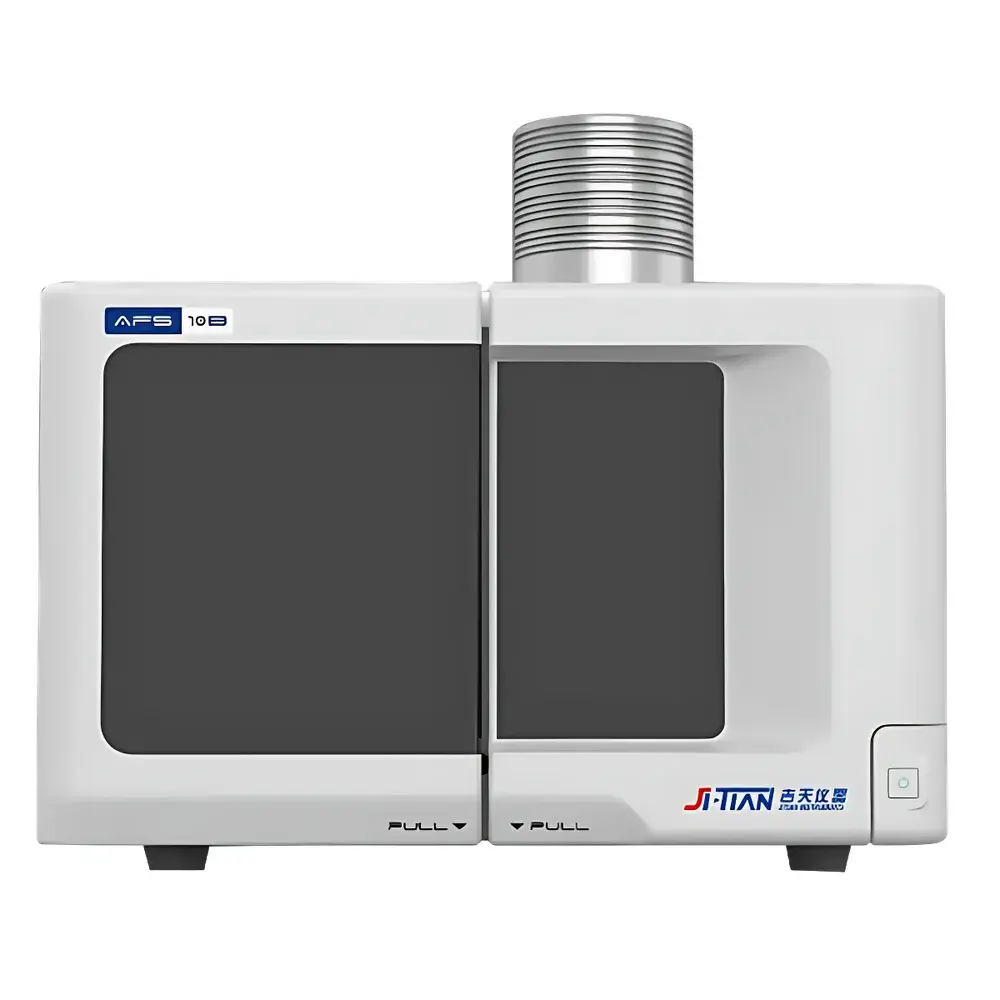
Titan Instruments AFS-10B Atomic Fluorescence Spectrometer
| Brand | Titan Instruments |
|---|---|
| Origin | Beijing, China |
| Manufacturer Type | Authorized Distributor |
| Country of Origin | China |
| Model | AFS-10B |
| Pricing | Available Upon Request |
Overview
The Titan Instruments AFS-10B Atomic Fluorescence Spectrometer is a compact, high-performance hydride generation atomic fluorescence (HG-AFS) instrument engineered for trace-level quantification of hydride-forming elements—including arsenic (As), mercury (Hg), selenium (Se), antimony (Sb), bismuth (Bi), tellurium (Te), cadmium (Cd), and lead (Pb)—in liquid samples. Based on the principle of atomic fluorescence spectroscopy, the system atomizes analytes via sodium borohydride–acid reduction, followed by excitation using element-specific hollow cathode lamps and detection of characteristic fluorescence emission at defined wavelengths. Its modular architecture integrates optimized gas–liquid separation, precise vapor transport, and low-noise photomultiplier tube (PMT) detection to deliver high sensitivity (sub-pg/mL detection limits for As and Hg), excellent linearity (>0.9995 over 3–4 orders of magnitude), and long-term signal stability. Designed for field-deployable operation, the AFS-10B features a reduced footprint and ruggedized chassis suitable for mobile laboratories, environmental monitoring vehicles, and remote sampling stations.
Key Features
- Integrated six-roller peristaltic pump with monolithic compression block design—ensures consistent reagent delivery, minimizes pulsation, and enhances hydride generation efficiency and reproducibility.
- Drift compensation via software-based soft calibration—dynamically adjusts baseline and gain during analysis to counteract lamp aging, temperature drift, and optical path variation without manual recalibration.
- Intelligent lamp management system—supports dual-channel automatic lamp ignition, lamp usage time logging, and optional upgrade to plug-and-play lamp alignment (no manual adjustment required).
- Adaptive preheating protocol—reduces standby-to-analysis transition time by initiating thermal stabilization only when sample introduction is imminent, improving workflow throughput.
- Low-power wake-up mode—enables scheduled or remote activation; upon awakening, the system automatically initiates lamp warm-up, gas purge, and flow stabilization sequences prior to measurement.
- Modular expansion interface—dedicated RS-232 port and hydraulic coupling预留 for future integration of liquid chromatography (LC) modules, enabling seamless upgrade to speciation-capable AFS-LC systems for As(III)/As(V), methylmercury/inorganic Hg, or Se(IV)/Se(VI) analysis.
Sample Compatibility & Compliance
The AFS-10B accepts aqueous digests and extracts prepared via EPA Method 200.8, ISO 17294-2, GB/T 22105.1–2008, and other standardized acid digestion protocols (e.g., HNO₃–HCl–H₂O₂). It accommodates sample volumes from 0.5–5 mL and tolerates moderate matrix complexity (e.g., up to 5% v/v organic content or 0.5 M Cl⁻), provided interferences are mitigated via masking agents (e.g., thiourea–ascorbic acid for As) or online matrix removal. The instrument supports full audit trail functionality compliant with GLP and GMP requirements, including user authentication, electronic signatures, version-controlled method storage, and immutable raw data logging—fully aligned with FDA 21 CFR Part 11 principles for regulated laboratories.
Software & Data Management
Titan AFS Control Software (v3.2+) provides a role-based, customizable interface with wizard-guided method setup, real-time signal visualization, peak integration with manual override, and automated QC flagging (e.g., blank drift >10%, recovery outside 85–115%). All analytical sessions generate timestamped, encrypted binary data files (.tad) containing raw intensity traces, calibration curves, instrument parameters, and operator metadata. Data export options include CSV, PDF reports (with configurable templates), and direct LIMS integration via ASTM E1384-compliant XML schema. Software updates are delivered via secure OTA channel with cryptographic signature verification.
Applications
The AFS-10B serves as a primary quantitative tool in regulatory and research laboratories performing routine trace metal analysis across diverse matrices: drinking water and wastewater (per EPA 1631E, ISO 11969), rice and cereal grains (GB 5009.11–2023), soil and sediment (ISO 11466), pharmaceutical excipients (USP ), cosmetic raw materials (EU Cosmetics Regulation Annex II), clinical urine/blood specimens (CLIA-waived protocols), and agricultural feedstuffs (AOAC 993.14). Its portability and rapid turnaround (<90 s/sample for As in water) make it especially suited for on-site compliance screening in municipal water utilities and food safety rapid response units.
FAQ
What hydride-forming elements can the AFS-10B quantify?
The instrument is validated for As, Hg, Se, Sb, Bi, Te, Cd, and Pb using standard HG-AFS methodology. Additional elements may be supported subject to lamp availability and method validation.
Is LC-AFS speciation capability built-in or retrofittable?
Speciation functionality is not native but enabled via optional LC module integration using the dedicated serial port and fluidic interface—full hardware and software upgrades are available under Titan’s AFS-10B Speciation Kit (Order Code: AFS-SK10B-LC).
Does the software support multi-user permission levels?
Yes—administrators, analysts, and reviewers are assigned distinct access rights governing method editing, result approval, audit log viewing, and system configuration changes.
How is instrument performance verified during routine use?
Built-in QC routines include daily bracketing with certified reference materials (CRMs), continuous blank monitoring, and automated recalibration triggers based on signal deviation thresholds—records are auto-archived with each run.
What maintenance intervals are recommended for the peristaltic pump tubing?
Titan recommends tubing replacement every 500–800 hours of operation or after 2,000 sample injections, whichever occurs first—calibration verification is advised post-replacement.




