
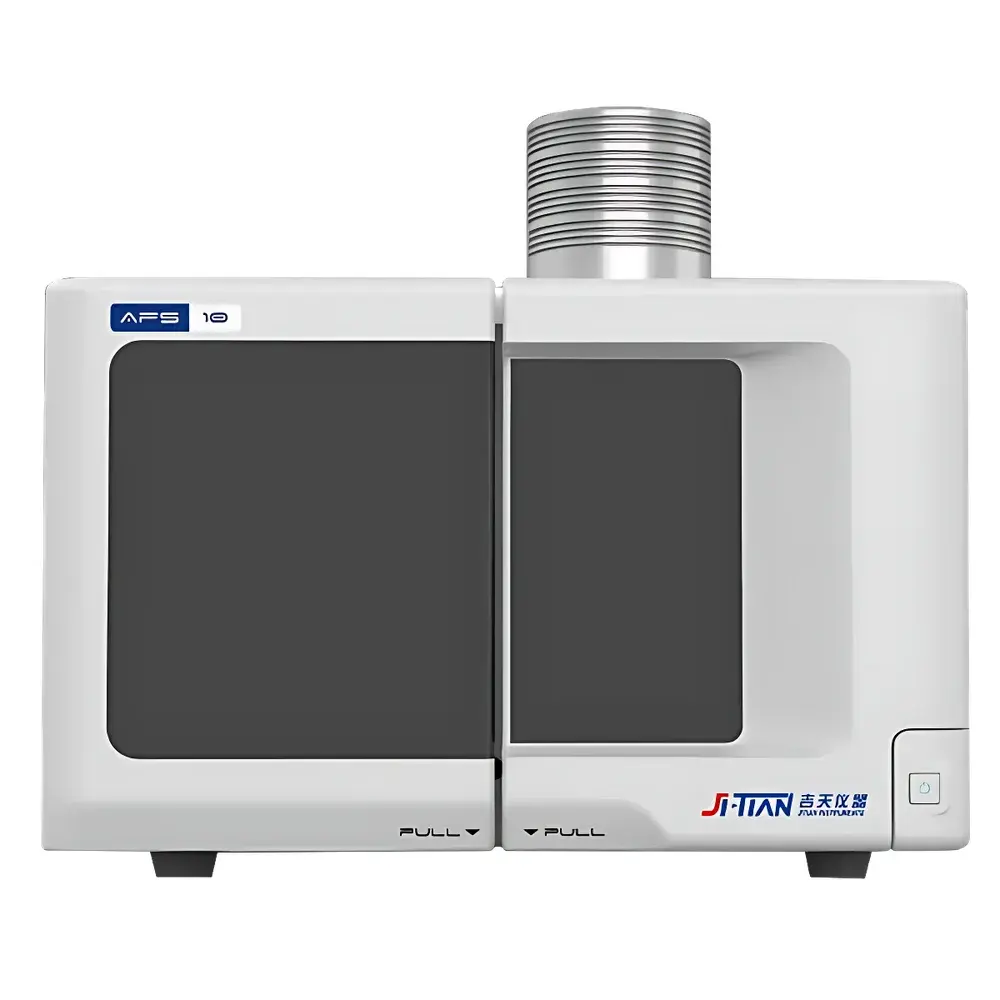
Titan Instruments AFS-10F Intermittent-Pump Rapid-Sampling Atomic Fluorescence Spectrometer
| Brand | Titan Instruments |
|---|---|
| Origin | Beijing, China |
| Manufacturer Type | Direct Manufacturer |
| Product Category | Domestic |
| Model | AFS-10F |
| Instrument Type | Multi-channel Atomic Fluorescence Spectrometer |
| Sample Introduction Mode | Vapor Generation / Hydride Generation |
| Detectable Elements | As, Sb, Bi, Sn, Se, Te, Pb, Ge, Hg, Cd, Zn |
| Linear Dynamic Range | >3 orders of magnitude |
| Photomultiplier Tube Wavelength Range | 160–320 nm |
| Atomizer Temperature Control Range | Adjustable (Precise PID-controlled heating) |
Overview
The Titan Instruments AFS-10F is a high-performance, multi-channel atomic fluorescence spectrometer engineered for trace-level quantification of hydride-forming and cold-vapor elements in complex environmental, food, clinical, and industrial matrices. It operates on the principle of atomic fluorescence spectroscopy (AFS), where analyte species—converted to free atoms via hydride generation (for As, Sb, Bi, Se, etc.) or cold-vapor atomic absorption/fluorescence (for Hg, Cd)—are excited by a high-intensity hollow cathode lamp (HCL) or electrodeless discharge lamp (EDL), and the resulting element-specific fluorescence emission is measured at right angles to the excitation beam. This configuration delivers exceptional signal-to-noise ratio, low detection limits (sub-pg/mL for key elements), and high selectivity—critical for compliance-driven laboratories performing routine analysis under regulatory frameworks such as ISO/IEC 17025, USP , and EPA Method 7063.
Key Features
- Intermittent peristaltic pump system with integrated six-roller design and monolithic compression block—ensures precise, pulse-free reagent delivery and maximizes hydride generation efficiency while minimizing memory effects.
- High-speed sampling circuitry operating at up to 500 Hz—enables rapid transient signal acquisition, reduces inter-channel crosstalk, and supports simultaneous dual-channel measurement without spectral overlap compromise.
- Drift-compensated soft calibration algorithm—dynamically corrects baseline drift during extended runs, improving long-term measurement reproducibility across shifts and days.
- Dual-core control architecture combining ARM processor and FPGA logic—dedicated microcontrollers manage lamp power, atomizer temperature, gas flow, and detector gain independently, ensuring deterministic real-time response and fault isolation.
- Intelligent preheating protocol—automatically initiates optimized warm-up sequences prior to sample introduction, reducing instrument stabilization time by up to 40% compared to conventional manual start-up.
- Auto-ignition for dual-channel HCLs with lamp usage logging—supports scheduled maintenance planning and traceable lamp lifetime tracking for GLP/GMP documentation.
Sample Compatibility & Compliance
The AFS-10F is validated for use with acid-digested, microwave-assisted, or leached samples prepared according to standardized protocols including GB 5009.11–2014 (total and inorganic arsenic in food), GB 5009.17–2021 (total and organic mercury), HJ 694–2014 (water), HJ 680–2013 (soil and sediment), and HJ 1133–2020 (ambient particulate matter). Its hydride generation module accommodates variable sample volumes (0.5–5 mL), tolerates moderate chloride and transition metal interference through proprietary masking reagents, and maintains robust performance in high-salinity or viscous matrices when paired with optional online dilution or matrix-matching modules. The system meets electromagnetic compatibility (EMC) requirements per IEC 61326-1 and conforms to safety standards IEC 61010-1 for laboratory analytical equipment.
Software & Data Management
Titan’s AFS-Control Suite v4.x provides a secure, audit-ready software environment compliant with FDA 21 CFR Part 11 requirements. Core capabilities include role-based user access control (administrator, analyst, reviewer), full electronic audit trail (timestamped record of all method edits, data exports, and instrument parameter changes), real-time system status dashboard, automated method validation reporting, and seamless integration with LIMS via ASTM E1384-compliant export formats (CSV, XML, PDF). The interface supports customizable themes, drag-and-drop sequence building, one-click recall of recent methods and results, and context-sensitive help embedded directly within workflow dialogs.
Applications
The AFS-10F serves as a primary analytical platform in accredited testing laboratories conducting routine monitoring of regulated elements across diverse sectors: food safety (arsenic in rice, mercury in fish), environmental compliance (As and Sb in drinking water per WHO guidelines), agricultural testing (Cd in fertilizers, Se in feed), pharmaceutical quality control (catalyst residue screening in APIs), clinical toxicology (blood/urine Hg speciation support), and geological exploration (trace metal profiling in ore leachates). Its modular design allows expansion into elemental speciation workflows—via optional serial port interface—for As(III)/As(V), methylmercury/ethylmercury, and selenite/selenate differentiation when coupled with HPLC separation.
FAQ
What hydride-forming elements can the AFS-10F quantify with certified accuracy?
The instrument is factory-validated for quantitative determination of As, Sb, Bi, Sn, Se, Te, Pb, Ge, Hg, Cd, and Zn at sub-pptr concentration levels in aqueous digests meeting ISO 17294-2 and EPA 200.9 criteria.
Is the AFS-10F compatible with third-party automatic samplers?
Yes—it supports RS-232 and TTL-level digital I/O interfaces for synchronization with 160-position or 212-position autosamplers from Titan or qualified OEM partners, enabling unattended overnight operation.
Can the system be upgraded for speciation analysis?
Absolutely—the rear-panel dedicated serial interface allows direct connection to HPLC systems; firmware and software upgrades enable time-resolved fluorescence detection synchronized with chromatographic elution profiles.
Does the software support multi-user environments with electronic signatures?
Yes—AFS-Control Suite implements full 21 CFR Part 11 functionality, including biometric or token-based electronic signature capture, sealed audit logs, and configurable permission tiers for method development, data review, and report approval.
What maintenance intervals are recommended for optimal long-term stability?
Routine maintenance includes quarterly quartz tube inspection, semiannual PMU (pump unit) recalibration, annual photomultiplier dark current verification, and lamp replacement based on cumulative on-time logging—each tracked automatically in the instrument’s service history database.
Related Products





