
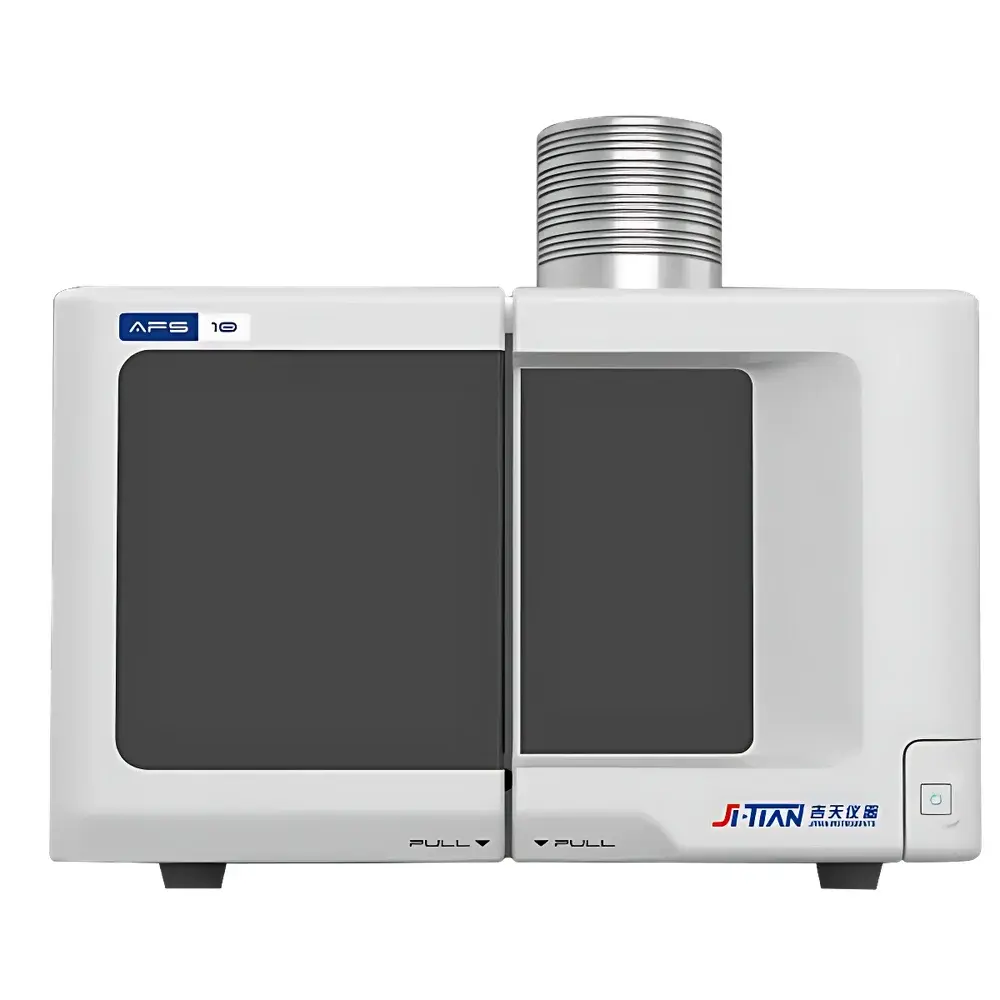
Titan Instruments AFS-10U Intermittent Pump Rapid-Sampling Atomic Fluorescence Spectrometer
| Brand | Titan Instruments |
|---|---|
| Origin | Beijing, China |
| Manufacturer Type | Direct Manufacturer |
| Instrument Type | Multi-channel Atomic Fluorescence Spectrometer |
| Sample Introduction Method | Peristaltic Pump |
| Waste Disposal | Rear Exhaust Configuration |
| Hydride Generation Mode | Vapor Generation / Hydride Generation |
| Gas Flow Control | Mass Flow Controller (MFC) |
| Detectable Elements | As, Sb, Bi, Sn, Se, Te, Pb, Ge, Hg, Cd, Zn |
| Relative Standard Deviation (RSD) | < 0.6% |
| Linear Dynamic Range | > 3 orders of magnitude |
| Detection Limits | As, Sb, Se, Bi, Te, Hg, Sn, Pb < 0.01 µg/L |
| PMT Wavelength Range | 160–320 nm |
| Atomizer Temperature Control | Precise PID-regulated heating |
Overview
The Titan Instruments AFS-10U Intermittent Pump Rapid-Sampling Atomic Fluorescence Spectrometer is a high-performance, multi-channel analytical instrument engineered for trace-level quantification of hydride-forming and cold-vapor elements in liquid matrices. It operates on the principle of atomic fluorescence spectroscopy (AFS), where analyte species—pre-reduced to volatile hydrides (e.g., AsH₃, SbH₃, H₂Se) or elemental vapor (e.g., Hg⁰)—are atomized in a quartz cell heated to 800–1000 °C and subsequently excited by a high-intensity, element-specific hollow cathode lamp (HCL) or electrodeless discharge lamp (EDL). The resulting atomic fluorescence emission is collected at right angles to the excitation beam and measured by a low-noise photomultiplier tube (PMT) with spectral response optimized from 160 nm to 320 nm. This configuration ensures exceptional signal-to-noise ratio, minimal spectral interference, and robust performance in complex sample backgrounds typical of environmental, food, clinical, and geological applications.
Key Features
- Intermittent peristaltic pump with integrated six-roller design and monolithic pressure block — enables rapid, pulse-free reagent/sample delivery, enhancing hydride generation efficiency and reproducibility.
- High-speed sampling circuitry operating at up to 500 Hz — reduces inter-channel crosstalk and improves temporal resolution during dual- or multi-channel simultaneous detection.
- Drift-compensated soft calibration algorithm — continuously monitors baseline and lamp intensity drift, dynamically adjusting gain and offset to maintain long-term measurement stability over extended runs.
- Dual-core ARM + FPGA main control architecture — with dedicated microcontrollers managing lamp power, PMT HV, gas flow, and atomizer temperature — ensures deterministic real-time operation and electromagnetic immunity.
- Precise mass flow controller (MFC)-based gas regulation — delivers argon carrier gas with ±0.5% full-scale accuracy and < 0.1% short-term fluctuation, critical for consistent hydride transport and atomization.
- Intelligent thermal management system — PID-controlled atomizer furnace with programmable ramp profiles and thermal uniformity < ±2 °C across the quartz tube length.
Sample Compatibility & Compliance
The AFS-10U supports aqueous samples following standard acid digestion (e.g., HNO₃/HCl/HF) or microwave-assisted digestion protocols. It is validated for use in accordance with multiple internationally recognized regulatory methods, including GB 5009.11–2014 (total and inorganic arsenic in food), GB 5009.17–2021 (total and organic mercury in food), HJ 694–2014 (As, Hg, Se, Bi, Sb in water), HJ 680–2013 (soil and sediment analysis), and HJ 1133–2020 (particulate-bound As, Se, Bi, Sb in ambient air). Instrument design adheres to ISO/IEC 17025 general requirements for competence of testing and calibration laboratories. Data integrity features—including electronic signatures, audit trails, role-based user permissions, and 21 CFR Part 11–compliant software modules—are available as configurable options for GLP/GMP environments.
Software & Data Management
Titan’s proprietary AFS-Control Suite provides a modular, Windows-based platform supporting method development, sequence scheduling, real-time monitoring, and report generation. The interface supports customizable dashboard layouts, drag-and-drop method building, and automatic calibration curve fitting (linear, quadratic, or weighted least-squares). All analytical events—including lamp ignition, gas valve actuation, pump timing, and PMT voltage adjustments—are timestamped and logged with operator ID and reason-for-change fields. Raw data files are stored in vendor-neutral HDF5 format with embedded metadata (instrument configuration, calibration history, QC results), enabling third-party integration via OPC UA or RESTful API. Optional upgrade paths include automated peak deconvolution for overlapping signals and batch-processing workflows compliant with LIMS interfaces.
Applications
The AFS-10U is routinely deployed in accredited laboratories for routine trace metal analysis across diverse sectors: food safety testing (arsenic speciation in rice, mercury in fish); environmental monitoring (As and Sb in groundwater, Hg in atmospheric particulates); agricultural quality control (Cd and Pb in fertilizers, Se in feedstuffs); pharmaceutical raw material screening (catalyst residue analysis); clinical toxicology (blood/urine Hg and As quantification); and academic research in geochemistry and metallomics. Its capacity for rapid, multi-element hydride generation makes it particularly suited for high-throughput screening of large sample sets requiring sub-ppt detection sensitivity.
FAQ
What hydride-forming elements can the AFS-10U quantify simultaneously?
The instrument supports concurrent detection of up to two elements (e.g., As and Se) using dual-channel optical path design; additional elements require sequential analysis or optional hardware expansion.
Is the AFS-10U compatible with external autosamplers?
Yes — it integrates seamlessly with optional 160-position or 212-position XYZ robotic autosamplers, enabling unattended overnight operation and full traceability of sample IDs and dilution factors.
Can the system be upgraded for elemental speciation analysis?
Yes — the instrument includes a dedicated serial interface and hydraulic coupling port to support future integration of HPLC- or CE-based separation modules for As(III)/As(V), methylmercury/ethylmercury, or Se(IV)/Se(VI) speciation.
What maintenance routines are recommended for long-term PMT stability?
Annual PMT dark-current verification and quarterly quartz atomizer cleaning with 10% HNO₃ are advised; lamp alignment checks should be performed after every 500 hours of operation.
Does the software support audit trail export for regulatory submission?
Yes — all audit logs (user actions, method changes, calibration events, result modifications) are exportable as encrypted CSV or PDF with digital signature verification.






