
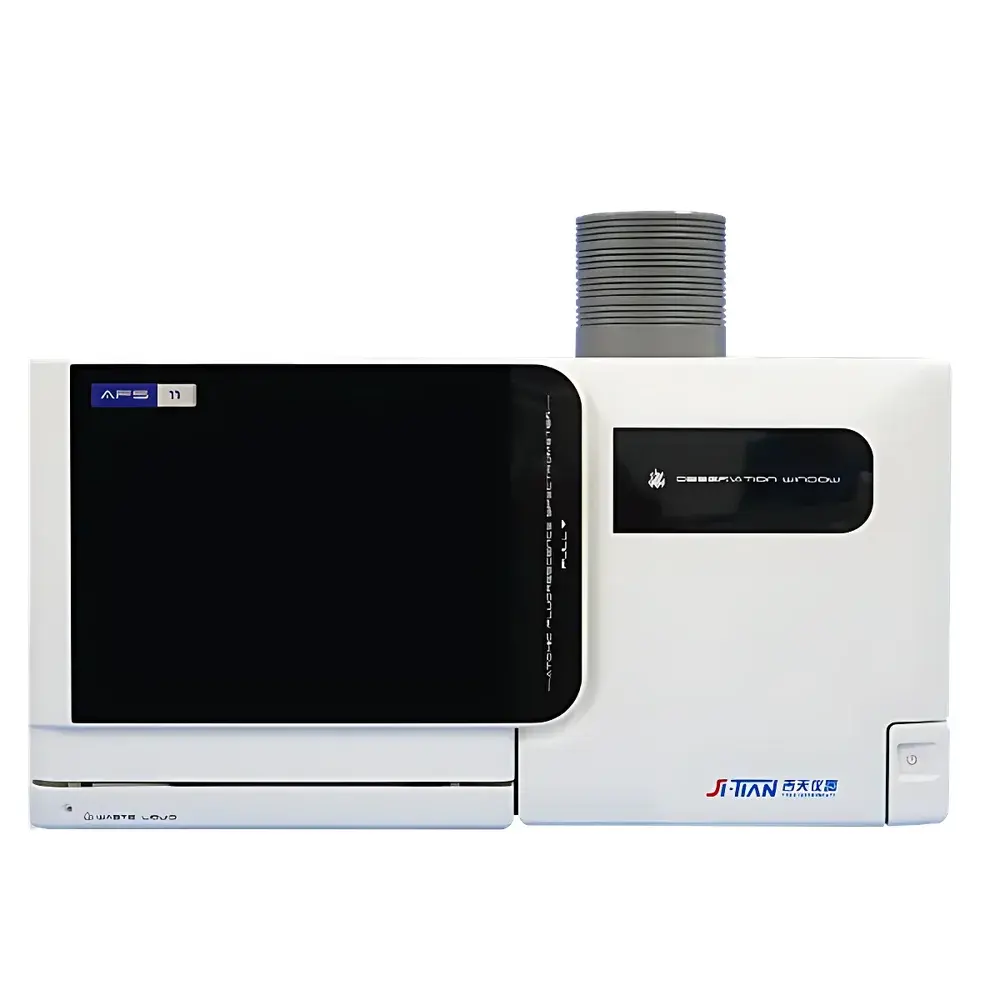
Titan Instruments AFS-11U Sequential Injection High-Precision Atomic Fluorescence Spectrometer
| Brand | Titan Instruments |
|---|---|
| Origin | Beijing, China |
| Manufacturer Type | Manufacturer |
| Product Category | Domestic |
| Model | AFS-11U |
| Instrument Type | Multi-channel Atomic Fluorescence Spectrometer |
| Sample Introduction | Dual Sequential Injection Pumps |
| Waste Disposal | Rear Exhaust Design |
| Hydride Generation Mode | Vapor Generation / Hydride Generation |
| Gas Flow Control | Mass Flow Controller (MFC) |
| Detectable Elements | As, Sb, Bi, Sn, Se, Te, Pb, Ge, Hg, Cd, Zn |
| Relative Standard Deviation (RSD) | <0.6% |
| Linear Dynamic Range | >3 orders of magnitude |
| Detection Limits | As, Sb, Se, Bi, Te, Hg, Sn, Pb < 0.01 µg/L |
| PMT Wavelength Range | 160–320 nm |
| Atomizer Temperature Control | Yes |
Overview
The Titan Instruments AFS-11U Sequential Injection High-Precision Atomic Fluorescence Spectrometer is a dedicated analytical instrument engineered for trace-level quantification of hydride-forming and cold-vapor elements in liquid matrices. It operates on the principle of atomic fluorescence spectroscopy (AFS), where analyte species—pre-reduced to volatile hydrides (e.g., AsH₃, SbH₃, SeH₂) or elemental vapor (e.g., Hg⁰)—are atomized in a quartz cell under argon shielding and excited by a high-intensity, element-specific hollow cathode lamp (HCL). The resulting fluorescence emission at characteristic wavelengths is detected by a low-noise photomultiplier tube (PMT) with spectral response spanning 160–320 nm. Designed for regulatory compliance and method robustness, the AFS-11U supports routine analysis in laboratories requiring adherence to ISO/IEC 17025, USP , EPA Method 1631E, and Chinese national standards including GB 5009.11–2014, GB 5009.17–2021, and HJ 694–2014.
Key Features
- Dual sequential injection system with micro-liter-level volumetric precision and real-time flow compensation, delivering repeatability better than 0.05% RSD for sample, carrier, and reductant delivery.
- Integrated drift correction via software-based soft calibration and Quality Control Protocol (QCP) functionality, enabling automatic multi-point standard curve validation and post-run baseline stabilization.
- Argon gas flow regulated by high-accuracy mass flow controllers (MFCs), ensuring stable atomization environment and minimizing signal fluctuation from pressure or temperature variation.
- ARM + FPGA dual-core architecture with distributed MCU control across critical subsystems—including lamp power supply, atomizer heater, pump drivers, and detector electronics—ensuring deterministic timing and electromagnetic immunity.
- Intelligent lamp management: automatic HCL ignition, dual-channel lamp recognition, eccentricity-compensating lamp holder (optional), and real-time filament current monitoring for predictive maintenance.
- Automated operational sequencing: full standard curve generation, auto-dilution of over-range samples, overnight sleep mode with scheduled preheating, and overflow-sensing waste reservoir with software alerting.
Sample Compatibility & Compliance
The AFS-11U accommodates aqueous samples following standardized digestion or extraction protocols—including microwave-assisted acid digestion (per HJ 680–2013), alkaline leaching, and direct hydride generation. It is validated for use with environmental water, soil extracts, food digests, biological fluids, pharmaceutical excipients, and cosmetic matrices. All hardware and firmware comply with IEC 61326-1 (EMC for laboratory equipment) and IEC 61010-1 (safety requirements). Data integrity features—including electronic signatures, audit trail logging, role-based user permissions, and 21 CFR Part 11–compliant software options—support GLP/GMP environments and regulatory submissions.
Software & Data Management
Titan’s proprietary AFS Control Suite provides a modular, dockable GUI supporting real-time dual-channel spectral visualization, step-by-step guided workflows, customizable reporting templates, and batch-wise sample information import/export (CSV, Excel). The software implements full traceability: every measurement event records operator ID, timestamp, instrument configuration, calibration history, and raw signal integrals. Audit trails are immutable and exportable in PDF or XML format. Optional modules include automated report generation compliant with CNAS reporting guidelines and integration-ready APIs for LIMS connectivity.
Applications
The AFS-11U is routinely deployed in accredited testing laboratories for:
- Food safety surveillance (inorganic As/Hg in rice, seafood, infant formula)
- Environmental monitoring (As, Sb, Se in drinking water per HJ 694–2014; Hg in air particulates per HJ 1133–2020)
- Geochemical analysis (total As/Pb/Hg in soils and sediments per GB/T 22105–2008)
- Clinical toxicology (urinary Hg, blood Se)
- Pharmaceutical quality control (catalyst residue screening in APIs)
- Academic research in speciation chemistry, where the instrument’s serial port interface enables future upgrade to hyphenated HPLC-AFS systems for As(III)/As(V), MeHg/EtHg, or Se(IV)/Se(VI) separation and detection.
FAQ
What hydride-forming elements can the AFS-11U quantify at sub-part-per-trillion levels?
The system achieves detection limits below 0.01 µg/L for As, Sb, Se, Bi, Te, Hg, Sn, and Pb when operated under optimized hydride generation conditions and using recommended KBH₄–HCl chemistry.
Does the AFS-11U support automated calibration and QC checks without manual intervention?
Yes—integrated QCP routines execute bracketing standards, continuing calibration verification (CCV), and duplicate spike recovery prior to and during sample batches, with pass/fail flags logged in the audit trail.
Can the instrument be integrated into a fully automated workflow?
It supports RS-232 and USB-to-serial communication protocols and is compatible with optional 160-position or 212-position autosamplers for unattended overnight operation.
Is morphological analysis capability built-in or field-upgradable?
The AFS-11U includes a dedicated serial interface and timing synchronization logic to interface with HPLC modules; morphology analysis functionality requires separate HPLC-AFS coupling hardware and software license.
How does the dual sequential injection design improve analytical reliability compared to conventional peristaltic pumping?
By eliminating pulsation-induced mixing variability and bubble entrapment—common in tubing-based systems—the dual syringe architecture ensures stoichiometric consistency in hydride generation reactions, directly enhancing RSD performance and long-term calibration stability.




